

Some days you're sure you want to leave. Other days you remember why you fell for them and can't imagine life without them. You've made mental lists, asked friends, maybe typed "should I break up with my partner" into Google at 2am.
If you feel torn, you're not weak or indecisive. You're facing one of the hardest decisions there is, and you're facing it with incomplete information, mixed feelings and a lot at stake. This guide won't tell you what to do. Nobody outside your relationship can. What it will do is show you what research has found about this decision, walk you through ten questions that cut through the noise, and help you reach a decision you understand and can stand behind.
The short answer: To decide whether to break up, ask whether you feel safe, still respect your partner, have truly tried to fix things, and want the same big things. A rough patch with mutual effort is different from a long pattern of contempt or disinterest. Fear or control are reasons to get support and leave.
Feeling torn is normal
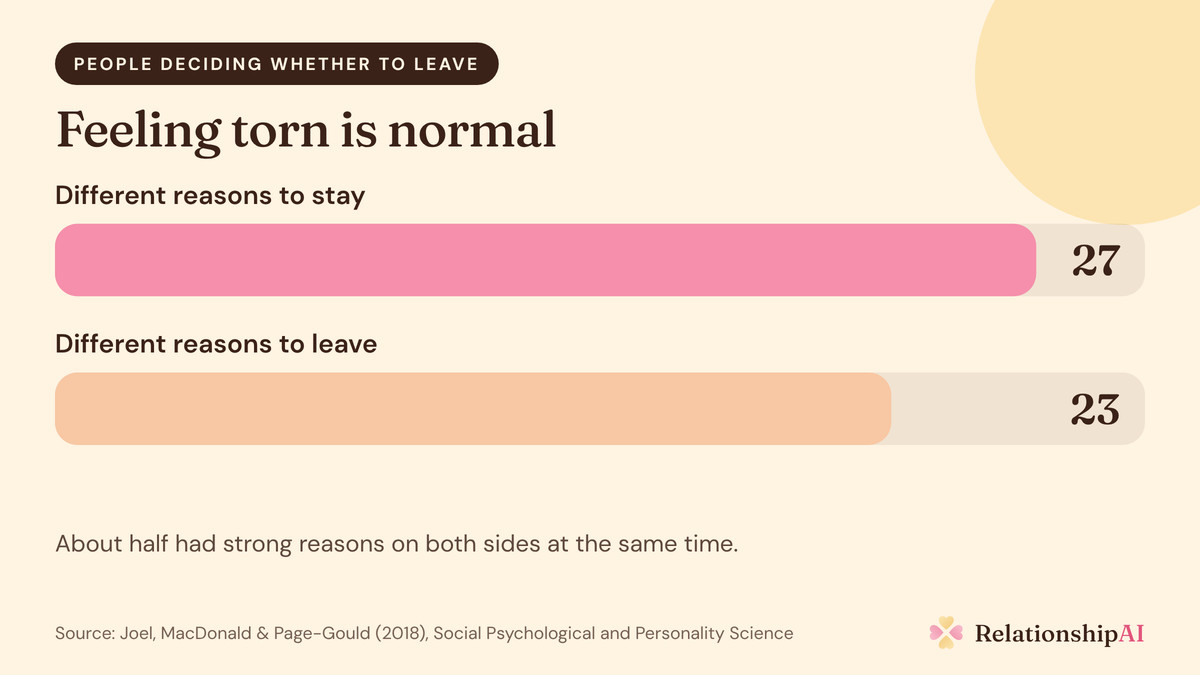
Researchers Samantha Joel, Geoff MacDonald and Elizabeth Page-Gould asked people who were actively deciding whether to break up what was pulling them each way. They found 27 different reasons to stay and 23 reasons to leave. The most common reasons to stay were emotional closeness, what they'd already invested and a sense of obligation. The most common reasons to leave were problems with the partner's personality, a breach of trust and the partner pulling away.
The most striking result: about half of the people had strong reasons on both sides at the same time. Feeling torn isn't a sign you're doing it wrong. It's what this decision usually feels like.
Why the "right" answer rarely feels clear We tend to imagine that a "right" decision would feel clear. But relationships aren't one thing. They're dozens of things at once: the person, the shared life, the history, the future you pictured, the friends, the apartment, the routines. Some of those can be wonderful while others are breaking down. Ambivalence isn't confusion. It's an accurate reading of a mixed situation. The goal isn't to make the mixed feelings disappear. It's to work out which parts matter most to you.
Quick quiz: Before a big decision, it can help to see what's missing. The free 2-minute relationship check-up quiz shows whether you most need more time together, better talks, more fun or more teamwork.
What research says predicts a breakup
In 2010, Benjamin Le and his colleagues combined 137 studies covering 37,761 participants over 33 years of research to find out what best predicts whether unmarried relationships end. Some of the results are surprising.
The strongest predictors of staying together weren't personality traits or how similar the two people were. They were things about the relationship itself: how committed people felt, how much they loved their partner, how much they felt the partner had become part of who they are, and how much they depended on the relationship. Satisfaction, having attractive alternatives and how much people had invested also mattered, but more modestly. Personality traits mattered relatively little.
| Factor | How strongly it predicted staying together |
|---|---|
| Commitment | Among the strongest |
| Love | Among the strongest |
| Feeling your partner is part of who you are | Among the strongest |
| Depending on the relationship | Among the strongest |
| Satisfaction, alternatives, investments | Moderate |
| Personality traits | Weak |
A newer, even larger analysis points the same way. In 2020, Samantha Joel and more than 80 colleagues used machine learning on 43 long-term studies of more than 11,000 couples. The strongest predictors of how happy people were in their relationship were all about the relationship as they experienced it: feeling that their partner was committed, appreciating their partner, sexual satisfaction, feeling that their partner was satisfied, and less conflict. Individual traits like personality or attachment style added very little once those were known. One sobering detail: none of these predictors could reliably forecast whether a relationship would get better or worse over time. How you feel about the relationship now is real information. It just can't predict the future on its own.
What does that mean for you? Not that you should stay because you depend on someone, or leave because you're not satisfied today. It means the questions that matter most are about the relationship's core: do you still feel committed, do you still love this person, and do you still want your lives to be connected? Those are the questions below.
Timing matters too. In a 2025 analysis of four long-running national studies with 11,295 people, Janina Bühler and Ulrich Orth found that relationships that ended went through two phases: years of slow, slight decline, then a turning point about one to two years before the split, after which satisfaction fell fast. The partner who later ended things usually became unhappy earlier. The researchers suggest that trying to repair things during the slow phase, before the steep drop, gives couples the best chance.
10 questions to ask yourself
Take your time with these. Write the answers down if it helps. Notice which ones you avoid, because that often says something too.
1. Do I feel safe with them?
This comes first. If you feel afraid of your partner, are being controlled, threatened or hurt, the question isn't about compatibility. It's about your safety. Skip to the safety note at the end.
2. Do I still respect them?
Relationship researcher John Gottman found that contempt, things like eye-rolling, mocking and talking down to each other, was the single biggest predictor of divorce in his studies. Disagreements are normal. Losing respect is much harder to come back from, because respect is what lets you take your partner's view seriously when you disagree.
Ask yourself honestly: when you think about your partner, is the main feeling frustration ("I wish they would...") or disdain ("They're pathetic")? Frustration can be worked with. Disdain is a warning sign.
3. Is this a bad season or a bad relationship?
A new baby, a job loss, illness, a move or caring for a parent can make any relationship feel worse for a while. Ask yourself: was it good before this period? Would it likely be good again when this passes? If the problems started with the stress, they may ease with it. If they were there long before, the stress may only be making them impossible to ignore.
4. Have we actually tried to fix it?
Not "I've hinted for months", but a clear, calm conversation about what's wrong and what you need. Many problems feel unsolvable only because they've never been said out loud. If your partner doesn't know how serious this is, they haven't had a real chance to respond. Our guide on how to fix a relationship is a good starting point.
5. Is the same fight coming back again and again?
According to the Gottman Institute, 69% of relationship conflicts are about perpetual problems: lasting differences in personality, values or needs that may never be fully resolved. So a recurring argument alone doesn't mean you're incompatible. Almost every couple has them.
The real question is whether you can talk about it without it getting worse every time. Can you laugh about it sometimes? Does either of you ever soften? Or does each round leave more damage? Our article on relationship problems that keep coming back explains what usually sits underneath.
6. Do we want the same big things?
Children, where to live, marriage, faith, how to spend money, how much time to spend together. Love matters, but big life goals that really clash rarely disappear on their own. Sometimes one person compromises and is happy with it. Sometimes the compromise turns into resentment. Be honest about which one it would be for you. Money is one clash that's easier to judge after a real talk, and our guide on how to talk about money with your partner can help you see how far apart you are.
7. If nothing changed, would I be okay in five years?
Not the best-case version of your partner, not who they could be if they finally changed. The person they are right now, with the effort they're making right now. Imagine the same relationship five years from now and notice how your body reacts. Relief? Dread? A shrug?
8. Am I staying for love, or mostly out of fear?
Fear of being alone, of starting over, of hurting them or of what people will say are all very human. But they can quietly make the decision for you. In research led by Stephanie Spielmann, people with a stronger fear of being single were more willing to settle for less responsive partners and to stay in relationships they weren't happy with. If fear is the main reason you're staying, it's worth being honest about that.
9. Does my partner make me feel more like myself, or less?
Healthy relationships usually help you grow. You feel more confident, more curious, more yourself. If you feel smaller, quieter or constantly on edge, pay attention to that. Our list of green flags in a relationship can help you compare.
10. What would I tell a friend in my situation?
We're often clearer about other people's lives than our own. Imagine your best friend described your relationship to you, word for word. What would you say to them? Would you be worried? Relieved for them? Would you tell them to try one more time, or ask why they're still there?
If I had to pick one question from the ten, it would be number 7. Not "is it bad right now?" but "if nothing changed, would I be okay in five years?" It cuts through a lot.
Three situations, three different answers
These examples are illustrative, not real people, but they show how the same question ("should I leave?") can have very different answers.
There is no scorecard
A lot of articles treat breaking up as a test you pass or fail. Count the red flags, add up the score, done. Real life is messier. You can love someone and still not be right together. You can have real problems and still have a relationship worth fighting for.
The goal isn't to find the "right" answer in one night. It's to make a decision you understand and can stand behind, whichever way it goes.
A calmer way to decide
If you've been going back and forth for months, a bit of structure can help.
- Write down your answers to the ten questions. Notice which answers come easily and which ones you skip.
- Separate the solvable from the unsolvable. Chores, time together and how you argue can often change. Different life goals, broken respect and fear usually don't change by themselves.
- Have one clear conversation. Tell your partner how serious this is and what would need to change. Their response is important information.
- Give it a defined time. Agree on something concrete for a few weeks or months, and then honestly check in with yourself. Open-ended "let's see" periods tend to drag on.
- Get an outside view. A therapist, a counselor or a trusted friend who isn't involved can notice what you can't.
If you decide to stay
Make it an active choice, not just avoiding the decision. Tell your partner what needs to change, and agree on something concrete. Consider couples counseling if you've been stuck for a long time. And if trust was broken, our guide on how to rebuild trust after a fight can help.
“I've had real doubts about us lately, and I want to work on it with you. Can we talk about what needs to change?”

If you decide to leave
Be clear and kind. Choose a private moment, say it directly and don't leave false hope. You don't owe a long list of every problem.
“I've thought about this for a long time, and I don't think we're right for each other anymore.”
Then lean on friends and family, and give yourself time to grieve, even if you were the one who left. Breakups hurt, but research summarized by the American Psychological Association shows they can also lead to real personal growth. In one study by psychologist Gary Lewandowski, people who spent 15 to 30 minutes a day for three days writing about the positive sides of their breakup felt better afterwards, especially when the breakup had been mutual. Our guide on how to get over a breakup has more on the weeks after.
Quick answers
How do I know if it's just a rough patch?
Rough patches usually have a clear cause, like stress, a move or a busy period, and both of you still want to make it work. If the problems were there long before and nothing changes even after honest conversations, it may be more than a rough patch.
Is it normal to doubt a long relationship?
Yes. Almost everyone in a long relationship has moments of doubt, and research on people deciding whether to break up found that about half had strong reasons to stay and to leave at the same time. What matters is how often, how strong, and whether the doubts are about specific problems you can work on.
Should I break up if I'm not in love anymore?
Not necessarily right away. Feelings in long relationships rise and fall, and they're strongly affected by stress and how much time you spend together. But if the loss of love has lasted a long time and comes with indifference or contempt, take it seriously. Love was one of the strongest predictors of staying together in the research.
Should I break up before the holidays?
There's no perfect time. If you've already decided, waiting weeks just to get through the holidays can feel dishonest and draining for both of you. If you're still unsure, the holidays aren't a reason to rush. If time with family is part of the strain, our guide to holidays with your partner's family can help you get through it as a team.
Is it wrong to break up with someone you still love?
No. You can love someone and still not be right together, for example if you want very different lives. Loving someone and choosing to stay are related, but they're not the same thing.
What should I say when I break up with someone?
Keep it short, clear and kind.
“I've thought about this for a long time, and I don't think we're right for each other anymore.”
Avoid long lists of problems and don't leave false hope.
A note on safety
If your partner hurts you, threatens you, controls your money or who you see, or makes you feel afraid, please reach out to a local helpline or support service before you end the relationship. Leaving can be the riskiest moment, and support services can help you plan it safely.
Sometimes it helps just to write it all out. You can do that in Coach Chat, or practice saying one hard sentence out loud before you say it for real.
Some situations call for a closer look before you decide: love bombing, a codependent relationship or a situationship that never became more.
In the US, you can reach the National Domestic Violence Hotline at 1-800-799-7233, by texting START to 88788 or at thehotline.org, and the 988 Suicide & Crisis Lifeline by calling or texting 988. Outside the US, contact a local helpline.
This article is general information, not therapy or medical advice.
Sources
- Joel, S., MacDonald, G., & Page-Gould, E. (2018). Wanting to stay and wanting to go: Unpacking the content and structure of relationship stay/leave decision processes. Social Psychological and Personality Science, 9(6), 631-644. Summary on ScienceDaily
- Joel, S., Eastwick, P. W., Allison, C. J., et al. (2020). Machine learning uncovers the most robust self-report predictors of relationship quality across 43 longitudinal couples studies. Proceedings of the National Academy of Sciences, 117(32), 19061-19071. Summary in Psychology Today
- Le, B., Dove, N. L., Agnew, C. R., Korn, M. S., & Mutso, A. A. (2010). Predicting nonmarital romantic relationship dissolution: A meta-analytic synthesis. Personal Relationships, 17(3), 377-390. Haverford College repository
- Spielmann, S. S., MacDonald, G., Maxwell, J. A., Joel, S., Peragine, D., Muise, A., & Impett, E. A. (2013). Settling for less out of fear of being single. Journal of Personality and Social Psychology, 105(6), 1049-1073. Summary on ScienceDaily
- Gottman Institute: Everything turns into an argument (on perpetual problems)
- American Psychological Association: Breakups aren't all bad: Coping strategies to promote positive outcomes
- Bühler, J., & Orth, U. (2025). Journal of Personality and Social Psychology. DOI. Summary on EurekAlert