

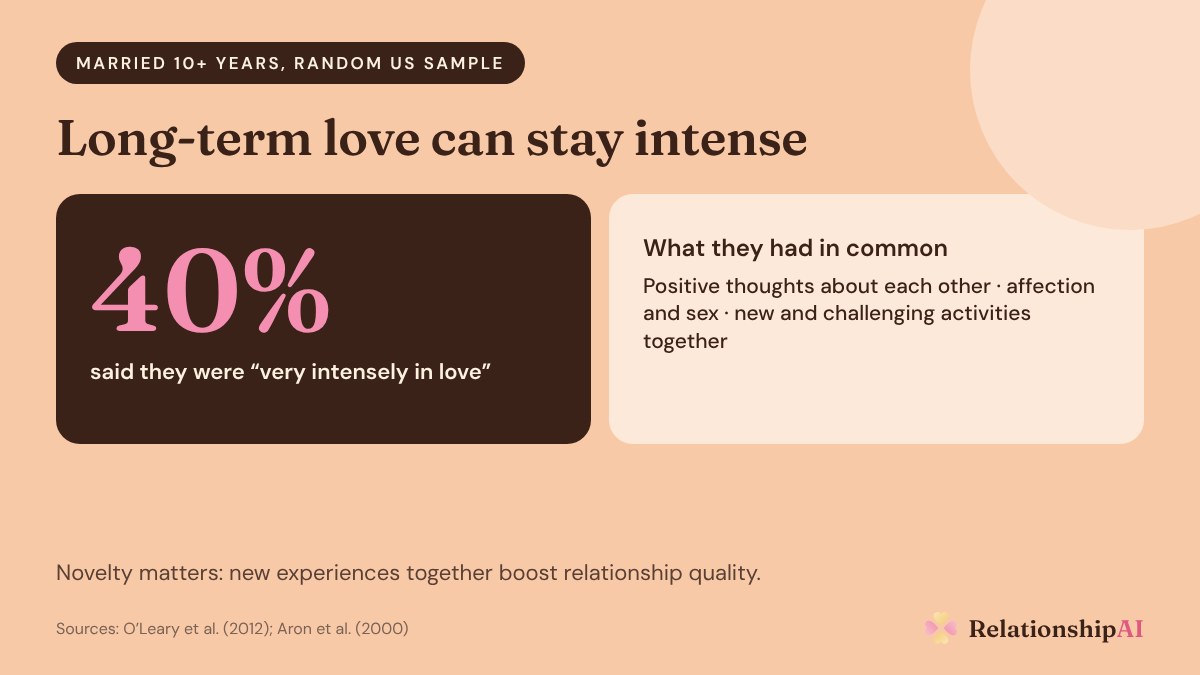
In a random sample of Americans who had been married for more than ten years, about 40% said they were still "very intensely in love". That finding, from a study led by Daniel O'Leary with Bianca Acevedo and Arthur Aron, surprises most people, because we're told that passion always fades. In a second sample from New York, the figure was about 29%. Lower, but still far from rare.
So the spark doesn't have to go. But "the spark" is a vague word, and vague problems get vague advice: more date nights, more surprises, more lingerie. Most lists of tips miss that couples usually lose one kind of spark, not all of them at once. A couple can still laugh together every day and feel no desire at all. Another can have plenty of sex and feel like roommates the rest of the week.
This guide starts with a short check to find which spark is fading for you, then explains what research says actually helps with that one.
The short answer: To keep the spark alive in a long-term relationship, first find which kind of spark has faded: novelty, desire, attention or warmth. Then make one small, repeated change in that area, like trying something new together every two weeks or one real question a week, instead of trying everything at once.
The 2-minute spark check
Read each statement and score it: 0 = rarely true, 1 = sometimes, 2 = often. Do it alone first. If you're both up for it, compare answers later.
Novelty
- In the last month, we did something together that was new for both of us.
- Our weeks don't all feel the same.
Desire
- I feel wanted by my partner.
- We can talk about sex or affection without it getting awkward or tense.
Attention
- My partner is curious about what's going on in my head, not just my schedule.
- I think about my partner fondly when we're apart.
Warmth
- We touch each other during the day in ways that aren't leading anywhere.
- We still say thank you and notice the small things.
Add up each pair. The area with the lowest score (0 to 2) is where to start. If two are tied, pick the one that bothers you more. If everything scores 3 or 4, your spark is in decent shape and the 4-week plan below is maintenance, not repair.
Quick quiz: Want a second view on what your relationship needs most right now? The free 2-minute relationship check-up quiz points to time together, better talks, more fun or more teamwork.
I like this check because it turns a vague, slightly scary feeling into something you can actually work on. "We've lost the spark" is hard to fix. "We haven't tried anything new in months" isn't.
If novelty is low: break the rut, not the bank
What research shows. In a long-running study of 123 couples, Irene Tsapelas, Arthur Aron and Terri Orbuch asked people in their seventh year of marriage how often the marriage felt like a rut. Those who felt more bored at year 7 were less satisfied nine years later, at year 16. The link ran through closeness: boredom made couples feel less close, and that lowered satisfaction.
In earlier experiments, Aron and colleagues had couples spend time on activities that were either new and exciting for them or pleasant and familiar. The new and exciting ones led to bigger increases in relationship quality.
What most advice gets wrong. "Exciting" doesn't mean skydiving. In a 2021 study on planning date nights, Cheryl Harasymchuk and colleagues found that what mattered was whether the couple themselves saw a date as exciting. How exciting outside coders rated the dates was only marginally related. A first attempt at making dumplings can count if neither of you has done it before.
Try this: each of you writes five things you've never done together that cost less than a takeout. Swap lists, and pick one from your partner's list each two weeks.
If desire is low: more connection, less pressure
What research shows. In a set of studies led by Amy Muise, couples in established relationships kept daily diaries for three weeks. On days when people felt they had grown or learned something through their relationship, they reported more desire for their partner, and couples were 25 to 34% more likely to have sex. The link was stronger for couples who had been together longer. The activities themselves were often ordinary. What mattered was the feeling of discovering something new with or through the other person.
How you think about desire matters too. In six studies with almost 1,900 people, Jessica Maxwell and colleagues compared two beliefs. One was that a good sex life comes from finding the right partner (sexual destiny). The other was that it takes effort and adapting to each other (sexual growth). People with stronger growth beliefs were more satisfied with their sex lives and their relationships, and so were their partners.
What most advice gets wrong. Many people expect desire to arrive out of nowhere, like it did at the start. Sex therapists often point out that in long relationships desire tends to be more responsive: it shows up once you're already close, relaxed and touching, not before. Waiting to "be in the mood" first can mean waiting for months.
Try this: have one low-stakes conversation, not in bed.
“What's something that used to make you feel wanted by me, that I've stopped doing?”
Just listen. No defending, no immediate plan.
If attention is low: get curious again
What research shows. In the O'Leary study, the couples who stayed intensely in love thought positively about their partner and thought about them when apart. That sounds passive, but much of it comes from knowing what's going on in each other's inner life. After years together, many couples stop asking because they assume they already know the answers.
What most advice gets wrong. The fix isn't more time together. Two hours of logistics and phone scrolling side by side doesn't build attention. Ten minutes of real curiosity does more.
Try this: once a week, ask one question you don't know the answer to. "What's been taking up space in your head this week?" works. So does "What would you do with a free year?" Our list of deep questions to ask your partner has more, sorted by how deep they go.
If warmth is low: bring back small, daily signals
What research shows. Affection was one of the things the intensely-in-love couples in the O'Leary study had in common. It's also the spark that fades most quietly, because nobody decides to stop hugging. It just happens less, until one day it's mostly before sex or not at all.
What most advice gets wrong. Grand gestures don't fix it. A surprise weekend away is lovely, but it doesn't replace the hand on the shoulder while one of you cooks. Warmth works when it's frequent and expects nothing back.
Try this: choose one small daily ritual, like a proper hug when one of you gets home or a minute in bed before reaching for the phone. Our guide on how to say "I love you" without words has ideas for every kind of day.
| Fading spark | Common sign | Start with |
|---|---|---|
| Novelty | "Every week is the same" | One new thing each two weeks |
| Desire | Feeling like roommates | A low-pressure talk about feeling wanted |
| Attention | Talking only about logistics | One real question a week |
| Warmth | Touch only before sex, or not at all | One daily ritual of affection |
A 4-week plan
Pick your lowest area and give it four weeks. One change at a time works better than nine at once.
- Week 1: name it. Tell your partner what you noticed, without blame. Try: "I miss feeling excited about our weekends. Could we try something new together this month?"
- Week 2: one small action. Do the "try this" step for your area, once.
- Week 3: repeat and adjust. Do it again. Ask each other what felt good and what felt forced.
- Week 4: check in. Score the spark check again. If your area went up by even one point, keep going. If not, try a different action in the same area, or move on to the next lowest.
When the spark isn't the real problem
Sometimes a fading spark is a symptom. Resentment from fights that never get resolved, one partner carrying most of the household load, or a stressful year with a new baby can all drain desire and warmth. Date nights won't fix those. If the same argument keeps coming back, start with our guide to relationship problems that keep coming back. If you're worried your partner is pulling away, signs your partner is losing interest can help you read what's going on calmly.
It's also fine for a relationship to have quieter seasons. What matters is that you notice, and come back to each other when life allows.
Bringing this up can feel awkward, especially the desire part. If you want to work out what you're actually asking for first, Coach Chat can help, and you can rehearse the conversation in Partner Practice.

Quick answers
Is it normal for the spark to fade?
The intense, all-consuming early phase usually changes. But research shows many long-term couples stay very much in love, and a fading spark can often be brought back.
How do you get the spark back after years together?
Find out which part has faded first: novelty, desire, attention or warmth. Then make one small, repeated change in that area rather than trying everything at once.
Does date night really help?
It helps most when it's something you both find new or exciting, not the same restaurant every time. And it can't replace everyday warmth and attention.
What if only one of us wants more spark?
Talk about it as a shared project, not a complaint. "I'd love us to feel closer. Would you try one new thing with me this month?" is easier to say yes to than "We never do anything anymore."
A note on safety
Wanting more closeness is normal. But nobody should be pressured into intimacy. If a partner pushes, controls or frightens you, that isn't about the spark. Please reach out to a local helpline or support service.
In the US, you can reach the National Domestic Violence Hotline at 1-800-799-7233, by texting START to 88788 or at thehotline.org, and the 988 Suicide & Crisis Lifeline by calling or texting 988. Outside the US, contact a local helpline.
This article is general information, not therapy or medical advice.
Sources
- O'Leary, K. D., Acevedo, B. P., Aron, A., Huddy, L., & Mashek, D. (2012). Is long-term love more than a rare phenomenon? If so, what are its correlates? Social Psychological and Personality Science, 3(2), 241-249. Stony Brook University record
- Tsapelas, I., Aron, A., & Orbuch, T. (2009). Marital boredom now predicts less satisfaction 9 years later. Psychological Science, 20(5), 543-545. Summary from the University of Michigan
- Muise, A., Harasymchuk, C., Day, L. C., Bacev-Giles, C., Gere, J., & Impett, E. A. (2019). Broadening your horizons: Self-expanding activities promote desire and satisfaction in established romantic relationships. Journal of Personality and Social Psychology. Summary by the British Psychological Society
- Harasymchuk, C., Walker, D. L., Muise, A., & Impett, E. A. (2021). Planning date nights that promote closeness: The roles of relationship goals and self-expansion. Journal of Social and Personal Relationships. Summary on Psychology Today
- Maxwell, J. A., Muise, A., MacDonald, G., Day, L. C., Rosen, N. O., & Impett, E. A. (2017). How implicit theories of sexuality shape sexual and relationship well-being. Journal of Personality and Social Psychology. Summary on Neuroscience News
- Aron, A., Norman, C. C., Aron, E. N., McKenna, C., & Heyman, R. E. (2000). Couples' shared participation in novel and arousing activities and experienced relationship quality. Journal of Personality and Social Psychology, 78(2), 273-284. PubMed