

Being the one who notices, helps and holds things together is not a problem. Many good relationships run on exactly that. The question people search for when they type "codependent relationship" is usually a quieter one: when did caring start to cost me this much?
This guide doesn't hand you a label. It gives you three tests that separate generous care from codependency, explains what the research does and does not show, and gives you words for the first, awkward steps back toward yourself.
The short answer: A codependent relationship is one where caring for your partner has replaced caring for yourself: you silence your needs, feel responsible for their moods, and lose your sense of self. Caring is healthy when you can say no, have a life of your own, and your help is a choice, not a compulsion.
Caring and codependency look the same from outside
Two people make their partner a late dinner after a hard day. One does it because they want to and would be fine skipping it tomorrow. The other does it because skipping it feels dangerous: their partner might be disappointed, might pull away, might stop needing them.
Same act, different engine. That is why lists of "signs" often feel confusing. The difference is less about what you do and more about why you do it and what it costs you.
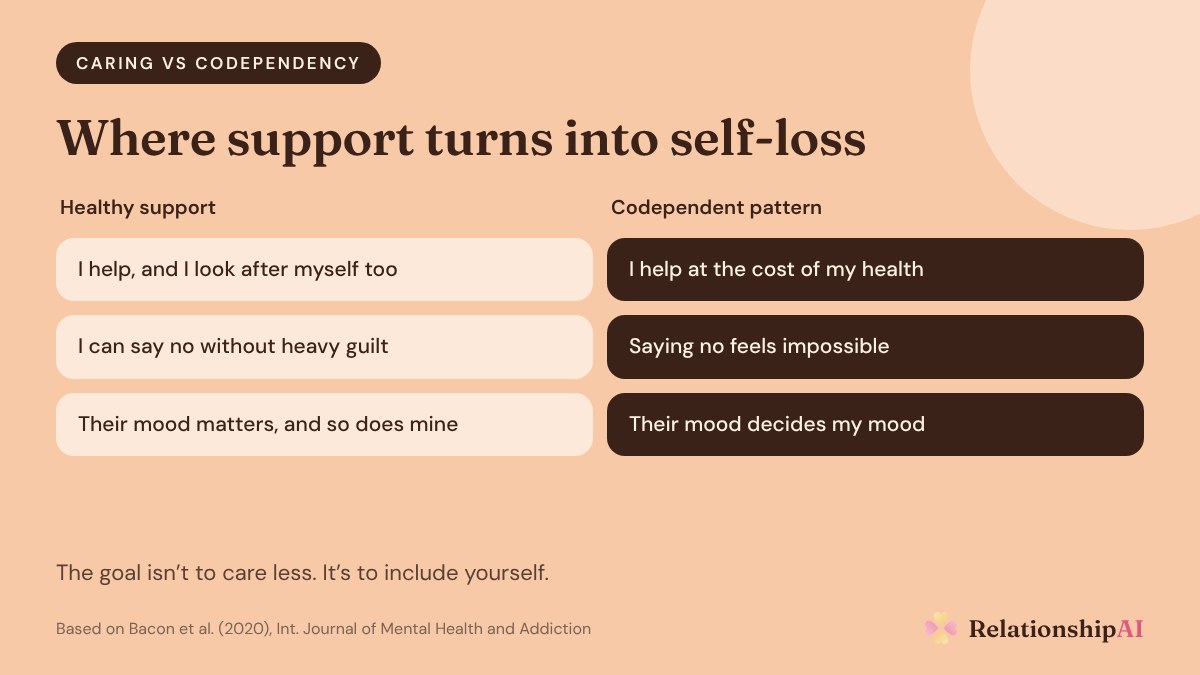
| Caring | Codependency | |
|---|---|---|
| Why you help | Because you want to | Because not helping feels unsafe |
| When they're upset | You feel for them | You feel you must fix it |
| Saying no | Uncomfortable, but possible | Feels like betrayal |
| Your own needs | Still on the list | Off the list, or "later" |
| Receiving help | You can accept it | You'd rather not be a burden |
| After helping | Usually you feel good | Often you feel drained, then guilty for resenting it |
Three tests that cut through the confusion
Test 1: The "if I stopped" test
Imagine you stopped doing one thing you usually do for your partner this week: the reminders, the mood-managing, the covering for them with friends. What do you feel?
If the honest answer is "a bit odd, but fine", that's care. If it's dread, or a sense that the relationship would fall apart, the helping may be holding up more than the relationship. It may be holding up your sense of being worth keeping.
Test 2: The receiving test
Researchers Heidi Fritz and Vicki Helgeson studied a pattern they called unmitigated communion: focusing on other people while leaving yourself out. In their work, it was marked by two things, overinvolvement in other people's problems and neglect of your own needs, and it went together with more distress. One telling detail in this line of research: people high in this trait often find it hard to accept support.
So ask yourself: when your partner offers to help you, can you say yes? If being cared for feels more uncomfortable than caring, notice that.
Test 3: The silence test
Psychologist Dana Jack developed the Silencing the Self Scale after listening to women with depression describe their relationships. Two of its items capture the pattern well: "Caring means putting the other person's needs in front of my own" and "I don't speak my feelings in an intimate relationship when I know they will cause disagreement."
Count how many times last week you swallowed a small "actually, I'd prefer..." to keep the peace. One or two is normal life. A steady habit of silence is how people slowly disappear in a relationship.
What the three tests have in common Each one checks whether you still exist in the relationship as someone with needs, opinions and the right to receive. Codependency is not "caring too much". It is caring in a way that has quietly removed you from the people you care for.
Of the three, I'd start with the "no" test. If saying no to your partner feels dangerous rather than just uncomfortable, that tells you more than any label.
What the research actually says (and what it doesn't)
Codependency is a popular word, but a messy scientific concept. It's not a diagnosis, there's no agreed definition, and much of what you read online goes beyond the evidence. Here is what is reasonably well supported.
It seems to be more about the self than about the relationship. In a study of 318 adults, Jessica Lampis and colleagues found that differentiation of self (being able to stay yourself while close to someone, without getting swept up in their emotions or cutting off) predicted codependent behavior more strongly than how well the couple was getting along. In plain words: codependency often travels with you from relationship to relationship.
It shows up in how couples handle stress. A 2023 study of 246 adults in relationships in Hungary, by Zsuzsa Happ and colleagues, found that higher codependency went together with more negative ways of reacting to each other's stress and with lower life satisfaction. Interestingly, it was not linked to less positive support. Codependent partners weren't less caring. They were caught in more of the unhelpful patterns around the caring.
People who identify with it often trace it back to childhood. In a small interview study, Ingrid Bacon and colleagues heard people describe families with a lot of control, criticism or an absent parent, and a "chameleon-like" habit of adapting to others until they lost track of themselves. Small studies like this can't prove causes, but they help explain why the pattern feels so automatic.
What we don't know: whether codependency is a separate thing from anxious attachment, people-pleasing or low self-esteem, and which treatments work best. Be wary of anyone who sells you a precise "codependency type" or a guaranteed cure.
What to do this week
You don't need to overhaul your relationship. Change here starts very small, because every step back toward yourself will feel selfish at first. That feeling is the old rule talking, not the truth.
Pick one thing to stop managing. Not the biggest one. Maybe you stop texting them reminders about their own appointments. Let the small consequence happen.
Answer one preference honestly. The next time they ask "Where do you want to eat?", say an actual place.
Let one offer of help land. When they offer to cook, drive or listen, say "Yes, thank you" and stop there. No "Are you sure?", no paying it back on the spot.
Put one thing in your calendar that is only yours. A class, a run, a friend. Keep it even if they seem a bit low that evening.
Words for when it feels hard
“That sounds really rough. Do you want me to just listen, or would ideas help?”
“I can't do that tonight. I could help on Saturday morning.”
“I've noticed I've been putting myself last for a while. I'm going to start doing a few things just for me. It's not about you. It's so I have more to give us.”
“I know this is different from how I usually am. I'm not going anywhere. I'm just trying to show up as a whole person.”
If saying these out loud feels scary, you can rehearse them privately in Partner Practice as many times as you need.
When it's not (only) about you
Sometimes codependent habits grow around a partner who really is struggling, with addiction, depression or a crisis, and sometimes around a partner who benefits from your self-erasure. If your partner punishes you for having needs, controls who you see, or makes you afraid, this isn't a codependency problem to fix by trying harder. Our guide to the signs of a toxic relationship can help you look at it clearly. If you keep pouring care into someone who rarely meets you halfway, read about the emotionally unavailable partner too.
It's also worth knowing that the urge to keep someone close at any cost is closely related to anxious attachment styles. Understanding your own style can make the pattern feel less like a personal failing and more like something you learned, and can relearn.

Quick answers
What are the signs of a codependent relationship?
Common signs include feeling responsible for your partner's moods, struggling to say no, hiding your own needs to keep the peace, losing touch with friends and interests, and feeling anxious or guilty when you do something for yourself.
Is codependency the same as being in love?
No. Love includes caring about your partner and also about yourself. Codependency is when caring for them has crowded out your own needs, opinions and life, so that the relationship depends on you staying small.
Can a codependent relationship be fixed?
Often, yes, if both partners are willing. It usually means building a life of your own again, practicing small honest no's and sharing needs out loud. Counseling helps many people. Our guide on how to fix a relationship covers the steps couples take together.
Is codependency linked to attachment styles?
They overlap. People with anxious attachment may cling to a partner to feel safe, and a common pairing is one anxious and one avoidant attachment partner. Attachment can explain the pull, but it doesn't make the pattern permanent.
A note on safety
If you feel unable to leave, are being threatened or hurt, or your partner controls your money, phone or friendships, please contact a local domestic abuse helpline or support service. You deserve support for yourself, not only for the person you care for.
In the US, you can reach the National Domestic Violence Hotline at 1-800-799-7233, by texting START to 88788 or at thehotline.org, and the 988 Suicide & Crisis Lifeline by calling or texting 988. Outside the US, contact a local helpline.
This article is general information, not therapy or medical advice.
Sources
- Fritz, H. L., & Helgeson, V. S. (1998). Distinctions of unmitigated communion from communion: Self-neglect and overinvolvement with others. Journal of Personality and Social Psychology, 75(1), 121-140. Carnegie Mellon University publication list
- Jack, D. C., & Dill, D. (1992). The Silencing the Self Scale: Schemas of intimacy associated with depression in women. Psychology of Women Quarterly, 16(1), 97-106. DOI
- Lampis, J., Cataudella, S., Busonera, A., & Skowron, E. A. (2017). The role of differentiation of self and dyadic adjustment in predicting codependency. Contemporary Family Therapy, 39. DOI
- Happ, Z., Bodó-Varga, Z., Bandi, S. A., Kiss, E. C., Nagy, L., & Csókási, K. (2023). How codependency affects dyadic coping, relationship perception and life satisfaction. Current Psychology. Read the study
- Bacon, I., McKay, E., Reynolds, F., & McIntyre, A. (2020). The lived experience of codependency: An interpretative phenomenological analysis. International Journal of Mental Health and Addiction, 18(3), 754-771. Read the study