

Right now it probably feels like this will last forever. Here is something worth holding on to: in a study that followed dating couples every two weeks for nine months, researchers led by Paul Eastwick asked people to predict how upset they would be if their relationship ended. When breakups actually happened, people were less distressed than they had predicted, and the ones who had been most in love overestimated their future pain the most.
You'll still hurt. But your brain is probably exaggerating how long and how badly. This guide breaks recovery into three stages, because what helps on day two is different from what helps in month two.
The short answer: To get over a breakup, get through the first 48 hours with basic care and support, create distance from your ex online, let the feelings come, then rebuild routines and parts of yourself that went quiet. Most people recover faster than they expect, and writing about the breakup can help.
Stage 1: the first 48 hours
The goal here is not to feel better. It's to get through without making things harder for future you.
Tell two people. Not a group chat, two actual people who can check on you. "I've just broken up with Max. I don't need advice, I just didn't want to be alone with it."
Do the basics on purpose. Eat something, drink water, sleep even if it's broken, go outside once. Grief is physical, and your body needs looking after.
Don't make any big moves. No long messages, no "one last talk", no deleting every photo at 3am in a rage you'll regret, no new haircut. Decisions made in the first 48 hours are usually made by the pain.
Write one sentence for later. On your phone: "Remember why this ended: ___." You'll need it in week two.
Stage 2: the first two weeks
This is often the hardest stretch. The shock wears off and the missing kicks in.
Put distance between you and the feed
In a study of 464 people after a breakup, Tara Marshall found that keeping tabs on an ex on Facebook, even without contacting them, went along with more distress, more longing for the ex and less personal growth. Every check reopens the wound.
You don't have to block anyone dramatically. Mute, archive, hide. If they're in your group chats, mute those too for a while.
Expect the "should I text them?" wave
It usually comes at night or after a drink. Have a plan ready:
- Open your notes and read the sentence from stage 1.
- Write the message to your ex there, not in the chat.
- Send it to a friend instead, or sleep on it. You can always send it tomorrow. You almost never will.
It can help to know why the pull is so strong. In a 2021 study of 361 people who had gone through a serious breakup, Morgan Cope and Brent Mattingly found that people with more attachment anxiety wanted their ex back more, and that this was partly explained by feeling less sure of who they were after the split. The urge to get back together can be a sign that you've lost track of yourself, not proof that the relationship should continue.
Let the feelings be what they are
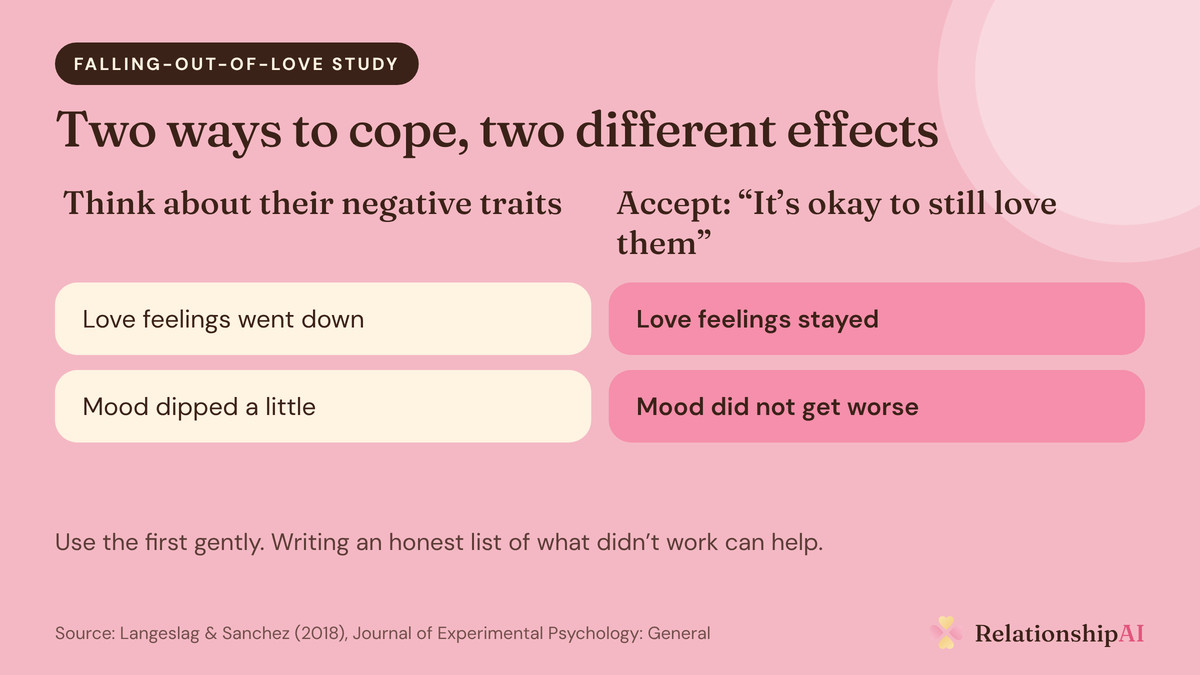
Sadness, anger, relief, guilt, all in one afternoon. That's normal. Trying to force yourself to stop loving someone rarely works. Accepting that you still have feelings, and that they will fade, takes away some of their power. If the replaying gets stuck, our guide on how to stop overthinking in a relationship has ways to break the loop.
Why it feels like you've lost part of yourself In three studies, Erica Slotter, Wendi Gardner and Eli Finkel found that after a breakup people's sense of who they are became less clear. Their sense of self felt, as they put it, "less clear and even smaller", and that loss of clarity contributed to the distress. In a relationship, your routines, plans and even your taste in films get shared. When it ends, you have to sort out which parts were you. That sorting is a big part of what healing is.
If you take one thing from this stage, mute them. Not as a statement, just as basic self-care. Every check resets the clock.
Stage 3: weeks three to twelve
Now recovery becomes active. The goal shifts from surviving to rebuilding who you are on your own.
Tell the story, out loud or on paper
In a 2015 study by Grace Larson and David Sbarra, people who had recently broken up and repeatedly reflected on the breakup as part of the research (answering questions and speaking about it privately over nine weeks) recovered better than a comparison group. The researchers linked it to a clearer sense of who they were as single people.
You can do a version of this yourself. Once a week, write or record a few minutes on:
- What happened, in your own words.
- What you miss, and what you don't.
- Who you are now that you weren't a month ago.
Rebuild the parts of you that got quiet
The friend you saw less. The sport you dropped. The music your ex didn't like. The trip you postponed. Pick one this month. You're not trying to "become a new person". You're getting reacquainted with the existing one.
Get honest about the relationship
When you're steadier, look back without blame or nostalgia. What were the good parts? What wasn't working? What would you want to be different next time? Our guide to green flags in a relationship can help you notice what healthy looks like for you. If the relationship involved manipulation, read about gaslighting and love bombing, which can help you make sense of what happened.
How long does it take?
There's no fixed number, and anyone who promises one is guessing. Many people notice the worst of it easing within weeks to a few months, often in waves rather than a straight line. A bad day in month two doesn't mean you're back at the start. It means you're human.
| Sign you're healing | Sign you might need more support |
|---|---|
| Whole hours, then days, without thinking of them | Weeks pass and nothing feels any lighter |
| You can look at a photo and feel sad, not wrecked | You can't sleep, eat or work for long stretches |
| You start making plans that don't involve them | You're drinking or using more to cope |
| You can see both good and bad in the relationship | You feel hopeless or think about hurting yourself |
If anything in the right column sounds like you, please talk to a doctor or counselor. If you're thinking about ending your life, contact emergency services or a crisis line right away.
If you're the one who ended it
You're allowed to grieve too. Ending something can still mean losing someone you love, along with the future you'd imagined. Guilt is common, but it isn't proof you made the wrong choice. If you're still unsure whether it was right, our guide on whether to break up can help you think it through calmly.
And for the 2 am moments when nobody's awake and you're about to text your ex, you can write it to Coach Chat instead. It won't reply with a read receipt.

Quick answers
How long does it take to get over a breakup?
It varies a lot. Many people feel noticeably better within a few months, but grief comes in waves. Research suggests people often recover faster than they expect.
Should I stay friends with my ex?
Maybe later, rarely right away. Contact and even checking their social media tend to slow recovery. Give yourself real distance first.
Is it normal to still love my ex?
Yes. Love doesn't switch off when a relationship ends. Accepting the feeling, rather than fighting it, usually helps it fade.
How do I stop thinking about my ex?
Reduce the triggers (mute, archive, hide), fill your time with people and things that are yours, and give the thoughts a set time and place, like a weekly journal, instead of all day.
Should I get back together with my ex?
Only if the reasons it ended have really changed, not just because you miss them. Missing someone is normal. It isn't, by itself, a reason to go back.
A note on safety
If your ex is contacting you after you've asked them to stop, threatening you, or turning up uninvited, that may be harassment. Please contact a local support service or the police. And if you're struggling to cope and having thoughts of harming yourself, contact emergency services or a crisis line now.
In the US, you can reach the National Domestic Violence Hotline at 1-800-799-7233, by texting START to 88788 or at thehotline.org, and the 988 Suicide & Crisis Lifeline by calling or texting 988. Outside the US, contact a local helpline.
This article is general information, not therapy or medical advice.
Sources
- Eastwick, P. W., Finkel, E. J., Krishnamurti, T., & Loewenstein, G. (2008). Mispredicting distress following romantic breakup: Revealing the time course of the affective forecasting error. Journal of Experimental Social Psychology, 44(3), 800-807. Full text (PDF)
- Slotter, E. B., Gardner, W. L., & Finkel, E. J. (2010). Who am I without you? The influence of romantic breakup on the self-concept. Personality and Social Psychology Bulletin, 36(2), 147-160. Summary on ScienceDaily
- Marshall, T. C. (2012). Facebook surveillance of former romantic partners: Associations with postbreakup recovery and personal growth. Cyberpsychology, Behavior, and Social Networking, 15(10), 521-526. Full text (PDF)
- Larson, G. M., & Sbarra, D. A. (2015). Participating in research on romantic breakups promotes emotional recovery via changes in self-concept clarity. Social Psychological and Personality Science, 6(4), 399-406. Summary on ScienceDaily
- American Psychological Association: Breakups aren't all bad: Coping strategies to promote positive outcomes
- Cope, M., & Mattingly, B. (2021). Journal of Social and Personal Relationships. Summary on PsyPost