
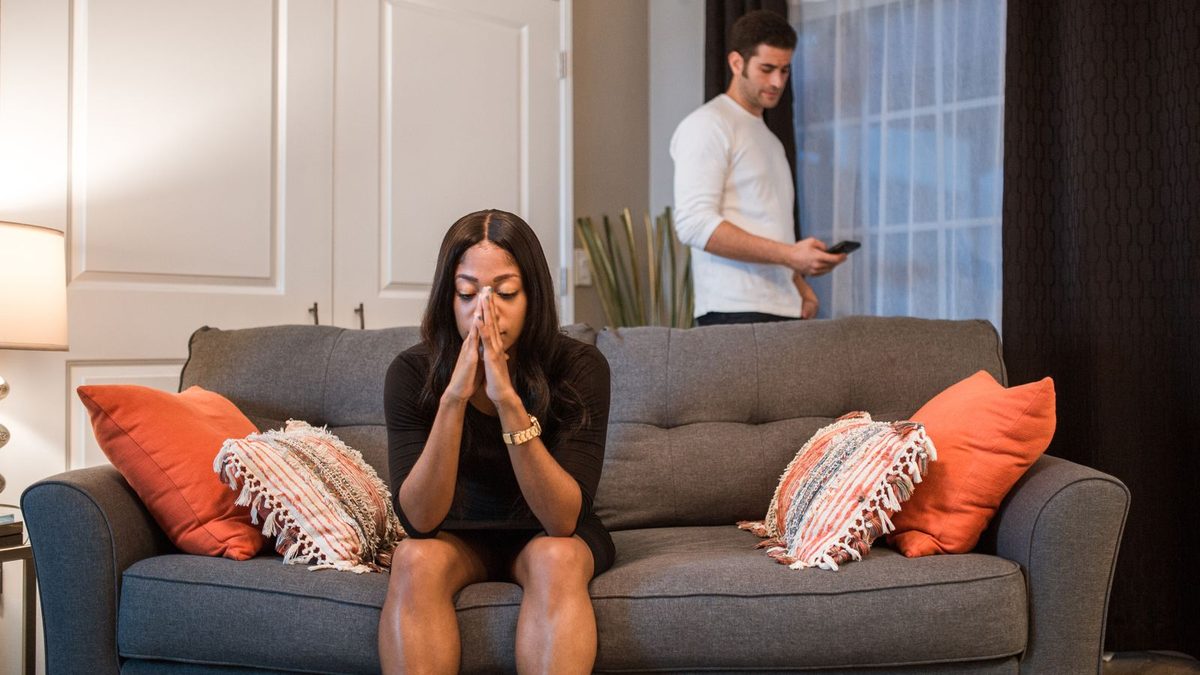
You had a lovely weekend together. Then on Monday they go quiet, take longer to reply and seem to need a lot of time alone. You wonder what you did wrong. Nothing, probably. But the pattern keeps repeating.
If that sounds familiar, your partner may have an avoidant attachment style. It's one of the most searched topics in relationship psychology, because it's so common and so confusing to live with. In a large, nationally representative US study, about a quarter of adults described themselves in a way that matched avoidant attachment.
This guide explains what avoidant attachment looks like, why avoidant partners pull away when things get close, and how to build a closer relationship without chasing or losing yourself.
The short answer: An avoidant partner values independence, pulls away after close moments, and finds emotional talks uncomfortable. To love someone with avoidant attachment, don't chase but stay present, make closeness feel safe rather than heavy, ask for what you need clearly, and notice how they show love through actions.
What is avoidant attachment?
Attachment styles describe how we tend to handle closeness and dependence in relationships. People with an avoidant style learned, often early in life, that relying on others wasn't safe or wasn't welcome. So they became very self-reliant.
As adults, they often want love and connection, but closeness can also feel uncomfortable or even threatening. When things get too close, they instinctively create distance. Our guide to how attachment styles work explains all four styles.
| Secure partner | Avoidant partner |
|---|---|
| Comfortable with closeness and independence | Values independence much more than closeness |
| Talks about feelings when needed | Finds talking about feelings uncomfortable |
| Reaches for support when stressed | Handles stress alone, often in silence |
| Sees needing each other as normal | Sees needing others as a weakness |
| Stays steady after closeness | Pulls back after moments of closeness |
Quick quiz: Curious about your own side of the pattern? The free 2-minute attachment style quiz shows whether you lean secure, anxious, avoidant or fearful-avoidant.
8 signs of an avoidant partner
1. They pull away after close moments
A great date or a deep conversation is followed by distance. Closeness seems to trigger a need for space.
2. They value independence very highly
Their own time, plans and space feel non-negotiable, sometimes even early in the relationship.
3. Emotional conversations make them uneasy
They change the subject, make a joke or say "I'm fine" when something is clearly wrong.
4. They handle stress alone
Instead of reaching out, they go quiet and deal with it on their own.
5. Commitment talks feel heavy for them
Conversations about the future, moving in or labels can make them withdraw.
6. They focus on small flaws
When things get serious, they may suddenly notice everything that's "wrong" with you or the relationship.
7. They seem cool after conflict
Instead of repairing, they shut down and wait for it to pass.
8. They show love through actions more than words
Fixing your bike or booking a trip might be how they say "I care". It's real, even if it's quieter.
Why avoidant partners pull away
In a classic study, Jeffry Simpson, Steven Rholes and Julia Nelligan videotaped 83 dating couples while the woman waited for what she believed would be a stressful experiment. Partners with more avoidant styles behaved differently from more secure partners: they sought less comfort when they were anxious, and gave less support when their partner was anxious.
The old alarm behind pulling away For an avoidant person, needing someone, or being needed, can quietly activate an old alarm: "relying on people leads to disappointment". Pulling away turns that alarm off. It isn't usually a decision about you. It's a learned way of staying safe. That's why pushing harder for closeness often backfires, while calm, steady closeness with room to breathe tends to work much better.
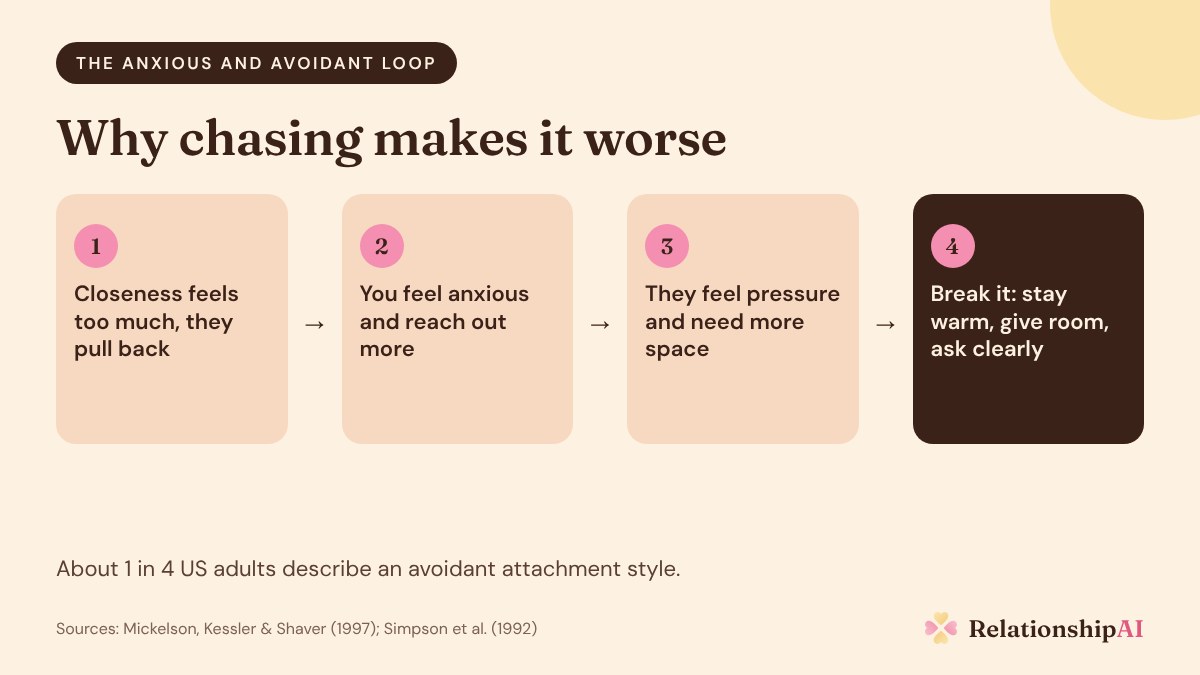
This can turn into a loop. In a 2022 study of 175 couples, Ione Bretaña and colleagues found that more avoidant people withdrew more during conflict, their withdrawal made their partner more demanding or aggressive, and that pattern lowered satisfaction for both. The more one partner pulls back, the harder the other pushes, which makes pulling back feel even more necessary.
How to love someone with avoidant attachment
1. Don't chase, but don't disappear
When they pull away, the instinct is to text more, ask more, push more. That usually increases the distance. Stay warm and available, and let them come back.
“I can tell you need some space today. That's okay. I'm here when you're ready.”
2. Make closeness feel safe, not heavy
Side-by-side activities, like walking, cooking or driving, often feel easier than face-to-face "we need to talk" moments.
3. Ask for what you need clearly and calmly
Avoidant partners often respond better to clear, specific requests than to emotional pressure. Research backs this up. In a study of 180 couples filmed while one partner asked the other to change something, Nickola Overall and colleagues found that more avoidant partners reacted with more anger and withdrawal. But when the person asking "softened" the request, by respecting their partner's independence and showing they were valued, that anger and withdrawal dropped, and the conversations went better.
“It would really help me if you texted when you need a quiet evening, so I don't worry.”
4. Notice their way of showing love
Practical help, time together and loyalty may be their language. Our guide to love languages can help you spot it.
5. Give them time to process
They might not be able to answer an emotional question on the spot. Let them come back to it.
One way to put it: "You don't have to answer now. Can we talk about it tomorrow evening?"
6. Look after your own needs
If you're more anxious in relationships, an avoidant partner can trigger your fears strongly. Keep your own friendships, hobbies and support. Our guides on relationship anxiety and emotionally unavailable partners may help.
Avoidant does not mean cold
Many articles treat avoidant people as cold or incapable of love. That's unfair and usually wrong. Avoidant partners can be deeply loyal, steady and caring. They just show it differently and need more room.
Attachment styles can also change. Research suggests that secure, consistent relationships and therapy can help people feel safer with closeness over time. The aim isn't to "fix" your partner, but to build a relationship where both of you feel safe: you with enough closeness, and them with enough space.
Talking about needs and space without it turning into a fight takes practice. You can plan the conversation in Coach Chat first.
This is the section I'd want every anxious partner to read. Pulling away isn't proof they don't care. It's often proof that caring feels risky to them.
Quick answers
What is avoidant attachment?
A style of relating where someone values independence highly and finds closeness and depending on others uncomfortable, often because of early experiences.
What are the signs of an avoidant partner?
Pulling away after closeness, discomfort with emotional talk, handling stress alone, withdrawing from commitment talks and shutting down after conflict.
Do avoidant partners love you?
Often, yes. They may show love through actions, loyalty and time together rather than words and emotional talks.
Why does my avoidant partner pull away?
Closeness can activate an old fear of depending on others. Pulling away helps them feel safe again. It's usually not about you.
Should I give an avoidant partner space?
Yes, but stay warm and available. Space with reassurance works better than chasing or going cold yourself.
Can an avoidant partner change?
Attachment styles can shift with self-awareness, secure relationships and therapy. Change is more likely when they want it themselves.
Can an anxious and an avoidant partner work?
Yes, but it takes awareness from both sides. Without it, the anxious partner may chase and the avoidant partner may withdraw, making each other's fears stronger.
A note on safety
Needing space is not the same as control or punishment. If a partner uses silence to hurt you, controls what you do or makes you afraid, please reach out to a local helpline or support service.
In the US, you can reach the National Domestic Violence Hotline at 1-800-799-7233, by texting START to 88788 or at thehotline.org, and the 988 Suicide & Crisis Lifeline by calling or texting 988. Outside the US, contact a local helpline.
This article is general information, not therapy or medical advice.
Sources
- Overall, N. C., Simpson, J. A., & Struthers, H. (2013). Buffering attachment-related avoidance: Softening emotional and behavioral defenses during conflict discussions. Journal of Personality and Social Psychology, 104(5), 854-871. University of Minnesota record
- Bretaña, I., Alonso-Arbiol, I., Recio, P., & Molero, F. (2022). Avoidant attachment, withdrawal-aggression conflict pattern, and relationship satisfaction: A mediational dyadic model. Frontiers in Psychology, 12, 794942. Full text
- Simpson, J. A., Rholes, W. S., & Nelligan, J. S. (1992). Support seeking and support giving within couples in an anxiety-provoking situation: The role of attachment styles. Journal of Personality and Social Psychology, 62(3), 434-446. Abstract
- Mickelson, K. D., Kessler, R. C., & Shaver, P. R. (1997). Adult attachment in a nationally representative sample. Journal of Personality and Social Psychology, 73(5), 1092-1106.