

Money is one of the few topics most couples avoid until it's urgent: a card is maxed out, a big purchase appears, the rent goes up. Then the talk happens in the worst possible mood.
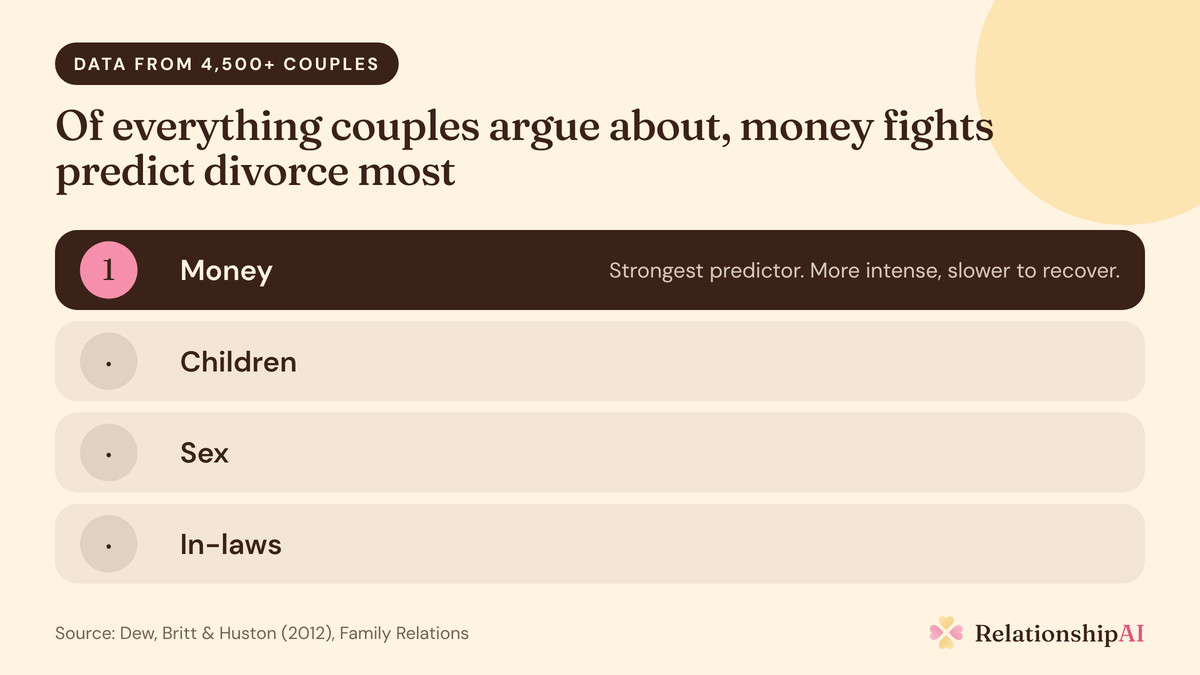
It's worth doing better. In a study of more than 4,500 couples, Jeffrey Dew, Sonya Britt and Sandra Huston found that arguments about money were a stronger predictor of divorce than arguments about other topics like children, sex or in-laws. Not because money matters more than love, but because money fights tend to be heated, repetitive and tied to deep values about security and fairness.
This guide gives you a simple structure for a calm "money date", a look at what research says about common money set-ups, and words for the four situations couples find hardest.
The short answer: To talk about money with your partner, choose a calm time and start with stories and goals before numbers. Then share the facts honestly and make one or two small decisions, like a no-need-to-ask spending amount. Regular short money dates prevent most money fights.
What research says before you start
Hidden money is more common than you'd think. In a 2021 Harris Poll for the National Endowment for Financial Education, 43% of US adults who had ever combined finances with a partner admitted to at least one financial deception, most often hiding a purchase, an account, a bill or cash. Of people who'd been involved in one, 85% said it affected their relationship, most often through an argument or less trust.
Opposites attract, and then argue. Scott Rick, Deborah Small and Eli Finkel found that "tightwads" (who find spending painful) and "spendthrifts" (who spend more than they'd like) tend to marry each other, and that these mismatched couples reported more money arguments and lower marital well-being, even after accounting for income and debt.
How you set up accounts may matter. In an experiment with 230 engaged or newly married couples, Jenny Olson and colleagues randomly assigned couples to open a joint account, keep separate accounts, or do what they liked. Over two years, couples who merged into a joint account maintained their relationship quality, while the other groups showed declines. The researchers caution that a joint account isn't right for everyone, especially where there's financial instability or a risk of control.
The money date: a 4-round agenda
Pick a relaxed time, not the day a bill arrives. Make it pleasant: coffee, a walk, snacks. Plan for 45 minutes, not a whole evening.
Round 1: Stories (10 minutes)
Start with history, not numbers. It explains a lot about how each of you reacts.
- How was money talked about (or not) in your family growing up?
- What's a money memory that still sticks with you?
- What does "financial security" mean to you?
Round 2: Dreams (10 minutes)
Talk about what money is for before talking about rules.
- What would you love us to be able to do in five years?
- What's one thing worth spending more on, and one thing worth spending less on?
- What would make you feel calm about money?
Round 3: The facts (15 minutes)
Now the practical part. Share honestly, without judgment.
- What do we each earn, owe and save?
- What do we spend each month on the basics?
- Is there anything one of us doesn't know yet? (This is the hardest question. Thank each other for honest answers.)
Round 4: One decision (10 minutes)
Don't try to solve everything. Make one or two small decisions:
- A "no need to ask" amount: purchases under this can be made without checking in.
- One shared goal for the next three months.
- When you'll do the next money date (once a month works well for many couples).
Why stories first When money talk starts with numbers, people get defensive fast: every figure feels like a judgment. Starting with stories and dreams reminds you both that you're on the same team, and explains why your partner gets anxious about savings or generous with gifts. It's much easier to agree on rules once you understand what's underneath them.
I'd resist the urge to skip round 1. Talking about how money worked in your families feels like small talk. It's usually where the real explanation for your arguments is hiding.
Which money set-up suits you?
| Set-up | How it works | Can suit couples who... |
|---|---|---|
| Fully joint | All income into shared accounts | ...have similar values and full trust, and want a "we" approach |
| Joint for bills, separate for personal | Each puts in an agreed amount or percentage | ...want shared responsibility plus personal freedom |
| Fully separate | Each pays an agreed share of costs | ...are early in the relationship, or have very different situations |
The Olson study suggests fully merging may help couples feel more united, but what matters most is that both of you genuinely agree, and that neither of you is left without access to money.
What to say in 4 tricky situations
1. You have debt your partner doesn't know about
Tell them sooner rather than later, with a plan. "There's something I need to tell you that I've been embarrassed about. I have about $4,000 in credit card debt. I've made a plan to pay it off by next autumn, and I'd like you to know so there's nothing hidden between us."
2. One of you earns much more
Talk about fairness, not equality. "I've been thinking about how we split costs. Splitting everything 50/50 leaves me with almost nothing at the end of the month. Could we look at splitting by percentage of income instead?"
3. Spender meets saver
Name the difference without labeling the person. "I think we feel very differently about spending. I get anxious when savings go down, and I know you feel restricted when I want to check every purchase. Could we agree on a monthly amount each of us can spend freely, no questions asked?"
4. You found a hidden purchase
Lead with the feeling, not the accusation. "I saw the charge for the new bike, and I felt hurt that you didn't mention it. I don't mind the bike. What matters to me is that we don't hide things from each other. Can we talk about why it felt easier not to tell me?"
If the talk still turns into a fight
Take a break when either of you feels flooded, and come back to it later. Our guide to communication habits has ways to keep arguments from escalating, and if something hurtful was said, how to apologize to your partner can help. If money is part of a bigger stress, see our guide on supporting your partner when they're stressed. And if you're about to move in together after long distance, money is one of the big topics to cover first, see our long distance relationship tips.

Quick answers
When should couples talk about money?
Early, and then regularly. A first light talk about goals and habits fits once the relationship is getting serious. A fuller conversation about debts, income and plans belongs before moving in together, opening joint accounts or getting married.
Should couples have joint bank accounts?
It depends on the couple. One study found that couples randomly assigned to a joint account reported better relationship quality over time. Many couples do well with a mix: a joint account for shared costs and separate accounts for personal spending.
How do I tell my partner I have debt?
Choose a calm moment, say it plainly, and come with a plan.
“I want to be honest about something. I have this amount of debt, and this is how I'm paying it off.”
Hiding it usually does more damage than the debt itself.
Why do couples fight about money?
Because money is rarely only about money. It carries feelings about safety, freedom, fairness and control, often shaped by how each person grew up. If the same money fight keeps coming back, our guide to relationship problems that keep coming back can help. And with gifts and travel adding up at the end of the year, it's worth agreeing on a budget before the holidays with your partner's family.
A note on safety
If your partner controls your access to money, takes your income, prevents you from working or builds up debt in your name, that's financial abuse. Please contact a local domestic abuse helpline or support service. Our guide on signs of a toxic relationship explains more about control.
In the US, you can reach the National Domestic Violence Hotline at 1-800-799-7233, by texting START to 88788 or at thehotline.org, and the 988 Suicide & Crisis Lifeline by calling or texting 988. Outside the US, contact a local helpline.
This article is general information, not therapy, legal or financial advice.
Sources
- Dew, J., Britt, S., & Huston, S. (2012). Examining the relationship between financial issues and divorce. Family Relations, 61(4), 615-628. Summary on EurekAlert
- Olson, J. G., Rick, S. I., Small, D. A., & Finkel, E. J. (2023). Common cents: Bank account structure and couples' relationship dynamics. Journal of Consumer Research, 50(4), 704-721. Summary from Kellogg Insight
- Rick, S. I., Small, D. A., & Finkel, E. J. (2011). Fatal (fiscal) attraction: Spendthrifts and tightwads in marriage. Journal of Marketing Research, 48. Summary from the University of Michigan
- National Endowment for Financial Education (2021): 2 in 5 Americans admit to financial infidelity against their partner