
Red flags get all the attention. But if you've been through a difficult relationship, the bigger challenge is often recognizing what good looks like. Healthy can feel strange at first. Calm can feel like boredom. Consistency can feel too good to trust.
This guide lists nine green flags in a relationship, but with a twist: for each one, there's a simple way to actually notice it, in early dating or years in. Several come from research on what separates thriving couples from the rest.
The short answer: The clearest green flags in a relationship are a partner who is genuinely happy about your good news, supports your goals without taking over, tells you calmly when something is wrong, repairs quickly after conflict, respects your need for a pause, and leaves you feeling calmer and more like yourself.
1. They're genuinely happy about your good news
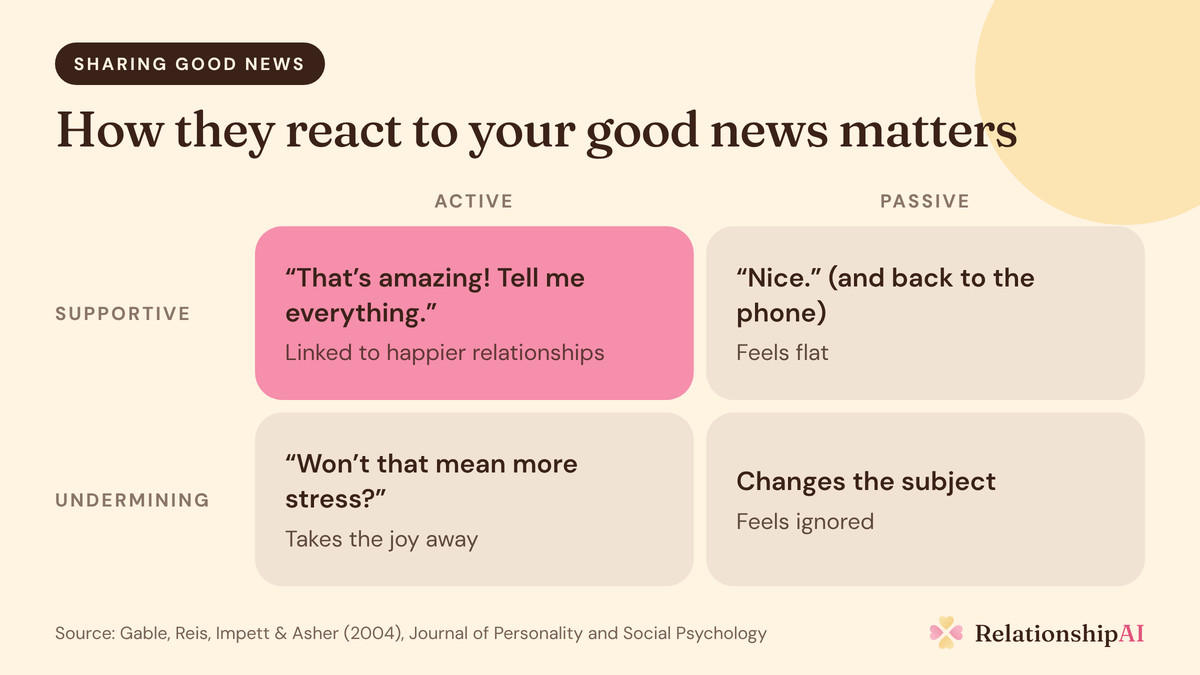
Why it matters: Psychologist Shelly Gable and colleagues found that the way a partner responds when you share something good matters a great deal. When partners responded actively and enthusiastically, people reported more intimacy and daily satisfaction. Responses that were flat, dismissive or turned the conversation back to the partner had the opposite effect.
How to spot it: Share a small win and watch. "That's amazing, tell me everything" is the green flag. "Nice" (back to the phone), "Won't that mean longer hours?" or "Guess what happened to me today" are not.
2. They support your goals without taking over
Why it matters: In a study where couples talked about their personal goals, Brooke Feeney found that responsive, non-intrusive support (encouraging without controlling) was linked to the partner feeling happier, having higher self-esteem and feeling more confident about reaching their goals. Pushing, criticizing or taking over the plan didn't help.
How to spot it: Mention something you want to try: a course, a career change, a marathon. A green-flag partner asks questions, offers help if you want it, and doesn't make you feel silly or selfish for wanting it.
Support also feeds itself when it is noticed. In a 2024 study of 163 long-term Swiss couples, Michelle Roth, Guy Bodenmann and colleagues found that helping a partner through stress made the helper happier with the relationship mainly when it led to gratitude, felt or expressed. A partner who supports you, and a relationship where that support is appreciated, tend to come together.
3. You become more like the person you want to be
Why it matters: Researchers call this the Michelangelo phenomenon: a close partner who sees you as the person you hope to become, and treats you that way, helps you grow toward that version of yourself. In a study of dating couples, Stephen Drigotas found it was strongly linked to personal well-being, even after accounting for how satisfied people were with the relationship.
How to spot it: Ask yourself: since this relationship started, am I more or less like the person I want to be? Braver, calmer, more creative, more yourself? Or smaller and more careful?
4. They tell you when they're upset, calmly
Why it matters: Problems you can name are problems you can fix. Silence, sulking or sudden explosions leave you guessing.
How to spot it: After something goes wrong, do they say "That bothered me, can we talk?" or do you find out three days later, from their mood?
5. They can lose an argument
Why it matters: In healthy relationships, disagreement isn't a contest. Each person can say "you're right" or "I hadn't thought of that" without it feeling like defeat.
How to spot it: In your next disagreement, notice whether they get curious ("Why do you see it that way?") or only defend. Do they ever change their mind?
6. They repair quickly
Why it matters: Every couple has bad moments. What matters is how quickly and how genuinely they're repaired. A sincere apology, a hand on the arm, a joke that breaks the tension, offered the same day rather than a week later.
How to spot it: After a fight, who reaches out first, and how long does it take? A green-flag partner sometimes reaches out first, and accepts your attempts too. Our guide on how to apologize to your partner shows what a good repair looks like.
7. They respect "I need a minute"
Why it matters: When people are overwhelmed in an argument, a short break often helps more than pushing through. A partner who can pause, and actually come back to the topic later, makes conflict safer.
How to spot it:
A green flag is "Okay, I'll make tea", followed by a calmer conversation. Not chasing you from room to room, and not using the break to disappear for days.
8. They notice the small moments
Why it matters: Gottman's research on newlyweds found that couples still together six years later had responded to each other's small "bids" for attention, like a comment, a question or a touch, far more often than couples who later divorced.
How to spot it: When you point at something out of the window or mention a song you like, do they look, ask, react? Small moments of turning toward you are among the most reliable green flags there are.
9. You feel calmer after talking to them
Why it matters: The deepest green flag is a feeling: that this person is a safe place. Not exciting every minute, not perfect, but steady.
How to spot it: After a conversation about something hard, do you feel lighter or more anxious? If you consistently feel worse, confused or on edge, that's worth paying attention to.
Green flags in early dating
In the first weeks, you can't see how someone handles years of stress, but you can notice:
- Consistency: their messages match their actions.
- Respect for your pace: no pressure for more closeness, commitment or time than you're ready for. Very fast intensity can be love bombing.
- Curiosity: they ask about your life and remember what you told them.
- Honesty about what they want: our guide to clear coding shows what that looks like.
- How they treat others: waiters, friends, exes. Later, how they handle meeting your parents tells you a lot too.

Green flags aren't a scorecard
Nobody shows all nine all the time. Everyone has bad days, old habits and moments they're not proud of. Look for patterns over months, not perfection in a single week. And remember that a relationship can have green flags and red flags at the same time. If you're unsure about the red ones, our guides on signs of a toxic relationship and gaslighting can help you think it through.
Personally, I'd look hardest at number 9. A partner can tick every other box and still leave you anxious after every conversation. How you feel afterwards is data.
How to be a green flag partner
Most of these are skills, not personality traits. Pick one to practice this week: respond enthusiastically to your partner's good news, ask one curious question during your next disagreement, or reach out first after a tense moment. Our guides on communication habits and attachment styles go deeper.
If overthinking makes it hard to trust a good relationship, see how to stop overthinking in a relationship.
Quick answers
What are the biggest green flags in a relationship?
Genuine happiness about your good news, support for your goals without control, honest and calm communication, quick repairs after conflict, and feeling calmer and more yourself around them.
What is the difference between a green flag and a red flag?
Green flags make you feel safe, respected and free to grow. Red flags make you feel anxious, controlled, smaller or confused.
Is it normal if a healthy relationship feels boring?
Often, yes, especially after a chaotic relationship. Calm can feel unfamiliar at first. Boredom that comes with peace is usually a sign of safety, not a lack of love.
Can a relationship have green flags and red flags at the same time?
Yes. What matters is the overall pattern, and whether problems can be talked about and changed.
A note on safety
If your partner controls you, threatens you or makes you afraid, green flags elsewhere don't cancel that out. Please contact a local domestic abuse helpline or support service.
In the US, you can reach the National Domestic Violence Hotline at 1-800-799-7233, by texting START to 88788 or at thehotline.org, and the 988 Suicide & Crisis Lifeline by calling or texting 988. Outside the US, contact a local helpline.
This article is general information, not therapy or medical advice.
Sources
- Gable, S. L., Reis, H. T., Impett, E. A., & Asher, E. R. (2004). What do you do when things go right? The intrapersonal and interpersonal benefits of sharing positive events. Journal of Personality and Social Psychology, 87(2), 228-245. Abstract on PubMed
- Feeney, B. C. (2004). A secure base: Responsive support of goal strivings and exploration in adult intimate relationships. Journal of Personality and Social Psychology, 87(5), 631-648. DOI
- Drigotas, S. M. (2002). The Michelangelo phenomenon and personal well-being. Journal of Personality, 70(1), 59-77. PubMed
- Gottman Institute: Turn toward instead of away
- Roth, M., Good, N., Ledermann, T., Landolt, S. A., Weitkamp, K., & Bodenmann, G. (2024). Building happier bonds: Gratitude as a mediator between dyadic coping and relationship satisfaction in romantic couples. Frontiers in Psychology. Summary on PsyPost