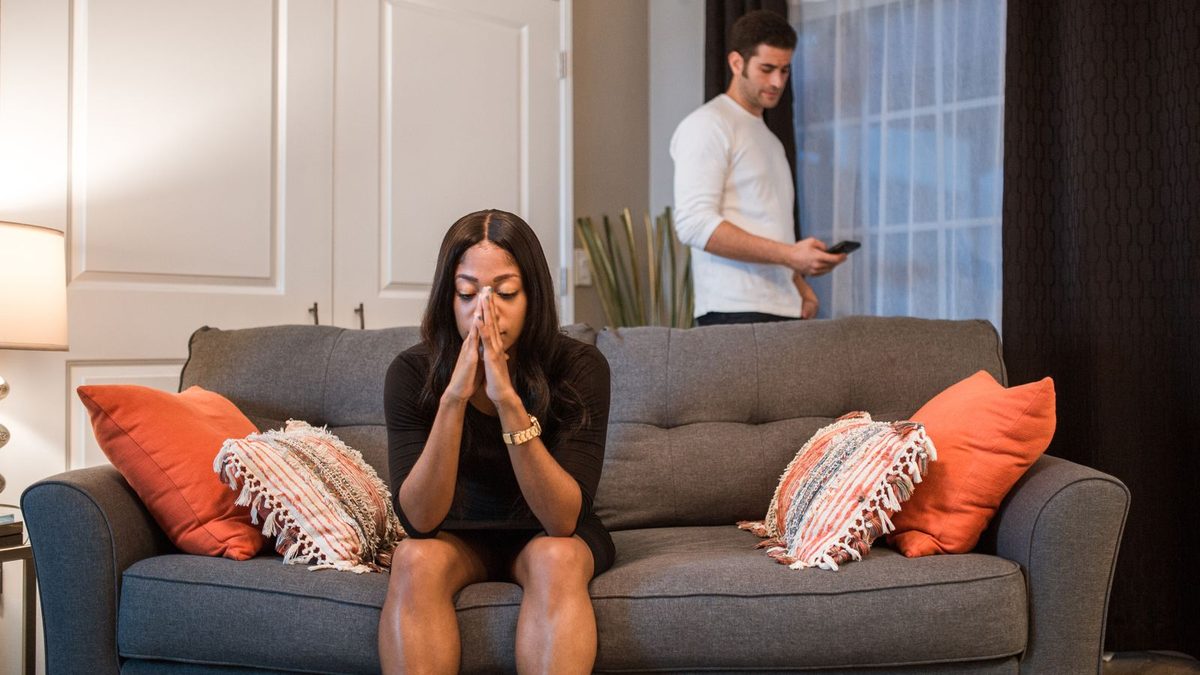

A bad fight can leave a strange silence afterwards. You've both said things you didn't quite mean, and now even passing the salt feels careful. The fight is over, but the trust hasn't come back yet.
Most advice on rebuilding trust after a fight talks about apologies, and those matter. But research points to three things that get far less attention: when you try to repair, who leads the recovery, and a short writing exercise that changed how couples experienced their fights over a whole year. This guide is organized by time: tonight, the next morning, and the week after.
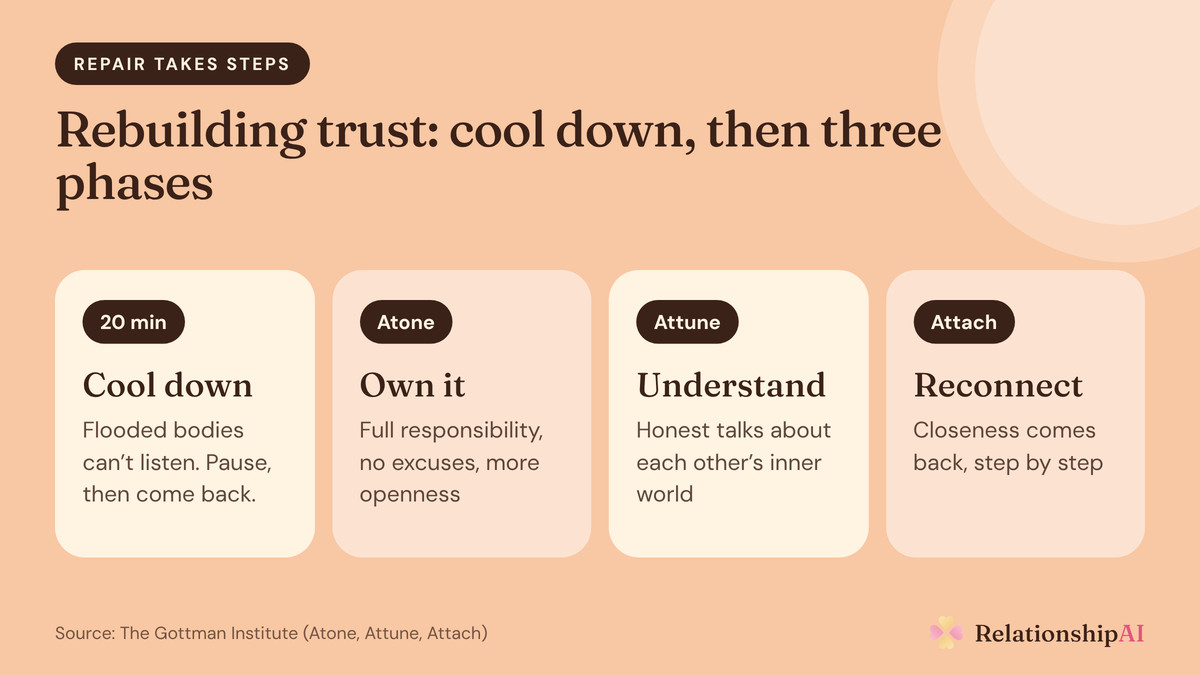
The short answer: To rebuild trust after a fight, calm down first and don't force a late-night fix. The next morning, own your part without excuses and listen to how it landed. Over the following week, keep one small promise, reconnect on purpose, and try a short writing exercise that looks at the fight from outside.
Tonight: don't try to fix it yet
If the fight was heated, the most useful thing you can do tonight is often nothing more than calming down.
Pause before you repair. When your body is still in fight mode, it's very hard to listen or speak kindly. Agree on a break: "I want to sort this out properly. Can we talk tomorrow when we're both calmer?" Then actually come back to it.
Sleep matters more than you'd think. In studies by Amie Gordon and Serena Chen at UC Berkeley, people reported more conflict with their partners on days after a poor night's sleep, and couples who'd slept badly were worse at resolving disagreements and at reading each other's emotions. A late-night "let's just finish this" conversation often makes things worse. Going to bed angry, but with a plan to talk, is often the wiser choice.
A 2026 study points the same way. Following 378 married couples through ten days of diaries, Asya Saydam and Jaime Hsu found that a better night's sleep generally predicted less marital strain the next day, with the strongest link for women married to men and for people in same-sex marriages.
Leave one small signal. A goodnight, a glass of water on their side of the bed, a "we'll figure it out". It says: the relationship is still here, even if the conversation isn't over.
Quick quiz: Want to see your own pattern in arguments? The free 2-minute conflict style quiz shows whether you escalate, shut down, people-please or repair.
I'll be honest, this is the advice people push back on most. Going to bed without fixing it feels wrong. But a calm conversation at breakfast beats a third round at 1 am almost every time.
The next morning: repair
Own your part, without conditions
Say exactly what you did and how it might have felt, with no "but" and no "if".
“I'm sorry I raised my voice and called your idea stupid. That wasn't fair, and I can imagine it felt humiliating.”
Research on apologies by Roy Lewicki and colleagues found that taking responsibility was the most important element of an effective apology, followed by offering to repair. Our full guide on how to apologize to your partner goes into this in detail.
Listen to the impact, not just the intent
"I didn't mean it that way" may be true, but it's not what your partner needs first. They need to know you understand how it landed.
One way to put it: "Tell me what that was like for you. I want to understand."
One of you can lead
In a long-running study at the University of Minnesota, Jessica Salvatore and colleagues watched couples recover after a conflict discussion. People who struggled to recover from conflict, often because of difficult early experiences, were more likely to stay together when their partner recovered well. The researchers suggested that one partner who can lead the cool-down can protect the relationship for both.
In practice: if you're the calmer one this time, go first. Offer a hug, a coffee, a light comment, a "shall we start over?" Leading the repair isn't admitting it was all your fault. It's taking care of the relationship.
The week after: rebuild
Make one small promise, and keep it
Trust grows back through predictable behavior, not big declarations. One specific, keepable promise beats five vague ones.
“Next time I feel myself getting heated, I'll say 'I need ten minutes' instead of carrying on.”
Then do it. Every time you keep a small promise, trust gets a little stronger.
Try the 21-minute reappraisal
This is the most surprising finding in the research on fights. In a two-year study of 120 married couples, Eli Finkel and colleagues asked half the couples to do a short writing exercise three times a year, about seven minutes each time. They wrote about their most recent disagreement from the perspective of "a neutral third party who wants the best for all involved".
Couples in both groups fought just as often, about equally serious topics. But the couples who did the exercise were less distressed by their fights, and the decline in marital satisfaction seen in the first year disappeared for them in the second.
Here's a version you can do this week, alone or both of you:
- Think about the fight from the outside. Imagine a kind, neutral friend who cares about both of you watching it. What would they see?
- Write down how they would describe it. What did each of you need? What did each of you miss? Where might something good come from this?
- Ask yourself one question: what might get in the way of seeing it that way during the next fight, and how could I get past that?
Seven minutes. Done.
Reconnect on purpose
After a fight, couples often avoid each other a little, even when it's resolved. Do something deliberately warm together: a walk, a meal, a film on the sofa. Small moments of turning toward each other, responding to a comment, a touch, a question, rebuild closeness faster than any big conversation. Our guide on how to say "I love you" without words has ideas.
If you're the one who was hurt
You're allowed to need time. Trust after a hurtful fight doesn't come back because someone said sorry once. It comes back as their behavior matches their words. Tell your partner what would help you.
“I appreciate the apology. What would really help me is seeing that the next disagreement goes differently.”
How long does it take?
After a single fight, often days. After repeated hurtful fights, it can take weeks or months of consistent behavior. If the same fight keeps coming back, our guide on relationship problems that keep coming back can help you find the pattern underneath, and our communication habits guide helps prevent the next escalation.
When it's more than a fight
If trust was broken by something bigger, like cheating, lying or secret spending, the process is longer. See our guides on rebuilding trust after cheating and trust issues in a relationship. And if fights involve threats, intimidation or fear, that's not a communication problem. Our guide to signs of a toxic relationship can help.
Some people find it easier to rehearse the morning-after conversation first. Partner Practice lets you do that with an AI playing your partner, as many times as you need.

Quick answers
Is it normal to feel distant after a big argument?
Yes. Many couples feel a bit careful and distant for a day or two after a fight. Deliberate small moments of warmth help close the gap.
Should we talk about the fight right away?
Only if you're both calm. If either of you is still heated, agree on a break and a time to come back to it. A good night's sleep often helps.
What should I say after a big fight?
Start with your part: "I'm sorry I said that. It wasn't fair." Then ask how it felt for them, and listen before explaining yourself.
Can trust come back stronger after a fight?
Often, yes. A fight that ends in genuine repair can show both of you that the relationship can handle conflict, which builds a deeper kind of trust.
A note on safety
Arguments happen in every relationship. Threats, intimidation, breaking things or physical harm do not. If you're afraid of your partner, please contact a local domestic abuse helpline or support service.
In the US, you can reach the National Domestic Violence Hotline at 1-800-799-7233, by texting START to 88788 or at thehotline.org, and the 988 Suicide & Crisis Lifeline by calling or texting 988. Outside the US, contact a local helpline.
This article is general information, not therapy or medical advice.
Sources
- Finkel, E. J., Slotter, E. B., Luchies, L. B., Walton, G. M., & Gross, J. J. (2013). A brief intervention to promote conflict reappraisal preserves marital quality over time. Psychological Science, 24(8), 1595-1601. Summary from Northwestern University
- Salvatore, J. E., Kuo, S. I.-C., Steele, R. D., Simpson, J. A., & Collins, W. A. (2011). Recovering from conflict in romantic relationships: A developmental perspective. Psychological Science, 22(3), 376-383. Summary from the Association for Psychological Science
- Gordon, A. M., & Chen, S. (2014). The role of sleep in interpersonal conflict: Do sleepless nights mean worse fights? Social Psychological and Personality Science, 5(2), 168-175. Summary on WBUR
- Lewicki, R. J., Polin, B., & Lount, R. B. (2016). An exploration of the structure of effective apologies. Negotiation and Conflict Management Research, 9(2), 177-196. Summary from Ohio State University News
- Saydam, A., & Hsu, J. (2026). Sleep tight, don't fight? Daily sleep quality and marital strain in same- and different-sex marriages in the United States. Journal of Health and Social Behavior. Summary on PsyPost