

Love bombing is hard to spot for a simple reason: at the start, it feels exactly like the romance people hope for. A list of red flags is easy to read in hindsight. In the moment, the flags look like flowers.
So instead of another list, this guide follows one fictional but very typical relationship from the first week to the third month, the way people describe it afterwards. At each stage you'll see what it feels like, what is actually happening, and what you can do. Then we'll look at how to tell it apart from someone who is simply very keen.
The short answer: Love bombing is intense flattery, gifts and constant contact early on, used to create fast attachment and later control. It often turns into criticism, pressure and hot-and-cold behavior once you're invested. The key difference from real enthusiasm is how they react when you set a boundary or say no.
Week 1: "I've never felt like this"
Sam meets Alex on an app. By day three they're talking for hours every night. Alex remembers everything Sam says, likes the same music, has the same plans for the future. By the end of the week Alex says: "I know this sounds crazy, but I think you might be the one."
What it feels like: Being deeply seen. Finally.
What may be happening: Intense mirroring and speed. On their own, these aren't proof of anything. Some people fall fast and mean it. But speed that outruns how well you actually know each other is the pattern to keep an eye on.
What to do now: Nothing dramatic. Just keep your normal life going and notice how they respond when you're not available.
Weeks 2 to 4: the gifts and the constant contact
Flowers arrive at Sam's work. A weekend trip is booked "as a surprise". Alex texts good morning, good night and many times in between, and seems hurt when Sam takes a few hours to reply.
What it feels like: Flattering and a little overwhelming. Sam's friends say "lucky you".
What may be happening: Two things worth separating. Generosity is lovely. But generosity that creates a sense of obligation, or contact that starts to feel like monitoring, is different. Western Australia's family violence service describes exactly this: gifts used to create obligation and constant messaging used to keep track of your time.
In a 2024 survey of 225 university students in Turkey, researchers Duman and Nazari found that about 43% reported love bombing experiences. The statement people agreed with most was strikingly simple: "He or she treated me so nicely that it didn't feel real."
What to do now: Slow one thing down on purpose. Say no to the trip, or reply in your own time. Watch the reaction more than the words.
“I'm really enjoying this, and I'd like to take it a bit slower. Can we keep the trip for later?”
Month 2: the first "no"
Sam wants a Friday night with old friends. Alex is warm about it on the surface, then quiet and wounded all evening by text: "I just miss you. I thought we were special." The next week it happens again, with a hint that Sam's friends "don't really get us".
What it feels like: Guilt. Sam starts seeing friends less, because it's easier.
What may be happening: This is the stage that matters most. A partner who loves you can feel disappointed and still respect your plans. In love bombing, the warmth starts to depend on you doing what they want. Early isolation from friends is one of the most consistent warning signs that domestic abuse organizations describe.
What to do now: Keep the plans. Tell a friend honestly what's going on, not the polished version.
Month 3: hot and cold
The affection still comes, but now in waves. After a disagreement Alex goes cold for a day, then returns with apologies, a gift and "I've never loved anyone like this". Sam feels relieved when the warmth comes back, and starts trying hard not to cause the next cold spell.
What it feels like: Walking on eggshells, while still remembering how good it was at the start.
What may be happening: The intense start has become something to win back. The UK charity Women's Aid describes love bombing as "a dangerous tactic often used by abusers in the early stages of the relationship". In 2023 the UK's Crown Prosecution Service included love bombing in its guidance on controlling or coercive behavior.
Not every love bomber becomes abusive, and not every whirlwind romance is love bombing. But this stage, warmth as reward and coldness as punishment, is where kind intentions and control part ways.
What to do now: Trust the pattern over the promises. Talk to someone outside the relationship. If you feel afraid, contact a support service (see the safety note below).
What the research says about who love bombs
There isn't much research yet, but what exists points in one direction. In a 2017 study of 484 young adults at the University of Arkansas, researchers led by C. C. Strutzenberg found that people with more narcissistic traits and lower self-esteem were more likely to love bomb, and that love bombing went together with heavy texting and social media use in the relationship.
That's useful because it moves the focus. The intensity often says more about the other person's needs (for control, for admiration, for reassurance) than about how special you are. The Turkish study found something else worth knowing: people who had experienced love bombing reported lower confidence in handling their own romantic relationships. If you've been through it, a dip in trusting your own judgment is a common after-effect, not a personal failing.
Love bombing or someone who's just very keen?
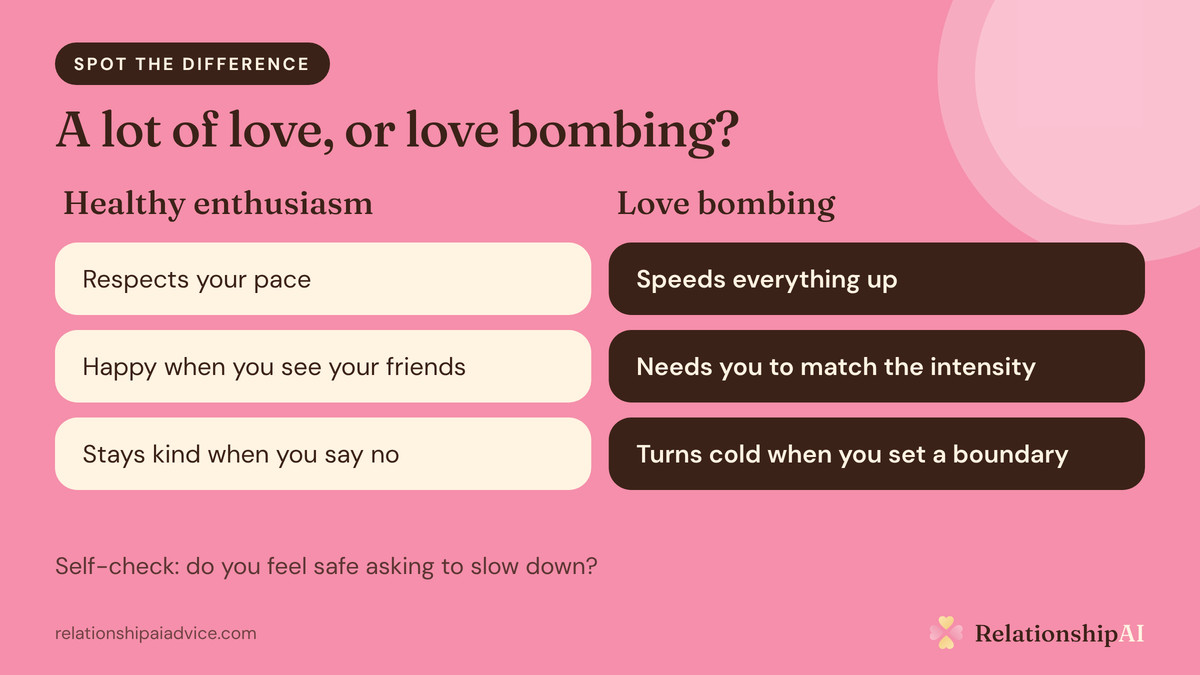
| Question | Keen and genuine | Love bombing |
|---|---|---|
| When you slow things down | They adjust, maybe with mild disappointment | They sulk, pressure or make you feel guilty |
| Your friends and plans | They want to meet your friends | Your friends become "a problem" |
| Gifts | Feel like gifts | Feel like debts |
| After a disagreement | They talk it through | They go cold, then flood you with affection |
| Over three months | Becomes steadier and more real | Becomes more conditional |
The single most useful test is the first column's first row.
and see what happens.
If you're unsure whether you're overthinking, our guide to green flags in a relationship shows what steady, healthy interest looks like. The opposite pattern, very little but just enough, is breadcrumbing. And someone who is simply clear about what they want is practicing clear coding.
Saying "let's slow down" to someone who's showering you with attention is hard. If it helps, you can rehearse it privately in Partner Practice first.
If you only test one thing, test the "no". Say no to something small and watch what happens. Real interest survives a no. Love bombing usually doesn't.

Quick answers
How long does love bombing last?
Often weeks to a few months, until commitment feels secure or the person feels they have control. It can return later as a way to win someone back after a fight or a breakup.
Can someone love bomb without meaning to?
Some people rush intensely because of their own anxiety, without a plan to control anyone. The impact on you can still be similar, so how they respond when you slow down tells you more than their intentions.
Is love bombing a sign of narcissism?
Research links it to narcissistic traits, but not everyone who love bombs is a narcissist. Focus on the behavior and how it changes over time, not a diagnosis.
What happens after love bombing stops?
Often affection becomes conditional: warmth when you comply, coldness or criticism when you don't. That shift is the clearest warning sign.
A note on safety
If a partner checks your phone, cuts you off from friends, controls money, threatens you or makes you afraid, this may be coercive control, which is a form of domestic abuse. It's not your fault. Please contact a local domestic abuse helpline or support service. If your phone may be monitored, use a friend's phone or a safe computer.
In the US, you can reach the National Domestic Violence Hotline at 1-800-799-7233, by texting START to 88788 or at thehotline.org, and the 988 Suicide & Crisis Lifeline by calling or texting 988. Outside the US, contact a local helpline.
This article is general information, not therapy or medical advice.
Sources
- Strutzenberg, C. C., Wiersma-Mosley, J. D., Jozkowski, K. N., & Becnel, J. N. (2017). Love-bombing: A narcissistic approach to relationship formation. Discovery, The Student Journal of Dale Bumpers College of Agricultural, Food and Life Sciences, 18(1), 81-89. Read the study
- Duman, N., & Nazari, S. (2024). University students' love-bombing and ghosting experiences and their self-efficacy in romantic relationships (in Turkish). Nevşehir Hacı Bektaş Veli Üniversitesi SBE Dergisi, 14(4), 2020-2036. Read the study
- Women's Aid (2023). Women's Aid responds to inclusion of love bombing in CPS's guidance on abuse
- Government of Western Australia, Department of Communities: What is love bombing?