
Holidays with your partner's family can be lovely. They can also be four days of politeness, unfamiliar rules, comments about your job, and the feeling that your partner turns into a different person the moment they walk through their parents' door.
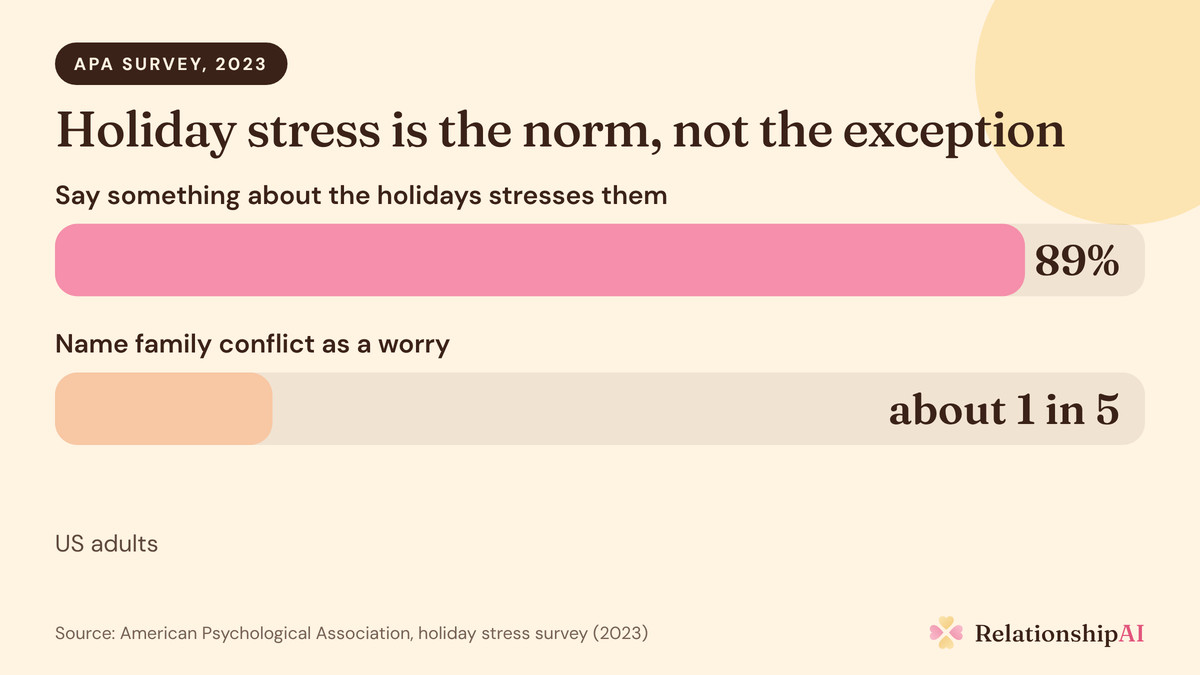
You're not imagining that it's hard. In the American Psychological Association's 2023 holiday survey, 89% of US adults said something about the holiday season causes them stress. And it matters for the relationship: in a long-term study of couples married around 20 years, Chalandra Bryant and colleagues found that conflict with in-laws predicted lower marital success later on, and one partner's in-law tension affected how the other partner felt about the marriage too.
The good news: most holiday stress with a partner's family is predictable, which means it's plannable. Here's a game plan, starting with Thanksgiving and then stage by stage for any family holiday.
The short answer: Holidays with your partner's family go best with a plan: agree beforehand on how long you stay, who handles which family, and a signal for when you need a break. Keep some time just for the two of you, let each partner manage their own parents, and save the debrief for after the drive home.
Thanksgiving with your partner's family
Thanksgiving is often the first big family holiday a new couple spends together, and it has its own rhythm. A few things help:
- Ask how their family does the day. Is it a midday meal or dinner? Football on TV all afternoon? A round of "what are you thankful for?" at the table? Knowing this ahead of time saves a lot of awkward guessing.
- Offer to bring a dish, and ask which one. Family recipes can be surprisingly sacred. "I'd love to bring something. Is there a side or dessert you'd like?" is safer than turning up with your own stuffing.
- Prepare your "thankful" answer. Keep it warm and simple: "I'm thankful to be here with all of you." If you want to include your partner, a light line works better than a big declaration.
- Plan the travel days together. The day before and the Sunday after are among the busiest travel days of the year in the US, so agree early on when you leave and how long you stay.
- Think about the next holiday now. If you're at their family for Thanksgiving, it's a natural moment to talk about where you'll spend Christmas, before anyone assumes.
Two weeks before: the planning talk
Most holiday fights between partners start with mismatched expectations, not with the family itself. Have one calm conversation before you go, ideally over a walk or a coffee, not the night before.
Agree on:
- How long you're staying, and whether you'll sleep there or somewhere else.
- Who handles their own family. A simple rule many couples swear by: each partner deals with their own parents. If a boundary needs setting, the "family member" does it.
- What topics are off limits for you, and which ones your partner knows will come up.
- Money: gifts, travel, who pays for what.
- What you each need to feel okay: a morning walk alone, one evening out just the two of you, no shared bedroom with the dog.
“I want this to go well for both of us. What's the one thing you're most worried about, and what's mine?”
Psychologist Terri Apter, who has studied in-law relationships extensively, found that over 60% of women, compared with about 15% of men, described a difficult relationship with their partner's mother. If that's you, say so before the visit, not halfway through it.
If you only do one thing from this guide, do this talk. So many holiday blow-ups start with two people who had quietly assumed different plans.
The day before: the briefing
Ask your partner for a five-minute briefing:
- Who's coming, and anything sensitive about each of them.
- House rules nobody will tell you: shoes, dinner times, religious traditions, who sits where.
- What usually goes wrong, and how the family handles it.
And agree on a signal and an exit: a word or look that means "I need a break", and a plan for it, like a walk to the shop or "helping" with something in another room.
Arrival day: first impressions and small helps
Bring something small: food you've made, flowers, something from your hometown. Learn the names of everyone you'll meet. Offer to help in the kitchen or with clearing up, even if they say no the first time. Helping gives you something to do, makes you look thoughtful, and often leads to easier side-by-side conversations.
Expect your partner to change a bit. Many people slip back into family roles at home: the quiet one, the joker, the peacemaker. It's not a betrayal. It's just very old habits.
The middle days: protecting the two of you
Keep a little time that's only yours. A walk after lunch, a coffee in town, ten minutes alone before bed. Even a small daily ritual makes a long visit feel much more manageable.
Pick your battles. Most holiday irritations aren't worth a stand: how the turkey is cooked, the TV volume, a great-aunt's opinions. Save your energy for the one or two things that genuinely matter.
When you feel flooded, step out. If you notice your heart racing and your patience going, take a 20-minute break before you say anything. The Gottman Institute recommends this kind of pause because it's very hard to listen or speak calmly when your body is in fight-or-flight mode.
The tense moments: what to say at the table
"So when are you two getting married?" / "When are the grandchildren coming?" Smile, glance at your partner. "We'll let you know when there's news!" Then change the subject.
A comment about your job, weight, food or choices: "I'm happy with it, thanks." A calm, short answer ends most of these. Long explanations invite debate.
“I think we see that one differently. Who wants more potatoes?”
A comment that crosses a line: This is your partner's job. Afterwards, privately: "When your mom said that about my family, it really hurt. Would you be willing to say something if it happens again?"
Your partner doesn't back you up: Don't fight about it in front of the family. Use your signal, take a break together, and talk in private. Bryant's research is a good reason to take this seriously: how couples handle in-law tension tends to spill into how they feel about each other.
The drive home: the kind debrief
The car ride home is where a lot of couples have their worst fight of the holidays, because both are tired and full of feelings. Agree beforehand: no deep debrief on the drive. Play music, get food, talk tomorrow.
When you do debrief, start with what went well, then one thing each of you would change next time. Criticizing your partner's family can feel like criticizing them. Psychologist Terri Orbuch's long-term research on married couples is a useful reminder that in-law relationships play out over decades, not over one visit. The goal is warmth and respect with healthy boundaries, not perfection.
“I'm glad we went. I loved seeing your dad with the kids. Next year, could we stay two nights instead of four?”

Splitting the holidays fairly
There's no single fair way. Couples commonly:
- Alternate years: your family this Christmas, mine the next.
- Split the days: one family for Christmas Eve, the other for Christmas Day or New Year.
- Host: invite both families to you, which gives you more control.
- Create your own tradition: one holiday each year that's just the two of you, or with friends.
What matters most is that you decide together, and that neither of you feels permanently second.
If you're bringing your partner home for the first time, see our guide on meeting your partner's parents, and if you're spending the holidays apart, our long distance relationship tips include ideas for the holidays. When tension spills over between the two of you, how to apologize to your partner and our guide on communication habits can help.
Quick answers
Do we have to spend every holiday with the same family?
No. Many couples alternate years, split the days, or create their own traditions. What matters is that you both feel the arrangement is fair.
What if I really don't like my partner's family?
You don't have to love them, but you do need to be civil and kind. Focus on a few warm moments, limit time where you can, and talk honestly with your partner in private.
What if my partner won't stand up for me?
Talk about it calmly before the next visit, with specific examples. Ask for something concrete, like stepping in when a certain topic comes up. A couples counselor can help if it keeps happening.
Is it okay to skip a family holiday?
Yes, sometimes. Taking a year off, or limiting the visit, can be a healthy choice, especially if visits are consistently harmful. Agree on it together.
A note on safety
If a family member is abusive, threatening or makes you feel unsafe, you don't owe anyone your presence. Your safety comes first. If your partner pressures you to accept harmful behavior, please talk to someone you trust or contact a local support service.
In the US, you can reach the National Domestic Violence Hotline at 1-800-799-7233, by texting START to 88788 or at thehotline.org, and the 988 Suicide & Crisis Lifeline by calling or texting 988. Outside the US, contact a local helpline.
This article is general information, not therapy or medical advice.
Sources
- Bryant, C. M., et al. (2001). The influence of in-laws on change in marital success. Journal of Marriage and Family, 63(3), 614-626. Abstract
- American Psychological Association (2023): Even a joyous holiday season can cause stress for most Americans
- Apter, T. (2009). What Do You Want from Me? Learning to Get Along with In-Laws. W. W. Norton. Discussed in Psychology Today
- WBUR (2012): The outsized power of the son-in-law, on Terri Orbuch's long-term study of married couples
- Gottman Institute: Physiological self-soothing