

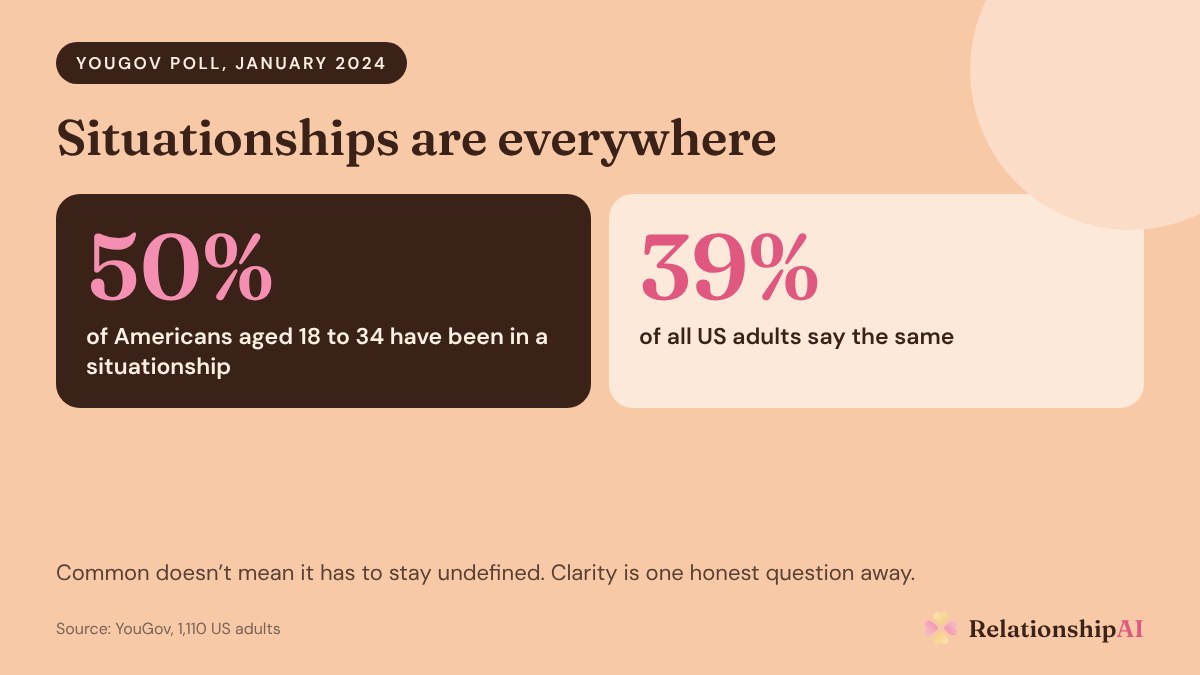
You see each other most weekends, text daily, maybe sleep over. But nobody has said what this is, and asking feels risky. That's a situationship, and in a 2024 YouGov poll, half of Americans aged 18 to 34 said they'd been in one.
You probably already know you're in one. The harder question is what to do about it. This guide helps with exactly that: a short look at what researchers have found, then a decision guide with three paths and the words for each.
The short answer: A situationship is a romantic or sexual connection without a clear label or commitment. To decide what to do, ask what you want and whether you're sliding or deciding. Then either stay and say so out loud, ask to define it, or walk away if your needs won't be met.
What research says about situationships
Situationships have only recently become a research topic, and most of the work so far comes from a team led by psychologist Michael Langlais.
They're real relationships, with less security. In a 2024 study, Langlais and colleagues defined a situationship as a romantic relationship with time spent together and physical or sexual intimacy, but no label and low commitment. When college students compared their recent romantic experiences, situationships involved similar physical closeness to committed relationships, but significantly lower satisfaction and commitment. And they often didn't turn into committed relationships.
People stay because some needs are met. In a 2025 follow-up combining interviews and a survey of 89 students, the things most linked to feeling satisfied and committed in a situationship were emotional investment, talking about the future, being prioritized, and having emotional needs met: affection, attention, feeling understood. Many participants saw the situationship as a possible path to a real relationship. Langlais described it as a kind of "relationship purgatory", a waiting room before becoming official.
Why that matters for you: a situationship can feel good enough to stay in, because some needs really are met. But "good enough for now" can quietly become months. That's where an older idea from relationship research helps.
Sliding versus deciding
Psychologists Scott Stanley, Galena Rhoades and Howard Markman described the difference between sliding and deciding in relationships. Sliding is when things just happen: you start sleeping over more, then you're spending holidays together, without ever choosing it. Deciding is when you consciously make a choice together.
Their work was about couples sliding into living together, but the idea fits situationships perfectly. A situationship is, almost by definition, a relationship nobody has decided on. The guide below is simply a way of turning sliding into deciding, whichever way you decide.
This idea is the one I'd keep. Most situationships aren't anyone's plan. They're a series of small "sure, why not" moments that nobody stopped to question.
The decision guide
Answer these three questions honestly. Write the answers down if you can.
1. What do I actually want? A committed relationship? Something casual but honest? Not sure yet? There's no wrong answer, but you need an answer before you can ask for it.
2. How do I feel most of the time in this? Mostly calm and happy, or mostly anxious, checking my phone and wondering where I stand?
3. What does their behavior (not their words) say they want? Do they make plans ahead, include you in their life, prioritize you? Or is it last-minute, private and on their terms?
Now find your path:
| If... | Your path is probably... |
|---|---|
| You're happy with casual, you feel calm, and you suspect they feel the same | Stay, but say it out loud |
| You want more, and their behavior suggests they might too | Define it |
| You want more, and their behavior says they don't | Walk away |
| You feel anxious most of the time, whatever you want | Define it or walk away, not stay |
Path 1: Stay, but say it out loud
Casual can be completely fine, if it's honest on both sides. The problem with most situationships isn't that they're casual. It's that each person is guessing.
“I'm enjoying this the way it is, and I'm not looking for anything serious right now. Is that where you are too?”
And agree on the basics, such as whether you're seeing other people and how you'll handle it if one of you starts wanting more. Then check in again in a couple of months, because feelings move.
Path 2: Define it
Pick a calm moment, not straight after a jealous spiral or at 1am by text. Keep it short, say what you want, and give them room to answer honestly.
“I really like what we have, and I've realized I want it to be a proper relationship. How do you feel about that?”
Then listen to the answer, including the vague ones:
- "Yes, me too" is a yes.
- "I really like you, but I'm not ready for a label" is usually a no for now.
- "Let's just see where it goes" after months together is, most of the time, a polite no.
If the answer is unclear, ask once more, kindly: "I hear you. To be honest, I need to know whether this could become a relationship in the next few months, or not." Then watch what they do over the next few weeks. Plans, introductions and consistency say more than words. If you'd like to see what clear, honest dating looks like, our guide to clear coding is a good reference point.
Path 3: Walk away
This is the hardest path, because some of your needs were being met. The Langlais research explains why it hurts: you're not leaving nothing, you're leaving a partial relationship and the hope attached to it.
“I've realized I want something more committed than this, and I don't think that's what you want. So I'm going to step back. I've really enjoyed our time together.”
You don't need their agreement, and you don't need a long explanation. Then give yourself real distance: mute, archive, don't reply to the "hey stranger" two weeks later. That message is often breadcrumbing, and replying restarts the cycle. Our guide on how to get over a breakup applies to situationships too. The grief is real even without a label.

If you're the one who doesn't want more
Be honest early, even if it's awkward. Keeping someone in a situationship because it's convenient, while knowing they want more, is where casual turns unkind.
“I really like spending time with you, but I'm not looking for a relationship right now. I'd understand if that's not enough for you.”
If uncertainty is making you spiral, our guide on relationship anxiety can help. And if you're with someone who keeps you close but never lets you in, read about emotionally unavailable partners.
The "what are we?" message is the one people rewrite ten times. Message check can tell you how it's likely to come across, and Partner Practice lets you rehearse saying it in person.
Quick answers
What is a situationship?
A romantic connection with time together and often physical intimacy, but no clear label or commitment. Research finds similar closeness to a relationship, but lower satisfaction and commitment.
Can a situationship turn into a relationship?
Sometimes, but research suggests it's less common than people hope. Clear communication about what you both want is the best way to find out.
How long should a situationship last?
There's no rule, but if months pass without clarity and you want more, it's worth asking directly. Long waiting tends to bring more anxiety, not more certainty.
How do I ask what we are without scaring them off?
Keep it calm and short, say what you want rather than demanding what they should feel, and give them room to answer. If honesty scares someone off, that's useful information.
This article is general information, not therapy or medical advice.
Sources
- Langlais, M. R., Podberesky, A., Toohey, L., et al. (2024). Defining and describing situationships: An exploratory investigation. Sexuality & Culture. Summary in Psychology Today
- Langlais, M. R., Guzman, P., Toohey, L., Podberesky, A., & Lee, A. (2025). Are situationships situational? A mixed-methods study on the motivations for being in a situationship. Sexuality & Culture. Summary on PsyPost
- Stanley, S. M., Rhoades, G. K., & Markman, H. J. (2006). Sliding versus deciding: Inertia and the premarital cohabitation effect. Family Relations, 55(4), 499-509. Overview from the Institute for Family Studies
- YouGov (2024): Half of 18-to-34-year-old Americans have been in a situationship