

Breadcrumbing is when someone gives you just enough attention to keep you interested, but never enough to build anything: a like on your story, a "hey stranger" every few weeks, plans that stay "soon". You don't need another definition. You probably need answers to the questions you've been turning over at night.
These are the ones people ask most, answered as honestly as research allows.
The short answer: Breadcrumbing is when someone gives you just enough attention to keep you interested, with no real intention of a relationship. Signs include sporadic messages, vague plans that never happen, and contact when they're bored. It's best handled by asking once directly, then stepping back if their actions don't change.
1. "Is this actually breadcrumbing, or am I overthinking?"
A useful test is to look at the pattern over a month, not at single messages. Breadcrumbing usually has three features together:
- Attention without movement. Messages, reactions and flirting, but no concrete plans that actually happen.
- Bad timing. Contact tends to arrive when you've gone quiet or started moving on.
- No answer to "what is this?" Questions about where things are going get a joke, a "let's see" or silence.
If only one of these fits, it may be a busy or awkward person. If all three fit for weeks, you're not overthinking.
| Probably busy | Probably breadcrumbing |
|---|---|
| Fewer messages, but plans still happen | Lots of messages, plans never happen |
| Says sorry and suggests a new time | "We should hang out soon!" with no date |
| Consistent, just slower | Hot and cold, often late at night |
| Answers when you ask what this is | Dodges the question every time |
2. "How common is this, really?"
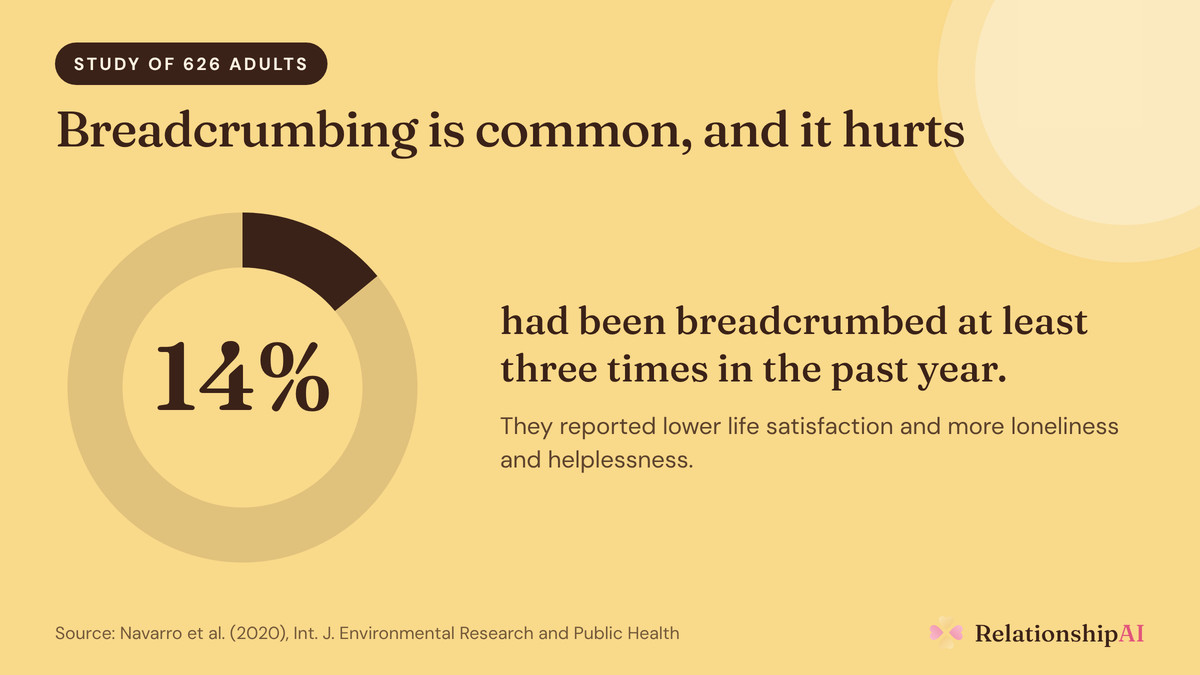
More common than it feels when you're in it. In a study of 626 adults in Spain, researchers led by Raúl Navarro found that about 36% said they'd been breadcrumbed at least once in the previous year. Here's the part people rarely mention: about 37% admitted they had breadcrumbed someone else. Most participants hadn't even heard the word before taking the survey.
So breadcrumbing isn't a rare cruelty only certain people commit. It's a common habit, often half-conscious, which makes it easier to stop taking it personally.
3. "Why does it hurt so much when nothing actually happened?"
Because uncertainty is hard on people. In a study of people in dating relationships, communication researchers Leanne Knobloch and Denise Solomon found that events which made people less sure about their relationship went with more anger and sadness, while events that made them more sure went with happiness.
Breadcrumbing is uncertainty on a drip. Each crumb restarts hope, each silence restarts worry, and your mind keeps the question open. In the Spanish research, people who had been breadcrumbed repeatedly reported lower life satisfaction and more loneliness and helplessness than people who hadn't.
Why a clear "no" can feel better than a maybe A "no" hurts once, and then you can grieve and move on. A maybe never gives you that ending. Your attention stays on the other person because the story isn't finished. That's not weakness. It's how almost everyone reacts to an open loop.
4. "Why do people breadcrumb?"
Usually not as a master plan. In a 2023 study where young adults described being breadcrumbed, participants thought breadcrumbers were often seeking attention, afraid of being alone, low in self-esteem, or wanting a sense of control. Other common reasons: keeping options open, enjoying the validation, or avoiding an awkward "I'm not interested."
Their reason explains it. It doesn't oblige you to keep accepting it.
5. "Why do I keep replying?"
In the same 2023 study, the people who had been breadcrumbed described the pull clearly: nearly half hoped it would turn into something, some expected the other person's feelings to catch up, and some found it hard to set a boundary.
If you lean toward an anxious attachment style, the pull can be even stronger, because the uncertainty itself feels like a reason to try harder. Noticing that is the first step to not acting on it automatically.
6. "Should I ask them directly?"
Yes, once, if you want clarity more than you want to keep the hope alive. Keep it short and give them an easy way to answer.
“I like talking to you, but I'm looking for something that actually goes somewhere. Are you up for meeting this week? If not, no hard feelings.”
Their response is the answer. A real plan means something. "Haha we'll see" also means something.
My view: yes, once. Not because the answer will always be what you want, but because one clear question gets you out of guessing, and guessing is what keeps you hooked.
7. "How do I step away without a big conversation?"
You don't owe a speech to someone who has given you crumbs. A short, kind message is enough:
“I've realized I want something more consistent than this. I'm going to step back. Take care.”
Then mute, archive or unfollow, whatever stops the crumbs from landing. That isn't petty. It protects the progress you've made from the next "hey stranger".
8. "Can breadcrumbing happen in a relationship, not just dating?"
Yes. In a committed relationship it can look like a partner who offers small affection to stop you leaving, but avoids real time, effort or change. If you keep getting just enough to stay and never enough to feel secure, it's worth reading about emotionally unavailable partners, and if the relationship has no clear label at all, about situationships.

9. "Will this mess up my next relationship?"
It can leave a mark. In the 2023 study, all nine participants said they had trust issues in later relationships, and many described anxiety and self-doubt. That was a small group, so it can't tell us how common this is. But it's a good reason to treat the experience as something to recover from, not just shrug off.
What helps: talking it through with friends, noticing the difference between someone who is consistent and someone who is intense, and, if the worry spirals, our guide on how to stop overthinking in a relationship. It also helps to know the opposite pattern. Someone who is too much, too fast may be love bombing, and someone who is clear about what they want is doing what's called clear coding.
Writing that "are we doing this or not?" message is the hardest part. If you want a second opinion before you hit send, Message check shows how it's likely to land and whether it reads as needy or harsh.
Quick answers
What does breadcrumbing mean?
Breadcrumbing means giving someone small, occasional signs of interest, like a like, a late-night text or a vague plan, without any real intention of a relationship. The "crumbs" are just enough to keep the other person hoping.
What is the difference between breadcrumbing and ghosting?
Ghosting is disappearing completely. Breadcrumbing is staying half present: the person never fully leaves, but never fully shows up either. Many people find breadcrumbing more confusing, because there is never a clear end.
Is breadcrumbing a red flag?
Usually, yes. It often means the person is not ready or not willing to commit, but likes the attention. Sometimes it reflects someone who is avoidant or overwhelmed rather than unkind, and our guide to an avoidant attachment partner explains that pattern. Either way, it is a sign to ask directly and watch what they do next.
How do I stop being breadcrumbed?
Ask once for what you want, for example a real plan this week. If their actions do not change, stop replying to the crumbs, mute or archive the chat, and put your energy into people who show up consistently.
A note on safety
If someone uses on-and-off attention together with threats, pressure for sexual content, or attempts to control you, that's no longer just breadcrumbing. Please talk to someone you trust or contact a local support service.
In the US, you can reach the National Domestic Violence Hotline at 1-800-799-7233, by texting START to 88788 or at thehotline.org, and the 988 Suicide & Crisis Lifeline by calling or texting 988. Outside the US, contact a local helpline.
This article is general information, not therapy or medical advice.
Sources
- Navarro, R., Larrañaga, E., Yubero, S., & Víllora, B. (2020). Ghosting and breadcrumbing: Prevalence and relations with online dating behaviors among young adults. Escritos de Psicología, 13, 46-59. Read the study
- Navarro, R., Larrañaga, E., Yubero, S., & Víllora, B. (2020). Psychological correlates of ghosting and breadcrumbing experiences: A preliminary study among adults. International Journal of Environmental Research and Public Health, 17(3), 1116. Read the study
- Khattar, V., Upadhyay, S., & Navarro, R. (2023). Young adults' perception of breadcrumbing victimization in dating relationships. Societies, 13(2), 41. Read the study
- Knobloch, L. K., & Solomon, D. H. (2003). Responses to changes in relational uncertainty within dating relationships: Emotions and communication strategies. Communication Studies, 54(3), 282-305. Penn State record