

"Emotionally unavailable" is usually treated as one thing: a partner who won't open up, full stop. But the same behavior, changing the subject, going quiet in hard moments, keeping things light, can come from very different places. And what helps depends completely on which one it is.
Pushing someone with an avoidant attachment style for a big talk tends to backfire. Asking someone with alexithymia "how do you feel?" may genuinely stump them. Waiting patiently for someone who isn't invested can cost you years.
So this guide doesn't give you a list of signs. It gives you five different reasons people are emotionally unavailable, how to recognize each one, and what tends to help.
The short answer: An emotionally unavailable partner may be avoidant, struggle to name their feelings, have learned that feelings aren't shared, be depleted by stress or depression, or simply not be invested in you. Each reason needs a different response, so watch their patterns and how they react when you ask for closeness.
First, what it looks like from your side
Whatever the reason, the experience for the partner is often similar: you know their opinions but not their feelings, hard conversations end in silence or a joke, they're great company for fun but hard to reach when life gets heavy, and you can feel lonely even when you're together.
It also tends to create a loop. A large review by Paul Schrodt and colleagues found that the demand/withdraw pattern, one partner pushing to talk while the other pulls away, is linked to lower relationship satisfaction for both people. The more you push, the more they withdraw, and the more they withdraw, the more you push. Understanding why they withdraw is the first step out of that loop.
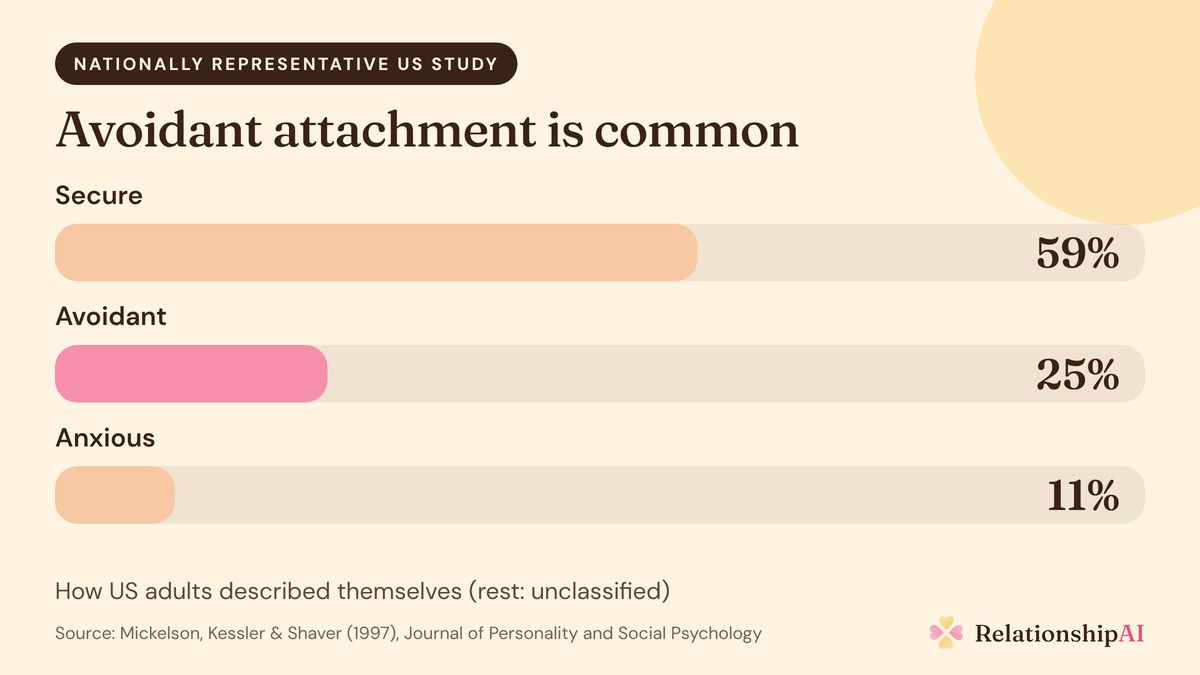
Reason 1: Avoidant attachment
What it looks like: closeness followed by distance. A wonderful weekend, then a quiet week. Strong independence. Discomfort with "where is this going" talks. Often affectionate in practical ways.
What's underneath: a learned sense that depending on others isn't safe, so closeness triggers a need for space.
What helps: calm, steady closeness without pressure, side-by-side time rather than intense face-to-face talks, clear and specific requests. Our full guide to the avoidant attachment partner goes into this in depth.
Hopeful note: attachment isn't fixed. In research following people over several decades, William Chopik and colleagues found that both attachment anxiety and avoidance tended to decline with age, and being in a committed relationship was linked to becoming more secure.
Reason 2: They genuinely struggle to identify feelings (alexithymia)
What it looks like: when you ask "How do you feel about it?", they look puzzled, say "fine" or "I don't know", and seem honestly unsure, not evasive. They may notice tension in their body but can't name the emotion. They're often better at practical help than emotional talk.
What's underneath: alexithymia, a personality trait that makes it hard to recognize and describe emotions. In a study of 155 married couples, Nick Frye-Cox and Colin Hesse found it in about 7.5% of men and 6.5% of women, similar to general population estimates. Alexithymia was linked to lower marital quality, largely through loneliness and difficulty with intimate communication.
What helps: smaller, more concrete questions.
“How do you feel about your dad?”
or "Was that more annoying or more upsetting?" Notice their care in actions. And know that therapy can help people build an emotional vocabulary.
Reason 3: They learned that feelings aren't for sharing
What it looks like: they have feelings and can sometimes name them, but sharing them feels weak, embarrassing or pointless. "I'll deal with it myself." Often more common in men raised with traditional ideas of masculinity, but not only.
What's underneath: norms about emotional control and self-reliance. In a study of college students, Shawn Burn and Zachary Ward found that the more women rated their male partners as following traditional masculine norms, the less satisfied they were with the relationship, and that partners' emotional control and self-reliance were among the norms linked to lower satisfaction.
What helps: make sharing safe and low-stakes. React to small disclosures with warmth, not a big emotional moment. "Thanks for telling me that" goes a long way. Avoid "Finally!" or making it a lesson. Over time, small safe experiences can change the old rule.
One way to put it: "You don't have to explain it perfectly. Even 'today was rough' helps me feel close to you."
Reason 4: They're depleted right now
What it looks like: a change from how they used to be. Flat, tired, withdrawn from friends and hobbies too, not only from you. Often linked to stress, grief, burnout or depression.
What's underneath: not a lack of interest, but a lack of capacity. When someone is struggling, emotional availability is often the first thing to go.
What helps: ask about them, not about the relationship. "You've seemed really low lately. How are you, honestly?" Support practically. If it lasts for weeks, gently encourage them to see a doctor or counselor. It's also encouraging that, in a study of more than 200 newlywed couples, Paula Pietromonaco and colleagues found that a partner's responsiveness helped protect relationship quality from the effects of depression and outside stress. Your steadiness matters. Our guide on supporting your partner when they're stressed can help.
Reason 5: They're unavailable to you
What it looks like: they can be open and emotional with others, or have been in past relationships, but keep you at arm's length. Plans stay vague. The relationship never quite becomes a priority. Sometimes they're still attached to an ex or someone else.
What's underneath: not a capacity problem, but a commitment problem. They may not want the relationship you want.
What helps: clarity, not patience. Ask directly what they want. If the answer, or their behavior over the next weeks, says they're not invested, believe it. Our guides on situationships, signs your partner is losing interest and whether to break up may help.
Which one is it?
| If they... | It may be... |
|---|---|
| Pull away after closeness, value independence highly | Avoidant attachment |
| Seem honestly unsure what they feel | Alexithymia |
| Know what they feel but see sharing as weakness | Learned norms |
| Changed recently, and withdrew from everything | Depletion or depression |
| Are open with others, closed with you | Low investment in this relationship |
Many people are a mix. The table is a starting point for a conversation, not a diagnosis.
My honest take: reason 5 is the one people least want to consider, and the one worth ruling out first. It hurts, but it saves a lot of time spent fixing the wrong problem.

Looking after yourself
Whatever the reason, you're allowed to have needs. If you're always the one reaching, it can slide into exhaustion or codependency. Keep friends you can be open with, notice whether things are slowly improving, and decide what you need long term. And if you notice the anxiety is mostly yours, our guide on how to stop overthinking in a relationship can help.
With a partner who shuts down, the wording matters a lot. Partner Practice lets you try different openings with an AI playing your partner, so you can find the ones that invite instead of pressure.
Quick answers
Can an emotionally unavailable person change?
Often, yes, especially when the reason is attachment, learned norms or temporary depletion, and when they want to. Change is slower when they simply aren't invested in the relationship.
Is being emotionally unavailable the same as avoidant attachment?
Not always. Avoidant attachment is one common reason, but alexithymia, cultural or gender norms, depression and low investment can look very similar.
How do I bring it up without pushing them away?
Pick a calm moment, describe what you notice and how you feel, ask a small concrete question, and give them time. "I miss feeling close to you. What would make it easier to talk?"
Should I stay with an emotionally unavailable partner?
It depends on whether things are slowly improving, whether they're willing to try, and whether your own needs can be met. Staying for years in loneliness, hoping they'll change, is a high price.
A note on safety
Emotional distance is not the same as cruelty. If a partner uses silence to punish you, controls you, or makes you afraid, that's a different situation. Please contact a local support service or helpline.
In the US, you can reach the National Domestic Violence Hotline at 1-800-799-7233, by texting START to 88788 or at thehotline.org, and the 988 Suicide & Crisis Lifeline by calling or texting 988. Outside the US, contact a local helpline.
This article is general information, not therapy or medical advice.
Sources
- Frye-Cox, N. E., & Hesse, C. R. (2013). Alexithymia and marital quality: The mediating roles of loneliness and intimate communication. Journal of Family Psychology, 27(2), 203-211. Summary on ScienceDaily
- Burn, S. M., & Ward, A. Z. (2005). Men's conformity to traditional masculinity and relationship satisfaction. Psychology of Men & Masculinity, 6(4), 254-263. Full text (PDF)
- Schrodt, P., Witt, P. L., & Shimkowski, J. R. (2014). A meta-analytical review of the demand/withdraw pattern of interaction. Communication Monographs, 81(1), 28-58. Summary on ScienceDaily
- Chopik, W. J., Edelstein, R. S., & Grimm, K. J. (2019). Longitudinal changes in attachment orientation over a 59-year period. Journal of Personality and Social Psychology. Summary by the British Psychological Society
- Pietromonaco, P. R., Overall, N. C., & Powers, S. I. (2021). Social Psychological and Personality Science. DOI, summary from UMass Amherst