

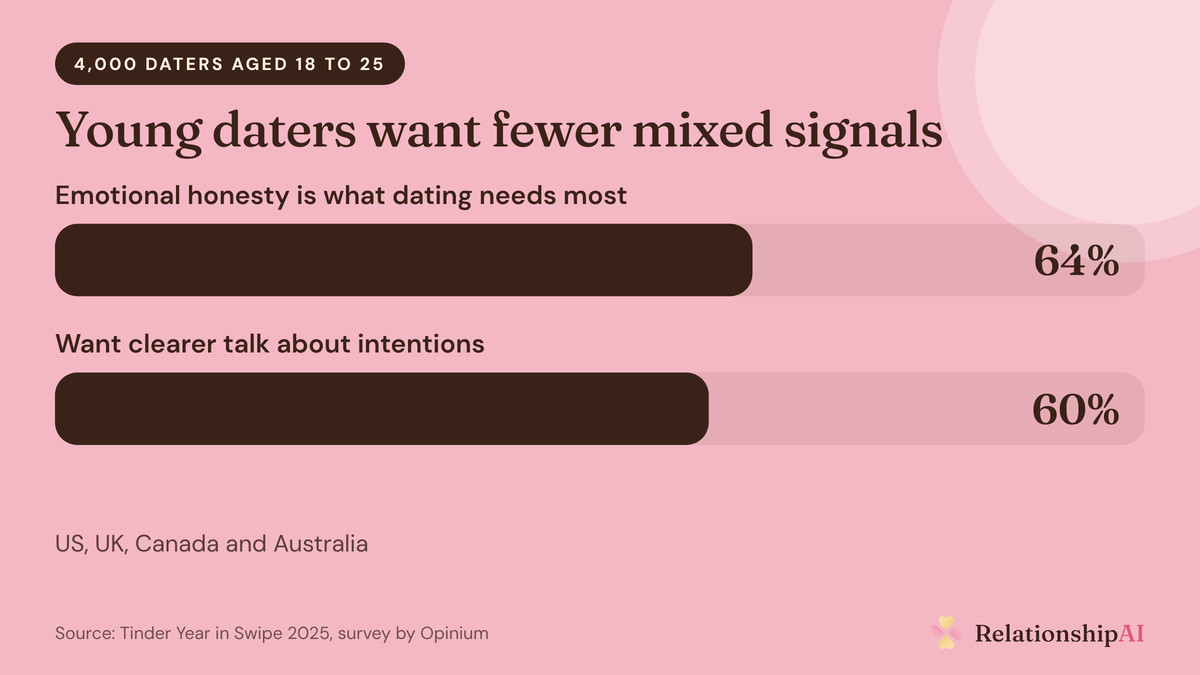
Clear coding is the dating trend of simply saying what you want: "I'm looking for something serious", "I'd like to see you again", "I don't think we're a match". Tinder named it one of the defining trends for 2026 and described it as "when intentions finally come with subtitles". In its international survey of 4,000 actively dating 18 to 25 year olds, 64% said emotional honesty is what dating needs most, and 60% wanted clearer communication about intentions.
Most people agree with clear coding in principle. The hard part is the actual words, so they don't sound needy, intense or harsh. That's what this guide is for: 20 messages you can adapt, organized by stage.
The short answer: Clear coding in dating means saying what you want, kindly and early: what you're looking for, whether you'd like a second date, and "no, thanks" when it isn't a match. It saves both people time, reduces anxiety, and a clear no is kinder than ghosting.
Why clarity works better than playing it cool
People are more interested than you expect. In a series of experiments, Michael Kardas, Amit Kumar and Nicholas Epley found that people consistently underestimated how interested others would be in hearing about them, and expected honest, deeper conversation to be more awkward than it turned out. "Playing it cool" is often protection against a reaction that wouldn't have happened anyway.
Uncertainty hurts. Communication researchers Leanne Knobloch and Denise Solomon found that events which made people less sure about a relationship went along with more anger and sadness, while events that brought certainty went with happiness. Mixed signals aren't romantic tension. They're stress.
A clear "no" is kinder than vanishing. In a 2023 experiment, psychologists led by C. M. Leckfor found that people who recalled being ghosted reported feeling worse, less in control and less sure of their own worth, than people who recalled being directly rejected. Clear coding applies to "no, thanks" too.
Stage 1: Your profile and first messages
Say the basics up front, briefly. You're not writing a contract.
- For your bio: "Looking for something long-term, but happy to start with a good coffee."
- For your bio: "Not looking for anything serious right now. Honest about it."
- Early in the chat: "Just so we're on the same page, I'm dating with the hope of finding a relationship. What about you?"
- If you're not sure what you want: "Honestly, I'm open and figuring it out. I'll tell you if that changes."
Stage 2: After a first date
Interest doesn't need to be hidden for three days.
- "I had a really good time tonight. Would you like to do it again next week?"
- "That was fun. I'd love to see you again. Are you free Thursday or Saturday?"
- If it was nice but not quite right: "Thanks for tonight, I really enjoyed talking. I don't feel a romantic spark, but I wish you the best."
- If you're unsure: "I enjoyed it, and I'm not sure yet how I feel. Would you be up for a second date to find out?"
Notice message 6: a specific day turns "we should hang out" into an actual plan. Vague plans are where mixed signals start.
Stage 3: A few dates in
This is the stage where people start guessing. Don't.
- "I'm enjoying getting to know you. Are you seeing other people at the moment? Either answer is fine, I'd just like to know."
- "I've stopped using the apps because I'd like to see where this goes. No pressure on you, I just wanted to be open."
- "I really like spending time with you. I'm not in a rush, but I'm hoping this could turn into something."
- If they've gone quiet: "Hey, I've noticed we haven't talked much this week. Are you still interested? It's okay if not."
Stage 4: Defining it
The "what are we?" conversation is easier when it's short and calm. Our guide to situationships has more help if this has been dragging on for months.
- "I'd like us to be exclusive. How do you feel about that?"
- "Can I ask where you see this going? I'm looking for a relationship, and I'd rather know now than guess."
- If they say "let's not label it": "I hear you. For me, a label matters, so I need to know if this could become a relationship in the next few months."
- If the answer is clear and it's not what you want: "Thanks for being honest. I want something different, so I'm going to step back. I've really enjoyed our time."
Stage 5: Saying no kindly
This is the part of clear coding people skip, and the part that matters most to the person on the other end.
- After one or two dates: "I've enjoyed meeting you, but I don't think we're a match. I wanted to tell you rather than just disappear."
- After a few weeks: "I've been thinking about it, and I don't see this becoming a relationship. You deserve someone who's sure, so I'd rather be honest now."
- If they keep messaging after you've said no: "I meant what I said. I'm not going to reply further, but I wish you well."
- If you're not ready to date at all: "I've realized I'm not in the right headspace to date right now. It's not about you, and I'm sorry for the timing."
This is the stage I'd most like people to take seriously. A two-line "I don't think we're a match" costs you a minute and saves the other person days of wondering.
What clear coding is not
- Not oversharing. You don't need to tell a first date about your ex, your therapy or your five-year plan. Clarity about intentions is enough.
- Not pressure. "I'd like to know" is different from "I need an answer tonight".
- Not a guarantee. Being clear doesn't make the other person feel the same way. It just means you find out sooner.
- Not blunt for the sake of it. You can be completely clear and still warm.

When it's hard to be clear
If clarity scares you, it may be because a "no" feels like proof you're unlovable. It isn't. It's just information about fit. If uncertainty sends your mind into overdrive, our guides on relationship anxiety and how to stop overthinking can help. And knowing the opposite patterns helps too: someone who gives you just enough attention to keep you hooked may be breadcrumbing, and someone who rushes intensely may be love bombing.
Stuck on the wording? Message check shows how a text is likely to come across and suggests a calmer version if it sounds needy or harsh.
Quick answers
What does clear coding mean in dating?
Clear coding means being upfront and kind about your intentions: what you are looking for, whether you want to see someone again and when it is not a match. It is the opposite of playing it cool or leaving people guessing.
Is clear coding a new trend?
The name is new, and dating apps have helped make it popular, but the idea is not. Research on relationship uncertainty has long shown that not knowing where you stand is one of the most stressful parts of dating.
Doesn't being clear scare people off?
It may put off people who want something different from you, and that saves you both time. People who want the same thing usually find clarity a relief. Keep the tone light and friendly, so it reads as confident rather than demanding.
How do I tell someone I want a relationship without sounding needy?
Keep it short, say what you want rather than what they should feel, and leave room for their answer.
“I'm enjoying this and I'd like to see where it goes as a relationship. How do you feel?”
If they go quiet or pull away after that, our guide to an avoidant attachment partner may help you read the pattern.
This article is general information, not therapy or medical advice.
Sources
- Tinder (2025): Year in Swipe 2025 press release (UK), survey of 4,000 actively dating 18 to 25 year olds in the US, UK, Canada and Australia by Opinium, October to November 2025
- Leckfor, C. M., Wood, N. R., Slatcher, R. B., & Hales, A. H. (2023). From close to ghost: Examining the relationship between the need for closure, intentions to ghost, and reactions to being ghosted. Journal of Social and Personal Relationships. Summary on PsyPost
- Kardas, M., Kumar, A., & Epley, N. (2022). Overly shallow? Miscalibrated expectations create a barrier to deeper conversation. Journal of Personality and Social Psychology, 122(3), 367-398. Summary from the American Psychological Association
- Knobloch, L. K., & Solomon, D. H. (2003). Responses to changes in relational uncertainty within dating relationships: Emotions and communication strategies. Communication Studies, 54(3), 282-305. Penn State record