
Relationship anxiety is the constant background question: are we okay? A slow reply becomes a sign. A flat "ok" becomes a verdict. A good evening is followed by a fear that it won't last. You may love your partner and still feel like you're bracing for something.
You probably don't need another list of signs. You need something to do when it hits. So this guide is a toolkit in three time-scales: the next two minutes, the rest of the day, and the next month. First, three research findings that make the toolkit make sense.
The short answer: To manage relationship anxiety, name the feeling, slow your breathing, list other explanations and wait before sending anything. During the day, swap reassurance-seeking for specific requests. Over a month, tell your partner calmly what helps and collect evidence of their care. Persistent anxiety may need a therapist.
Three things worth knowing
Most worries don't come true. In a 2020 study, psychologists Lucas LaFreniere and Michelle Newman asked people with generalised anxiety disorder to write down their worries for ten days and then track what actually happened. 91.4% of the worries didn't come true. It was a small study, and relationship worries aren't identical. But the lesson fits: the strength of a worry tells you how anxious you are, not how likely the fear is.
Your breath is a lever. In a 2023 Stanford study led by Melis Yilmaz Balban, a few minutes a day of "cyclic sighing" (a long exhale after a double inhale) improved mood and reduced physical arousal more than mindfulness meditation in the comparison group. When anxiety is in your body, start with your body.
It can soften over time. In long-term research following people over decades, William Chopik and colleagues found that attachment anxiety tended to decrease with age, and being in a committed relationship was linked to becoming more secure. Relationship anxiety is a pattern, not a life sentence.
Quick quiz: Anxiety in relationships is often linked to attachment. The free 2-minute attachment style quiz can show whether that's part of your pattern.
The next 2 minutes: when the spiral starts
The moment you notice it (the phone check, the tight chest, the urge to send a message), do this:
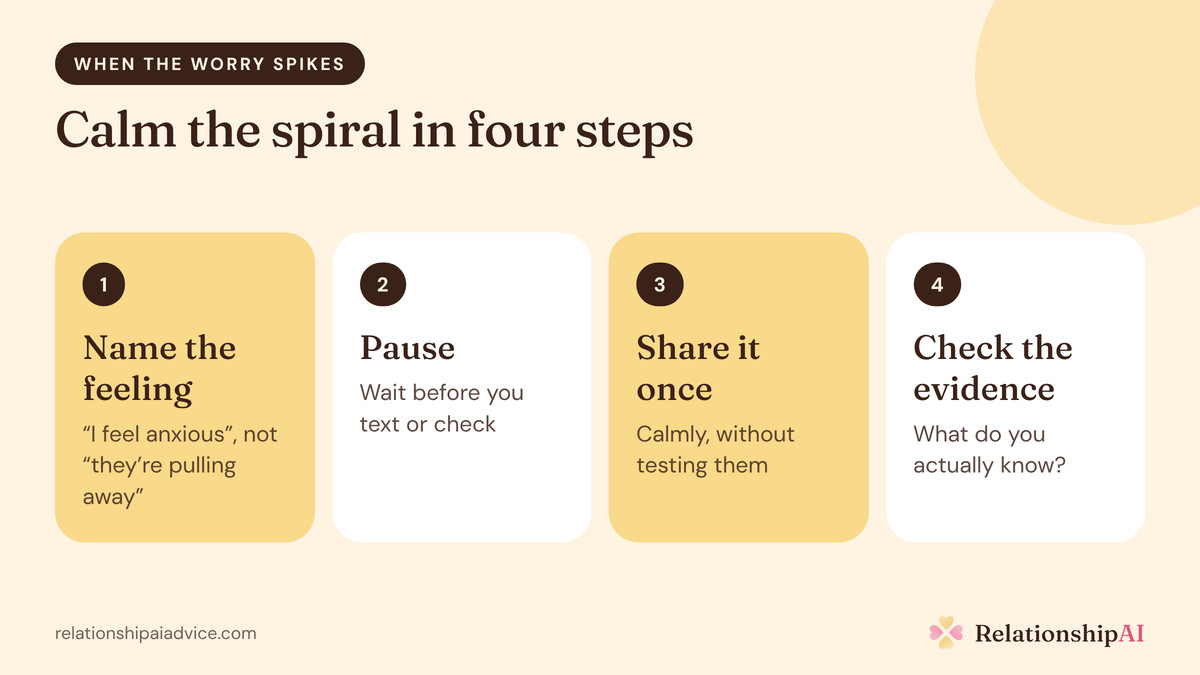
1. Name it. Say to yourself: "This is anxiety." Not "this is a sign". Naming the feeling as a feeling creates a little distance from the story.
2. Breathe it down. Two slow inhales through the nose (one full, one small top-up), then a long, slow exhale through the mouth. Repeat for one to two minutes. That's the cyclic sighing from the Stanford study.
3. Write three other explanations. "No reply for three hours" could mean: in a meeting, phone on silent, just not thinking about texting. If you can't think of three, ask: what would I tell a friend in this situation?
4. Don't send anything yet. Give it ten minutes. If the message still feels important after that, send it once, calmly.
Step 4 is the one I'd underline. Ten minutes doesn't sound like much, but a message you'd regret sending usually looks very different ten minutes later.
The rest of the day: stopping the loop from growing
Notice the reassurance loop. Asking "are we okay?" brings relief for an hour, and then the doubt comes back, often stronger. Research on reassurance-seeking (explained in our guide to trust issues) suggests frequent reassurance-seeking is linked to lower trust over time. Instead of asking for reassurance, ask for something specific. Instead of: "Are you sure you're not annoyed with me?"
“I'm feeling a bit wobbly today. Could we have dinner together tonight?”
Give worry a time slot. Pick 15 minutes later in the day as your "worry time". When a worry comes before then, write it down and tell yourself: "Later." Many worries look smaller by then, or have resolved on their own.
Do something that's yours. A walk, a call with a friend, an hour of a hobby. Anxiety shrinks your world down to the relationship. Widening it back out helps.
Watch out for "testing". Going quiet to see if they notice, or mentioning an ex to see if they're jealous, feels protective but tends to create the distance you're afraid of. Ask for what you actually need instead.
| When this happens | Try this |
|---|---|
| No reply for a while | Name it, breathe, list three other explanations |
| Urge to ask "are we okay?" again | Wait 10 minutes, then ask for something specific |
| A text reads as cold | Read it as if a friend had sent it |
| You want to test them | Say the need directly |
| A good moment feels scary | Notice it, and let yourself enjoy it anyway |
The next month: changing the pattern
Tell your partner once, calmly. Not as an accusation, as information. One way to put it: "I've realized I get anxious about us sometimes, especially when we're apart. It's not about anything you've done. It helps me a lot when you text if you're going to be late."
A partner who understands what's going on can help without being on call 24/7.
Collect evidence, not reassurance. Once a week, write down three moments when your partner showed they care. Over time this retrains your attention toward what's real instead of what's feared.
Understand where it comes from. Relationship anxiety often has roots: past breakups, being cheated on, growing up with unpredictable care, or a more anxious temperament. Our guide to attachment styles can help you understand your pattern. And if it shows up as constant replaying, see how to stop overthinking in a relationship.
Notice if fear is keeping you somewhere. In research led by Stephanie Spielmann, people with a stronger fear of being single were more willing to settle for less responsive partners and to stay in relationships they weren't happy in. Anxiety doesn't only make good relationships feel shaky. It can also keep people in the wrong ones.
Get support if it's taking over. If anxiety affects your sleep, work or daily life, or you feel anxious in most areas, not just the relationship, a therapist can help a lot. Cognitive behavioral therapy and attachment-focused approaches both have good track records with anxiety.
Is it anxiety, or is something really wrong?
Sometimes your gut is picking up on something real. If your partner is inconsistent, hides things or regularly makes you feel unwanted, the problem may not be your anxiety. Our guides on breadcrumbing, emotionally unavailable partners and the avoidant attachment partner can help you tell the difference. And if something has really changed lately, these signs your partner is losing interest can help you look at it calmly.
A useful check: does the anxiety appear mostly when your partner does something specific, or does it appear even when they're being reliable and kind? The first may be information. The second is more likely your anxiety talking.
If a spiral hits late at night, you can talk it through in Coach Chat before it turns into a 1 am message, and check how a text will land before sending it.

Quick answers
Is relationship anxiety normal?
Yes, some worry is very common, especially early in a relationship or after past hurt. It becomes a problem when it's constant and starts to affect your wellbeing or the relationship.
Can relationship anxiety ruin a relationship?
It can strain one, mostly through behaviors like constant reassurance-seeking, testing or checking. Working on those behaviors makes a big difference.
Is relationship anxiety a sign I'm with the wrong person?
Not necessarily. Many anxious people are in good relationships. But if your partner is regularly inconsistent or dismissive, your anxiety may be responding to something real.
When should I see a therapist for relationship anxiety?
If it affects your sleep, work or daily life, if it's been going on for months, or if you notice the same pattern in every relationship.
This article is general information, not therapy or medical advice.
Sources
- LaFreniere, L. S., & Newman, M. G. (2020). Exposing worry's deceit: Percentage of untrue worries in generalized anxiety disorder treatment. Behavior Therapy, 51(3), 413-423. Full text on PubMed Central
- Balban, M. Y., et al. (2023). Brief structured respiration practices enhance mood and reduce physiological arousal. Cell Reports Medicine. Summary from Stanford Medicine
- Chopik, W. J., Edelstein, R. S., & Grimm, K. J. (2019). Longitudinal changes in attachment orientation over a 59-year period. Journal of Personality and Social Psychology. Summary by the British Psychological Society
- Spielmann, S. S., MacDonald, G., Maxwell, J. A., Joel, S., Peragine, D., Muise, A., & Impett, E. A. (2013). Settling for less out of fear of being single. Journal of Personality and Social Psychology, 105(6), 1049-1073. Summary on ScienceDaily
- Evraire, L. E., Dozois, D. J. A., & Wilde, J. L. (2022). The contribution of attachment styles and reassurance seeking to trust in romantic couples. Europe's Journal of Psychology, 18(1), 19-39. Read the study