

Shorter replies. Fewer plans. Less touch. When you notice your partner pulling back, your mind usually jumps to one explanation: they're falling out of love. Sometimes that's true. Often it isn't. The same signal can come from stress, depression, a phone habit or a relationship that has slowly gone on autopilot.
This guide decodes the most common signs, one by one, with the likely explanations for each. First, what research says actually predicts a relationship fading, because it isn't what most people expect.
The short answer: Signs your partner may be losing interest include shorter replies, less touch, fewer plans and less curiosity about your life. Each can also come from stress, depression or a busy season. Look for a lasting pattern rather than one bad week, check your own anxiety, and then ask calmly.
What actually predicts a relationship fading
It's usually not the fights. In the PAIR Project, Ted Huston and colleagues followed 168 couples from their wedding day for 13 years. What best predicted distress and divorce wasn't conflict. It was the loss of early love and affection, especially in the first two years. Couples don't usually argue their way out of love. They drift.
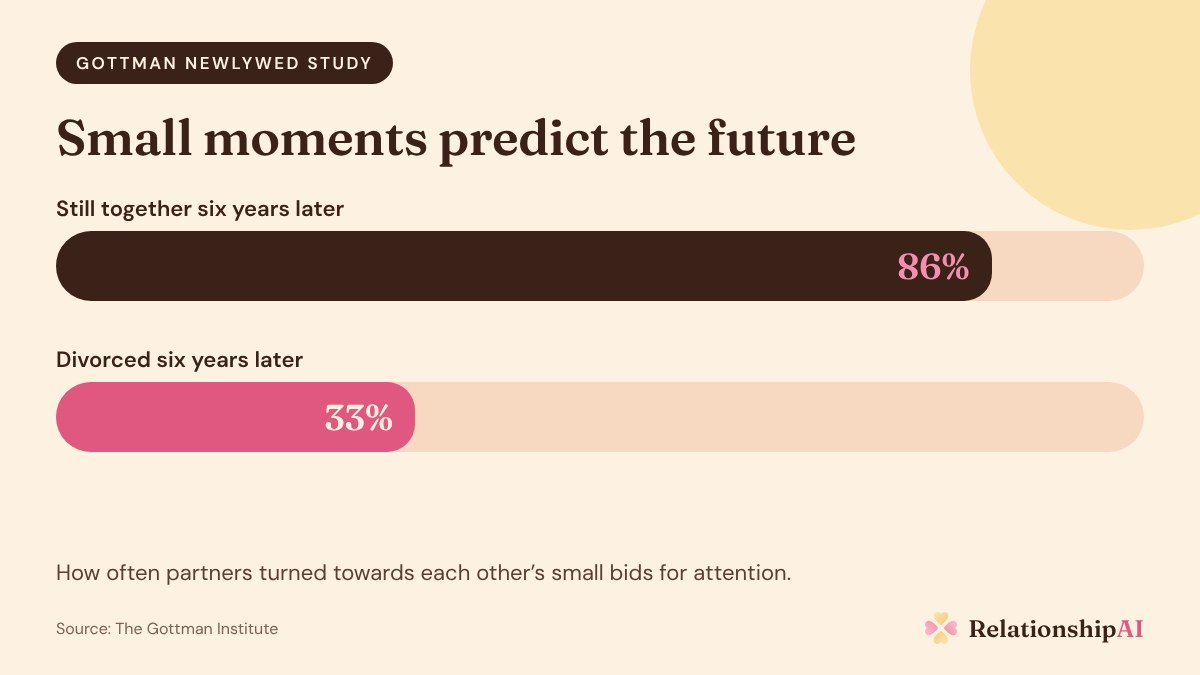
It shows up in small moments. John Gottman's research on newlyweds looked at "bids": small attempts to connect, like a comment, a question or a touch. Couples still together six years later had turned toward each other's bids 86% of the time. Couples who later divorced had done so only 33% of the time.
The phone plays a part. In a 2016 study of US adults, James Roberts and Meredith David found that 46% said their partner "phubbed" them (paid attention to their phone instead of them), and that feeling phubbed was linked to more conflict and lower relationship satisfaction. A 2025 meta-analysis pooling 52 studies and almost 20,000 people confirmed the pattern: partner phubbing went with lower relationship satisfaction and more conflict.
So the signs worth watching are not dramatic. They're the small daily ones. That's also good news: small things are fixable.
Quick quiz: Sometimes distance means a need isn't being met. The free 2-minute relationship check-up quiz can help you name which one.
The signals, decoded
Shorter, slower texts
Could mean: a busy or stressful period. A shift from "new relationship" texting to normal life. Or genuine disinterest. Look at: whether they're still engaged when you're actually together. Texting habits change naturally after the first months. In-person attention is the better measure.
Fewer plans, less initiative
Could mean: exhaustion, money worries, low mood, assuming you'll plan. Or losing interest. Look at: whether they say yes, and show up properly, when you suggest something. Someone tired still enjoys time together. Someone checked out tends to decline or seem elsewhere.
Less physical affection
Could mean: stress, a medical issue, medication, body image worries, resentment about something unspoken. Or fading attraction. Look at: whether all closeness has dropped, or just sex. A drop in sex with warmth intact often points to stress or health. A drop in all affection, including hugs and small touches, is more significant.
Irritated by small things
Could mean: stress spilling over (stress makes people more reactive to everyday relationship moments), unspoken resentment, or contempt starting to grow. Look at: whether they're irritable with everyone or mainly with you. Our guide on supporting your partner when they're stressed helps if it's the former.
Less curiosity about your life
Could mean: they're consumed by something of their own, or depressed. Or they've emotionally withdrawn. Look at: the bids. When you share something, do they turn toward you (ask, react, engage), ignore it, or turn against it with irritation? A pattern of turning away matters more than any single moment.
More time apart, by choice
Could mean: a healthy need for space, a new hobby or friendship, avoidance of a problem at home, or someone else. Look at: whether the time apart is open and shared ("I've joined a climbing group, come along sometime") or secretive and defensive.
Flat, low, uninterested in everything
Could mean: depression. Withdrawal, low energy and losing interest in things that used to bring joy are core features of depression, and they can look exactly like losing interest in a partner. Look at: whether it's only you, or work, friends, hobbies and food too. If it's everything, the conversation to have is about their wellbeing, not your relationship.
They avoid all conflict
Could mean: they've given up trying to be understood, which is worrying. Or they're conflict-averse and things feel fine to them. Look at: whether they still share opinions and preferences in general. Someone who has stopped caring stops disagreeing because the outcome doesn't matter to them anymore.
| If you see mostly... | It may be... | Start with... |
|---|---|---|
| Changes everywhere, not just with you | Stress or depression | Asking how they are, not how you are |
| Phone always in hand | A habit, not a verdict | A phone-free hour together |
| Warmth intact, less sex | Health, stress or a mismatch | A gentle, private conversation |
| Turning away from most bids, little warmth | Real emotional distance | An honest conversation about the relationship |
Before you talk: check your own lens
If you lean toward anxiety in relationships, a normal busy week can feel like rejection. Ask yourself: have they changed, or has my worry level changed? Our guides on relationship anxiety and how to stop overthinking help you separate the two.
I'd spend real time on this step. A busy month and a fading relationship can look identical from the inside, especially if you're already worried.
What to say
Lead with what you notice and how you feel, not with a conclusion.
“You obviously don't care about me anymore." You could say: "I've noticed we haven't had much time together lately and I miss you. How are you doing, honestly?”
“Are you losing interest?" Something like: "Things have felt a bit distant between us. Is something on your mind, about us or anything else?”
Then listen. Their answer might be about work, health, something you did, or the relationship. Each needs a different response, and you won't know which until you ask.
And turn toward them, on purpose, in small ways: respond to their bids, put your own phone away, suggest something you both used to enjoy. Huston's research suggests that protecting affection is what keeps couples together, so don't wait for them to go first. Our list of deep questions to ask your partner can help restart real conversations.
If it really is the relationship
Sometimes the honest answer is that they've drifted, or that they're unsure. That hurts, but it's information you can work with. Many couples find their way back with effort on both sides, sometimes with a couples therapist. If your partner says they don't know how they feel, give it a little time, but not unlimited time. Our guides on emotionally unavailable partners and whether to break up may help you decide what you need.
If you're dreading that first conversation, you can plan it in Coach Chat and rehearse it in Partner Practice first.

Quick answers
What are the signs my partner is losing interest?
Turning away from small attempts to connect, less affection, less curiosity about your life, fewer shared plans and more distance by choice, especially when it's specific to you rather than everything in their life.
Is it normal for a partner to be distant sometimes?
Yes. Stress, illness, work and low mood all create temporary distance. A short phase is normal. A long, unexplained pattern is worth talking about.
Should I give them space or pursue them?
Do a bit of both: give space to breathe, but don't go silent. Gently say what you notice and that you're there. Chasing and interrogating usually backfire.
Could it be depression rather than losing interest?
Yes. If they've lost interest in many things, not just you, and seem flat or low most days, depression may be part of it. Encourage them to talk to a doctor or counselor.
This article is general information, not therapy or medical advice.
Sources
- Huston, T. L., Caughlin, J. P., Houts, R. M., Smith, S. E., & George, L. J. (2001). The connubial crucible: Newlywed years as predictors of marital delight, distress, and divorce. Journal of Personality and Social Psychology, 80(2), 237-252. Summary in Psychology Today
- Roberts, J. A., & David, M. E. (2016). My life has become a major distraction from my cell phone: Partner phubbing and relationship satisfaction among romantic partners. Computers in Human Behavior, 54, 134-141. Summary on ScienceDaily
- Ni, N., Ahrari, S., Zaremohzzabieh, Z., Zarean, M., & Roslan, S. (2025). A meta-analytic study of partner phubbing and its antecedents and consequences. Frontiers in Psychology, 16, 1561159. Read the study
- Neff, L. A., & Karney, B. R. (2009). Stress and reactivity to daily relationship experiences: How stress hinders adaptive processes in marriage. Journal of Personality and Social Psychology, 97(3), 435-450. Full text (PDF)
- Gottman Institute: An introduction to emotional bids and trust