

Most lists of deep questions to ask your partner hand you 100 questions and stop there. But anyone who has tried one over dinner knows the question is the easy part. What happens in the next ten seconds, how you react to the answer, decides whether your partner opens up further or quietly closes the door.
So this guide gives you 30 well-chosen questions, sorted by how deep they go and where they work best. Then it covers the part most lists skip: how to respond so the conversation actually goes somewhere.
The short answer: Good deep questions to ask your partner start easy and get more personal step by step: memories, hopes, fears, and what you want for your future together. How you respond matters even more than the question, so listen, ask a follow-up, and share something of your own in return.
Two things research says before you start
Deep talk goes better than people expect. In 12 experiments with more than 1,800 people, Michael Kardas, Amit Kumar and Nicholas Epley found that people consistently expected deep conversations to be more awkward and less enjoyable than they turned out to be, and underestimated how interested the other person would be in what they had to say. Those experiments were mostly between strangers, but the lesson carries over: the awkwardness you're bracing for is usually smaller than you think.
The response matters as much as the question. In diary studies of thousands of everyday interactions, Jean-Philippe Laurenceau, Lisa Feldman Barrett and Paula Pietromonaco found that conversations felt most intimate when people shared feelings (not just facts) and when they felt their partner was responsive: understanding, accepting and caring. Sharing alone wasn't enough. Feeling heard was what turned sharing into closeness.
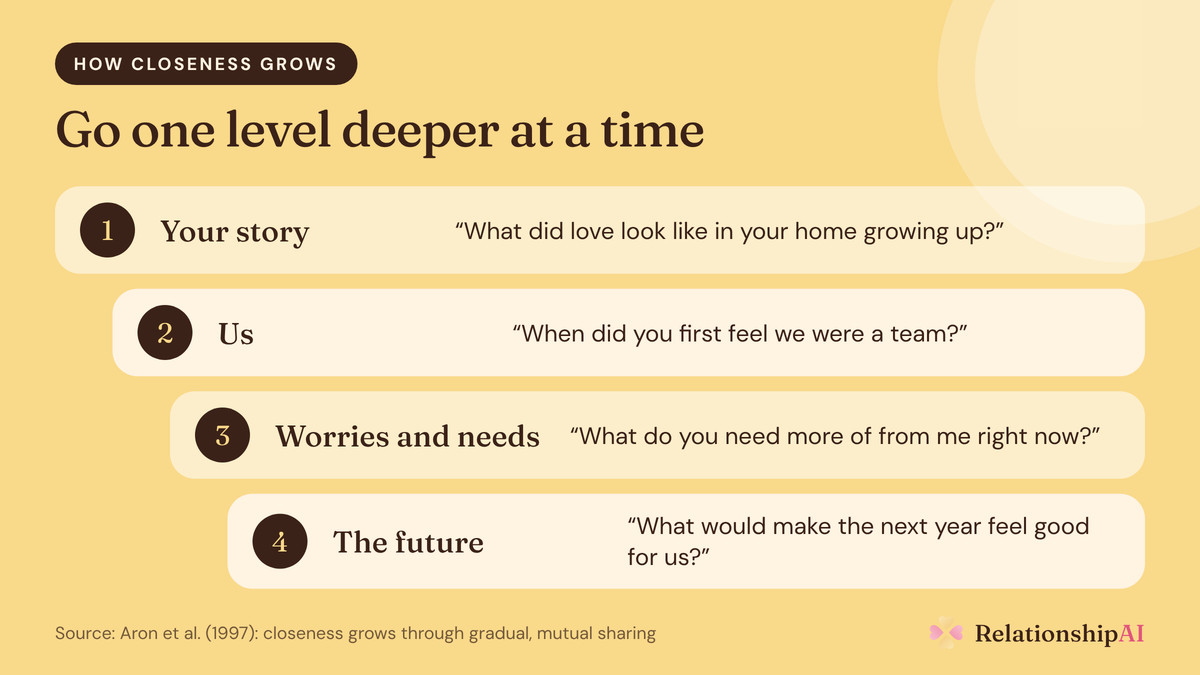
And yes, the idea of building closeness through gradually deeper questions has a famous origin: Arthur Aron's "36 questions" study, in which pairs of strangers who took turns answering increasingly personal questions felt much closer afterwards. The questions below use the same principle: start lighter, go deeper step by step.
Level 1: Easy and warm
Good for: a walk, a long drive, the first time you try this.
- What's a small thing that made you happy this week?
- What's a smell or song that instantly takes you back somewhere?
- If you could relive one ordinary day from your life, which would it be?
- What were you obsessed with as a kid?
- What's something you're quietly proud of that you rarely mention?
- Who was the first person who made you feel really understood?
- What's a place you'd love to show me one day, and why?
Level 2: Getting personal
Good for: a relaxed evening, a dinner without phones.
- When in your life did you feel most like yourself?
- Who taught you the most about love, for better or worse?
- What's a turning point in your life I might not know enough about?
- What do you wish people understood about you without you having to explain?
- What's something you changed your mind about in the last few years?
- What does a really good day look like for you now, compared with five years ago?
- When do you feel most appreciated by me?
- What's something we used to do that you miss?
Level 3: Vulnerable
Good for: a calm, private moment when you both have time. Not in the middle of a conflict.
- What's something you're worried about that you haven't said out loud?
- When do you feel most alone, even when I'm nearby?
- What's a part of yourself you find hard to show people?
- What do you need more of from me right now, and what do you need less of?
- What's something from your past that still affects how you react to things?
- What makes you feel safe enough to be honest with me?
- Is there something you've wanted to tell me but haven't found the moment for?
Level 4: Us and the future
Good for: a quiet weekend morning, an anniversary, the start of a new year.
- What would you like us to protect, no matter how busy life gets?
- What's one thing you'd like us to try or learn together?
- What does a good life look like for you in ten years?
- What's a habit of ours you'd love to keep forever?
- What's something you'd like to be braver about, and how can I help?
- If we could have one honest conversation we've been avoiding, what would it be about?
- What would make this year feel meaningful for you?
- What's one thing about us you never want to take for granted?
How to respond so they keep talking
This is where most deep conversations are won or lost. Based on what responsiveness research suggests helps people feel understood, accepted and cared for:
Ask one follow-up before you share your own story. "What was that like?" or "What made it stick with you?" shows you were listening, not waiting for your turn.
Reflect the feeling, not just the facts. They say: "My dad never came to my football games." Instead of: "Oh, my dad was the same."
“That sounds like it really hurt. Did you notice it at the time, or only later?”
Don't fix, judge or correct. Deep answers are not invitations for advice. "Have you tried talking to him about it?" can wait for another day.
Thank them. "Thanks for telling me that" is short, warm and makes the next deep answer more likely.
Let silence happen. A pause after a vulnerable question is usually thinking, not refusal.
If you remember one thing from this list, make it the follow-up question. Asking a deep question is easy. Staying curious about the answer is where the closeness actually comes from.
When the answer is hard to hear
Sometimes a deep question uncovers something painful: a need that isn't being met, an old hurt, a worry about the relationship. That's not a sign the question was a mistake. It's the point. Stay calm, thank them for being honest, and ask for time if you need it.
“I'm really glad you told me. I need a little while to think about it. Can we come back to it tomorrow?”
If an answer leads to a disagreement, our guide on communication habits can help keep it from escalating.

Make it a habit, not a one-off
One deep evening is lovely. A small habit is what actually changes a relationship. Some couples pick one question every Sunday morning, or keep a list on their phone for long drives. For lighter, more playful questions, see our date night questions for couples. If you're far apart, they work beautifully on video calls too, see our long distance relationship tips. And if you're about to meet the family, a few Level 2 questions about their childhood will help you before meeting your partner's parents.
Quick answers
What is a good deep question to ask your partner?
A good deep question is open and personal, but not interrogating.
“What's something you've changed your mind about in the last few years?”
or "When do you feel most like yourself with me?" Start lighter and go deeper as the conversation warms up.
What are the 36 questions to fall in love?
They come from a 1997 study by psychologist Arthur Aron, in which pairs of strangers took turns asking increasingly personal questions. The pairs felt noticeably closer afterwards. The key was gradual, mutual sharing, which is the same idea this list uses.
How often should couples have deep conversations?
There is no fixed number, but a small regular habit works better than a rare marathon. One question over Sunday breakfast or on a long walk is plenty. For more ways to keep things fresh, see our guide on how to keep the spark alive.
What if my partner doesn't like deep questions?
Start with the lighter levels, or make it playful with a game like the ones in our date night questions. Some people open up more while doing something side by side, like cooking or driving, than face to face.
This article is general information, not therapy or medical advice.
Sources
- Kardas, M., Kumar, A., & Epley, N. (2022). Overly shallow? Miscalibrated expectations create a barrier to deeper conversation. Journal of Personality and Social Psychology, 122(3), 367-398. Summary from the American Psychological Association
- Laurenceau, J.-P., Barrett, L. F., & Pietromonaco, P. R. (1998). Intimacy as an interpersonal process: The importance of self-disclosure, partner disclosure, and perceived partner responsiveness in interpersonal exchanges. Journal of Personality and Social Psychology, 74(5), 1238-1251. Full text (PDF)
- Aron, A., Melinat, E., Aron, E. N., Vallone, R. D., & Bator, R. J. (1997). The experimental generation of interpersonal closeness: A procedure and some preliminary findings. Personality and Social Psychology Bulletin, 23(4), 363-377.
- Association for Psychological Science: Fast-tracking intimacy