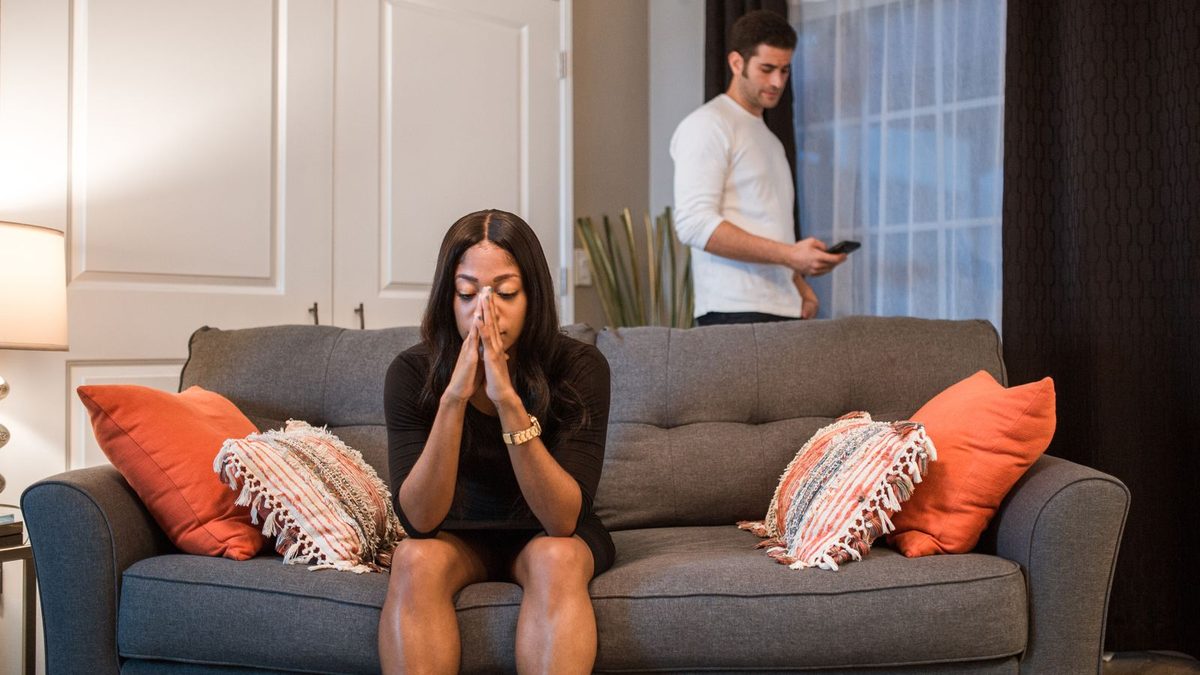

Here is a finding that surprises most people. In a classic study of couples where one partner was preparing for a major exam, the support that helped the most was often support the stressed partner didn't even notice. The other partner had done something helpful, but the stressed partner hadn't registered it as "being supported".
That says a lot about how to help someone who's under pressure. Big, visible rescue missions can backfire. Quiet, well-matched help usually works better. This guide gives you words for the most common kinds of stress, plus the thinking behind them, so you can adapt rather than recite.
The short answer: To support your partner when they're stressed, ask what kind of help they want, listen more than you fix, and offer practical help without making a big deal of it. Research shows support that goes almost unnoticed often helps most, because it doesn't make the stressed person feel weak or in debt.
The support paradox
Niall Bolger, Adam Zuckerman and Ronald Kessler followed couples through a stressful period with daily diaries. They found that when the stressed partner was clearly aware of receiving support, it didn't always help them feel better, and sometimes went with feeling worse. When support happened without them noticing it as support, it went along with better adjustment.
Why? Being obviously helped can carry a hidden message: you can't cope on your own. It can also make you feel indebted at the exact moment you have nothing left to give.
What this means in practice: the most useful help is often practical and low-key. Doing the dishes without announcing it. Handling the call to the landlord. Making the evening easy rather than making a speech about how much you're there for them.
Quick quiz: Do you comfort by fixing, listening, hugging or lightening the mood? The free 2-minute comfort style quiz shows your default and how to adjust it.
This is the finding I'd most want people to know about support. The urge is to make it visible, to show you care. Often the kindest thing is the help they barely notice.
Stress makes small things feel big
Lisa Neff and Benjamin Karney studied newlywed couples over several years and found that when people were under more stress than usual, their relationship satisfaction swung more with each good or bad day together. Stress seems to use up the mental energy we normally use to keep small problems in perspective.
So if your stressed partner snaps about the towel on the floor, it probably isn't about the towel. Knowing this makes it much easier not to take it personally, and not to start a fight about tone at the worst possible moment.
The good news comes from a 2021 study by Paula Pietromonaco, Nickola Overall and Sally Powers. Following more than 200 newlywed couples, they found that stress was linked to relationship quality dropping over time, except when the partner was highly responsive: listening, trying to understand, and recognizing what was needed. With a responsive partner, the stressed person's relationship looked much like that of people with low stress.
What to say, by type of stress
Use these as starting points, not scripts. The best line is the one that sounds like you.
Work stress
When they come home wound up:
“Long day? Do you want to tell me about it, or do you want an hour of not thinking about it?”
When they're stuck on a problem:
Skip: "Just quit then", "At least you have a job", or a ten-step plan nobody asked for.
Family stress
When their family is the source:
“You don't have to defend them to me, and you don't have to attack them either. I'm just on your side.”
“Do you want me to come with you, or would it be easier if I stayed out of it?”
Skip: piling on with your own criticism of their family. They can criticize their mom. It lands very differently when you do it. If the pressure peaks around visits, our guides on meeting your partner's parents and holidays with your partner's family have words for those moments.
Deadlines and exams
- "What can I take off your plate this week?"
- "I'll handle the weekend plans. You focus."
- A quiet cup of tea on the desk, no comment needed. (This is the invisible support from the study, in practice.)
Skip: "You should have started earlier." Even if it's true, it isn't useful now.
Burnout and the long grind
Burnout isn't one bad day, so one good evening won't fix it.
“You've been running on empty for weeks. I'm worried about you. What would make next week ten percent lighter?”
If it goes on for a long time or they seem low most days, gently raise the idea of talking to a doctor or counselor: "You don't have to figure this out alone. Would you be open to talking to someone?"
When they take it out on you
Support doesn't mean absorbing everything. You can be kind and clear at the same time.
“I can tell you're really stressed, and I want to help. I'm not okay with being snapped at, though. Can we try that again?”
“I'm going to give you a bit of space. I'm not angry, I'll check in later.”
Over text, when you're apart
The "no need to reply" matters. It gives comfort without adding a task.
Match the support to the person
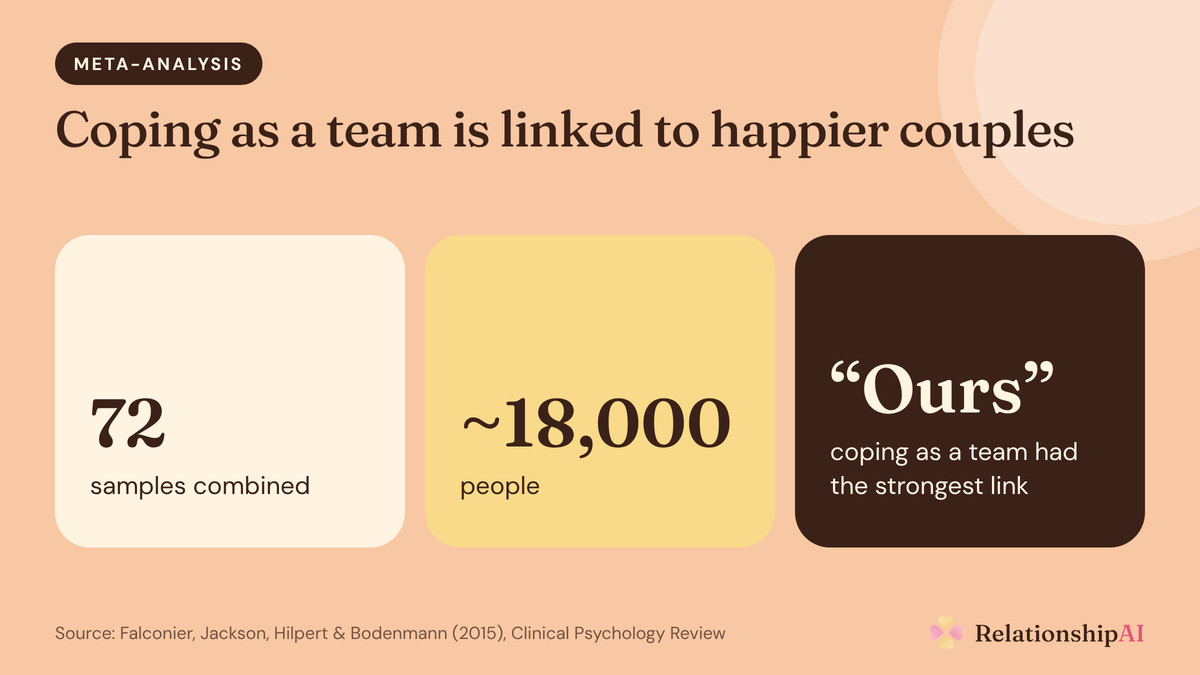
Couples researchers who study dyadic coping (how partners deal with stress together) have found that the way a couple handles stress is closely tied to how satisfied they are overall. A large review by Mariana Falconier and colleagues, combining data from dozens of studies, found that positive ways of coping together went with higher relationship satisfaction, and negative ones, like dismissive or hostile reactions, with lower.
But "positive" looks different for different people. Some people want to talk it all out. Others want a distraction. Some want help with the practical load, others feel controlled by it. The simplest fix is to ask once, on a calm day:
"When you're really stressed, what helps you most, and what makes it worse?"
Then remember the answer. That one conversation will make you a better support than any list.
Look after yourself too
Stress spreads. If you absorb every bad mood and drop your own life to manage theirs, you'll run out too. Keep your own friends, sleep and routines. Being a steady presence helps them more than being a worn-out one.
If you notice you've started to feel responsible for their every feeling, our guide on the difference between caring and codependency may be useful.
When it's your stress
Support works both ways. You can make it much easier for your partner to help:
- Say what's going on: "Work is really heavy this week. If I'm quiet, that's why."
- Say what you need: "I don't need advice, I just need a hug."
- Notice the effort: even clumsy support deserves a thank-you.
If stress is leading to more arguments, a few communication habits can stop small fights from escalating. If something hurtful was said, our guide on how to apologize to your partner helps you repair it.
If you're not sure what to say, you can think it through in Coach Chat, or run a text past Message check before you send it.
Quick answers
What should I say to my partner when they're stressed?
Start with "Do you want to talk about it, or would a distraction help more?" Then follow their lead. Short, warm and practical beats long and clever.
What should I avoid saying to someone who's stressed?
Advice nobody asked for, "it could be worse", "just relax", and anything that starts with "you should have".
How do I support my partner without taking on their stress?
Help with specific, limited things, keep your own routines, and let them own their problem. You can be on their side without carrying it for them.
What if my partner shuts me out when they're stressed?
Some people cope by withdrawing. Say you're there, leave the door open, and help practically. If the silence lasts for weeks, raise it gently on a calmer day.
When should a stressed partner get professional help?
If stress lasts for weeks, affects sleep, eating or work, or they seem hopeless, encourage them to talk to a doctor or counselor. If they mention not wanting to live, contact emergency services or a crisis line right away.
A note on safety
Stress can explain a bad mood. It never excuses threats, intimidation or violence. If your partner's stress turns into behavior that makes you afraid, please contact a local domestic abuse helpline or support service.
In the US, you can reach the National Domestic Violence Hotline at 1-800-799-7233, by texting START to 88788 or at thehotline.org, and the 988 Suicide & Crisis Lifeline by calling or texting 988. Outside the US, contact a local helpline.
This article is general information, not therapy or medical advice.
Sources
- Bolger, N., Zuckerman, A., & Kessler, R. C. (2000). Invisible support and adjustment to stress. Journal of Personality and Social Psychology, 79(6), 953. Harvard Medical School record
- Neff, L. A., & Karney, B. R. (2009). Stress and reactivity to daily relationship experiences: How stress hinders adaptive processes in marriage. Journal of Personality and Social Psychology, 97(3), 435-450. Full text (PDF)
- Pietromonaco, P. R., Overall, N. C., & Powers, S. I. (2021). Social Psychological and Personality Science. DOI, summary from UMass Amherst
- Falconier, M. K., Jackson, J. B., Hilpert, P., & Bodenmann, G. (2015). Dyadic coping and relationship satisfaction: A meta-analysis. Clinical Psychology Review, 42, 28-46. Read the paper