

Most long distance relationship tips focus on the time apart: video calls, care packages, watching films in sync. That matters. But research points to a part of long distance that gets far less attention and causes a surprising number of breakups: the moment you finally live in the same place.
This guide covers all three phases. First, some reassurance, because the data on long distance is better than its reputation.
The short answer: Long distance relationships work best with a shared reason and a rough end date, a contact rhythm that suits you both, sharing everyday life, and always knowing when you'll see each other next. Keep visits relaxed and real, and plan carefully for the move to the same city, which is often the hardest part.
The good news: long distance isn't the problem people think
In a nationally representative US study of 870 people, Gretchen Kelmer and colleagues found that people in long-distance relationships reported higher relationship quality on several measures, more dedication and less feeling of being "trapped" than people living close to their partner. At follow-up, they had broken up at about the same rate.
A Canadian study of more than 1,000 people in relationships, by Emma Dargie and colleagues, found few differences between long-distance and close-by couples, including in sexual satisfaction, with long-distance couples doing slightly better in some areas. Two things went with happier long-distance partners: a positive belief that long distance can work, and being fairly confident they would eventually live in the same city.
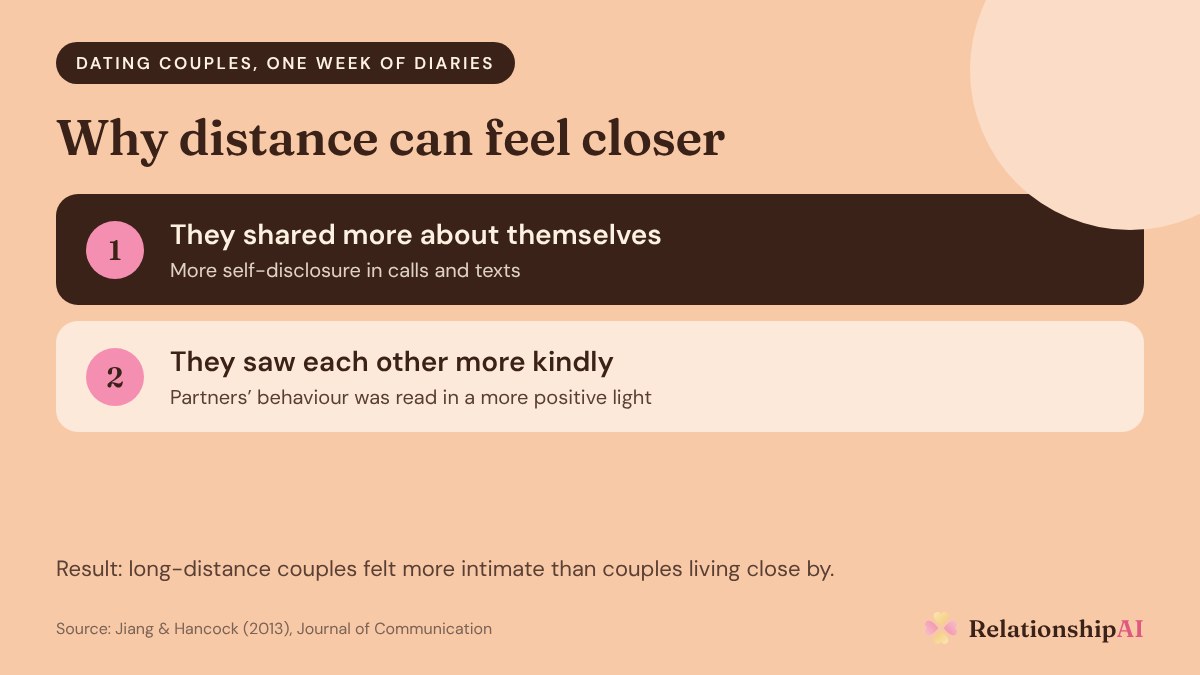
And in a study by Crystal Jiang and Jeffrey Hancock, long-distance couples felt more intimate after their daily conversations than close-by couples, partly because they shared more personal things and tended to see each other's messages in a generous light.
So the odds are fine. The question is how to use each phase well.
The same habits seem to keep both kinds of couple happy. In a 2021 study of 232 young adults in long-distance relationships and 263 in geographically close ones, Kaitlyn Goldsmith and Sandra Byers found that maintenance behaviors such as staying in touch, talking about the future and thinking fondly of each other were linked to higher satisfaction in both groups, in much the same way.
Phase 1: while you're apart
Agree on the "why" and the "until when"
The single clearest predictor in the Canadian research was a shared sense that the distance will end. You don't need a date in the calendar on week one. You do need to talk about it.
“I don't need a fixed plan yet, but I'd love us to talk about what closing the distance could look like in a year or two.”
Find a rhythm, not a rulebook
Some couples love a long call every night. Others prefer short messages through the day and one proper call at the weekend. Neither is better. What hurts is a mismatch nobody talks about.
“What amount of contact makes you feel close without feeling like a chore?”
Share the boring stuff
Jiang and Hancock's finding is useful: closeness at a distance comes from sharing what's actually going on, not from performing romance. A photo of your terrible lunch can do more than a long love letter.
Have hard conversations on a call
Text strips out tone and invites worst-case readings. If something bothers you, say "Can we talk about something tonight?" and do it with voices, ideally faces. If worries tend to grow in the silence between messages, our guides on relationship anxiety and trust issues can help.
Always know when you'll see each other next
A date on the calendar turns "I miss you" from a weight into a countdown.
Phase 2: during visits
Lower the pressure on "perfect"
When you only have three days, every hour feels like it has to be wonderful. That pressure is one reason first evenings so often end in a fight. Plan one or two nice things and leave lots of ordinary time: cooking, errands, being bored together on the sofa.
Practice real life, not just holiday life
In a study of long-distance dating couples, Laura Stafford and Andy Merolla found that partners apart idealized each other more: more romantic, more reminiscing, more sense of agreement, and the less often they saw each other face to face, the stronger the idealization. That feels lovely, but it can hide real differences. Visits are your chance to see each other tired, busy and grumpy. Do some boring weekdays together if you can.
Don't save every problem for the visit
If you've been holding a difficult conversation for "when we're together", the visit becomes tense before it even starts. Deal with the main issues on calls, and use visits for connection.
Phase 3: when you close the gap
This is the part most guides skip, and research says it matters. In Stafford and Merolla's study, long-distance couples were more stable than close-by couples while they were apart, but a good number broke up after they moved to the same place. Longer gaps between visits and very strong idealization during the distance predicted that instability.
Why? Because suddenly you're dealing with each other's actual habits, schedules and moods every day, after months or years of best-version visits. Plus one of you has usually moved, and may be lonely, jobless or homesick.
Why the move can wobble even strong couples At a distance, your partner partly lives in your imagination, and imagination is generous. Living together replaces the imagined version with the real one, all at once. Nothing has gone wrong. You're just meeting the everyday person, and building a new routine from scratch while one of you is often far from friends and family.
How to make the landing softer:
Talk about the practical stuff before the move. Money, chores, alone time, how much you'll socialize. Our guide on how to talk about money with your partner helps with the trickiest one.
Protect the mover's independent life. The person who moved needs their own friends, work and routines quickly, or they'll lean on the relationship for everything.
Expect a dip, and name it.
“This is harder than I thought it'd be. I don't think it means we're wrong for each other. I think we're just adjusting.”
Keep some long-distance habits. The weekly proper conversation, the small shared rituals. They don't have to stop just because you share a postcode.
I think this is the most underrated part of long distance. Couples plan for years to be in the same city and then spend almost no time planning what that will actually look like.
Long distance over the holidays
Holidays can be the hardest weeks apart, and the most complicated together, especially with two families involved. Our guide on holidays with your partner's family covers how to plan it as a team. For call ideas when conversation runs dry, try our deep questions to ask your partner, or turn a video call into a game night with our date night questions.

Quick answers
Do long distance relationships work?
Often, yes. Studies find long-distance couples are, on average, about as satisfied and about as likely to stay together as couples who live close by.
How often should you talk in a long distance relationship?
As often as feels good to both of you. Agree on a rhythm and adjust it. A mismatch nobody mentions hurts more than the amount itself.
What's the hardest part of a long distance relationship?
Many people say the time apart, but research suggests the move to the same city is a real risk point too. Planning for that transition helps.
When should you close the distance?
When you both want it and can make it work practically. Feeling fairly sure you'll live in the same place one day is linked to happier long-distance relationships.
This article is general information, not therapy or medical advice.
Sources
- Kelmer, G., Rhoades, G. K., Stanley, S., & Markman, H. J. (2013). Relationship quality, commitment, and stability in long-distance relationships. Family Process, 52(2), 257-270. PubMed
- Dargie, E., Blair, K. L., Goldfinger, C., & Pukall, C. F. (2015). Go long! Predictors of positive relationship outcomes in long-distance dating relationships. Journal of Sex & Marital Therapy, 41(2), 181-202. Summary from the University of Florida
- Stafford, L., & Merolla, A. J. (2007). Idealization, reunions, and stability in long-distance dating relationships. Journal of Social and Personal Relationships, 24(1), 37-54. Abstract
- Jiang, L. C., & Hancock, J. T. (2013). Absence makes the communication grow fonder: Geographic separation, interpersonal media, and intimacy in dating relationships. Journal of Communication, 63(3), 556-577. Summary on ScienceDaily
- Goldsmith, K., & Byers, E. S. (2021). Sexual and Relationship Therapy. Summary on PsyPost