

Most people with trust issues know the checklist by heart: checking the phone, expecting the worst, needing reassurance, testing the partner. What's less obvious is why the usual fixes so often don't work, and why someone can get a hundred reassurances and still not feel safe.
This guide explains how trust actually forms, according to decades of relationship research, and the quiet loop that can keep doubt alive even in a loving relationship. Then it gives you a way out of the loop.
The short answer: Trust issues often come from past hurt, but they're kept alive by a loop: doubt, reassurance-seeking, short relief, then more doubt. Trust grows through repeated small acts of reliability and care. Check whether the doubt fits your partner's current behavior or older wounds, and work on the loop, not just the feeling.
What trust is made of
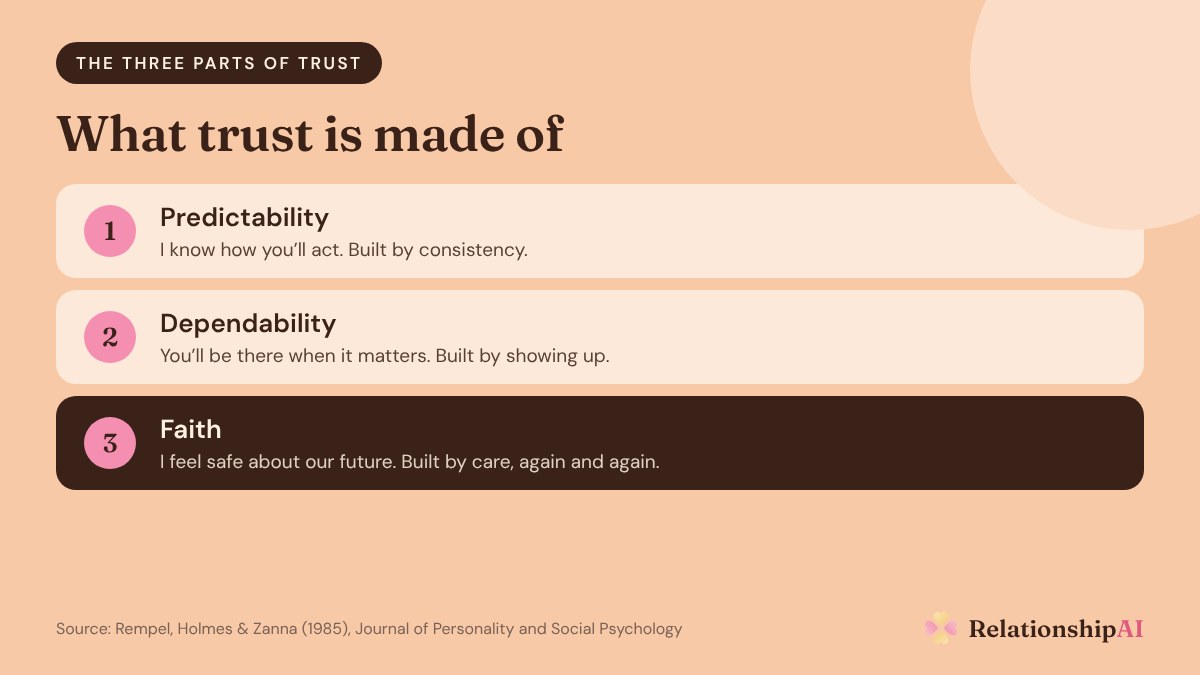
In a classic study, psychologists John Rempel, John Holmes and Mark Zanna described trust in close relationships as having three layers that build on each other:
- Predictability: your partner behaves in consistent ways. You know roughly what to expect.
- Dependability: you can count on them when it matters, especially when it costs them something.
- Faith: a deeper confidence that they'll be there in the future, even in situations you can't predict.
This is useful because trust issues usually sit in one layer more than the others. Some people trust that their partner is faithful (faith) but not that they'll show up on time (predictability). Others can count on daily reliability but still fear being left one day. Knowing which layer is shaky tells you what to work on.
How trust actually grows: small sacrifices
Here's the most practical finding in trust research. In two long-term studies of dating and married couples, Jennifer Wieselquist, Caryl Rusbult and colleagues found that people came to trust their partners when they saw them put the relationship ahead of their own immediate interests: staying calm instead of striking back in a fight, giving up something they wanted for the couple's sake.
They described a cycle. When one partner makes these small, costly choices, the other notices, trusts more, and becomes more willing to depend on the relationship, which in turn makes them more committed and more likely to make those choices too.
Trust, in other words, is not built by promises or by passing tests. It's built by seeing care that costs something.
Psychologists Shallcross and Jeffry Simpson tested this in the lab with "strain tests": conversations where one partner asks for something that costs the other, like moving cities for a job. Partners with high trust were more accommodating, and accommodated more when the sacrifice asked of them was bigger. Low-trust partners did the opposite.
The loop that keeps trust issues going
So why doesn't asking for reassurance fix things? Two studies explain it.
Reassurance can lower trust instead of raising it. In a 2022 daily diary study of 110 couples, Lyndsay Evraire and colleagues found that on days when people sought more excessive reassurance ("Do you still love me? Are you sure?"), they reported lower trust. For anxiously attached women in particular, more reassurance-seeking predicted lower trust the next day.
Once you show insecurity, you may start doubting the reassurance itself. In a series of studies, Edward Lemay and Margaret Clark found that people who felt they had shown their partner how insecure they were started to believe their partner saw them as fragile. Then they began to suspect that their partner's kind words weren't sincere, that the partner was just "walking on eggshells" around them. That made them feel less accepted, even when the partner's actual regard was positive.
Put together, it looks like this:
| Step | What happens |
|---|---|
| 1. Doubt | "What if they're losing interest?" |
| 2. Ask for reassurance | "Do you still love me?" |
| 3. Get reassured | "Of course I do." |
| 4. Short relief | Feels better for an hour or a day |
| 5. Discount it | "They only said that because I asked" |
| 6. Doubt returns, often stronger | Back to step 1 |
Nobody in this loop is doing anything wrong. Your partner is being kind. You're trying to feel safe. The loop is the problem, not either of you.
A quick self-check: past or present?
Before working on the loop, it helps to know whether your doubt is about this relationship or something older. Think about the last few times you felt distrust:
- Did your partner actually do something unreliable, secretive or hurtful? Or did a thought pop up without a clear trigger?
- Have you felt this way with previous partners or friends, too?
- Does your partner usually do what they say they'll do?
- When you've raised concerns, have they been open, or defensive and evasive?
If your partner is mostly reliable and you've felt this way before, the work is likely internal, often related to anxious attachment or relationship anxiety. If your partner has been repeatedly unreliable or dishonest, your distrust may be accurate information, not an issue to "fix" in yourself.
This check is the part I'd spend the most time on. So much of the advice about trust assumes the problem is the current partner. Often it's an old one.
How to break the loop
If you're the one struggling to trust
Swap reassurance questions for observations. Instead of asking "Do you still love me?", look for the evidence trust research says matters: moments when your partner chose the relationship over their own convenience. Write three down each week. It retrains your attention toward what's real.
Name the feeling once, then ask for something specific. Instead of: "Are you sure everything's fine with us?"
“I've been feeling a bit insecure this week. It would really help if we had a proper evening together on Friday.”
A specific request gives your partner a chance to show dependability. A vague question just restarts the loop.
Notice when you discount kindness. When the thought "they're only saying that" appears, label it: "That's the discounting thought." You don't have to believe it.
Stop checking. Checking phones or social media gives a moment of relief and then fuels more doubt. Our guide to jealousy in a relationship explains why checking backfires.
If your partner struggles to trust you
Be predictable in small ways: reply when you said you would, arrive when you said you'd arrive, follow through on small promises. That builds the first layer of trust. And when it's genuinely costly to you, choose the relationship once in a while, visibly but without making a speech about it.
“I can tell you've been feeling unsure. I want you to feel safe with me. What would actually help, apart from me saying it?”
If trust was broken in this relationship
When there's been a real betrayal, the loop above isn't the main issue. Trust needs to be rebuilt through transparency, consistency and time. Our guides on rebuilding trust after cheating and after a fight walk through that process, and how to apologize to your partner covers the first step.
When a wave of doubt hits late at night, writing it out first, in a journal or in Coach Chat, can help you pause the loop. If the patterns are long-standing or connected to past hurt, a therapist can help a lot.

Quick answers
What causes trust issues in a relationship?
Past betrayals, inconsistent care growing up, anxious attachment, or real unreliability in the current relationship. Often it's a mix.
Can trust issues be fixed?
Yes, in many cases. Trust grows when you notice a partner's reliable, caring actions over time, and when both partners break unhelpful loops like constant reassurance-seeking.
Does asking for reassurance help with trust issues?
Occasionally, yes. But frequent reassurance-seeking is linked to lower trust over time. Specific requests and noticing real evidence tend to work better.
Is it okay to check my partner's phone?
It usually makes trust issues worse, and it can damage trust from your side. Talking about what triggered the urge is more helpful.
When are trust issues a red flag?
When your distrust is a response to repeated lies, secrecy or inconsistency, it's information, not a flaw. And when a partner's "trust issues" are used to control you, that's a safety issue.
A note on safety
Distrust is sometimes used to justify controlling behavior: checking phones, tracking locations, restricting friends. If your partner does this, or makes you afraid, please contact a local domestic abuse helpline or support service.
In the US, you can reach the National Domestic Violence Hotline at 1-800-799-7233, by texting START to 88788 or at thehotline.org, and the 988 Suicide & Crisis Lifeline by calling or texting 988. Outside the US, contact a local helpline.
This article is general information, not therapy or medical advice.
Sources
- Rempel, J. K., Holmes, J. G., & Zanna, M. P. (1985). Trust in close relationships. Journal of Personality and Social Psychology, 49(1), 95-112.
- Wieselquist, J., Rusbult, C. E., Foster, C. A., & Agnew, C. R. (1999). Commitment, pro-relationship behavior, and trust in close relationships. Journal of Personality and Social Psychology, 77(5), 942-966. Full text (PDF)
- Shallcross, S. L., & Simpson, J. A. (2012). Trust and responsiveness in strain-test situations: A dyadic perspective. Journal of Personality and Social Psychology, 102(5), 1031-1044. Full text (PDF)
- Lemay, E. P., Jr., & Clark, M. S. (2008). "Walking on eggshells": How expressing relationship insecurities perpetuates them. Journal of Personality and Social Psychology, 95(2), 420-441. Full text (PDF).pdf)
- Evraire, L. E., Dozois, D. J. A., & Wilde, J. L. (2022). The contribution of attachment styles and reassurance seeking to trust in romantic couples. Europe's Journal of Psychology, 18(1), 19-39. Read the study