

If you've just found out, or just confessed, this probably feels like the end of the world. Here are two things research says that are worth knowing right now.
First, many couples do stay together. In a large 2026 survey of 3,429 people who had experienced infidelity, by Kathleen Nickerson, John Gottman and colleagues, most reported still being together with their partner. The sample came from people following affair-recovery therapists online, so it's more hopeful than the general population, but it shows what's possible.
Second, recovery isn't one moment of forgiveness. It's a process with recognizable stages. In a 2023 study, Stephen Fife and colleagues interviewed 16 couples who had stayed together after sexual infidelity and described their healing as meaningful. Their stories followed four stages: revelation, initial reactions, stabilizing, and revitalising. This guide walks through each one, with what each partner needs to do.
The short answer: Rebuilding trust after cheating usually goes through four stages: the revelation, intense reactions, stabilizing, and rebuilding a new relationship. The unfaithful partner needs to end the affair, answer questions honestly and stay consistent. The betrayed partner needs time and room to heal. It usually takes many months, often a year or more.
Stage 1: Revelation
Whether the affair was discovered or confessed, this is the moment the ground disappears.
For the betrayed partner: you don't need to decide anything today. Not whether to stay, not whether to forgive. Your only job is to get through the next days safely. Tell one trusted person. Sleep, eat, breathe. Strong reactions are normal: clinicians who specialize in affairs, like Donald Baucom, Douglas Snyder and Kristina Coop Gordon, describe infidelity as a traumatic event for the betrayed partner, with intrusive thoughts, hypervigilance and emotional swings that can last a long time.
For the unfaithful partner: this is where trust is either made worse or starts to be rebuilt. Tell the truth about the basics. Partial confessions that later turn out to be incomplete ("trickle truth") are often described by couples as more damaging than the affair itself.
One way to put it: "I did this. It's my responsibility, not yours. I'll answer your questions honestly."
Stage 2: Initial reactions
The first weeks and months are usually the most chaotic: anger, grief, questions at 2am, wanting details, not wanting details, wanting closeness, wanting distance, sometimes all in one day.
For the betrayed partner: you're allowed to ask questions. Many people need to understand what happened before they can think about why. It can help to separate questions that help you make sense of things ("How long did it last?", "Is it over?") from graphic details that may haunt you later. Ask yourself before each question: will knowing this help me heal, or hurt me more?
For the unfaithful partner: this is the hardest part of your job. Stay present for anger without getting defensive, and answer the same question again if it's asked again. The Nickerson study found that reparative actions mattered: reassurance, validating the betrayed partner's feelings, showing affection, answering questions, and cutting off contact with the affair partner. Among married or engaged couples where the unfaithful partner answered questions and cut contact, the large majority stayed together.
End the affair fully and visibly. No "closure" meetings, no secret messages. If you work together, decide together how to limit contact and be transparent about it.
Why repeated questions aren't a failure Betrayed partners often ask the same questions many times. It can feel to the unfaithful partner like the conversation is going in circles. It isn't. Each time the answer is the same, and given without irritation, the betrayed partner's mind gets a little more evidence that the truth is stable now. Consistency is how the first layer of trust, predictability, starts to grow back.
Stage 3: Stabilizing
Over time, things become less raw. Couples in the Fife study described this phase as assessing the damage, affirming their commitment to each other, and establishing accountability.
Transparency, without turning it into punishment. Many couples agree on a period of openness: shared phone access, letting each other know where you are, being reachable. This helps when it's offered freely. It hurts when it becomes permanent surveillance or a tool to punish. Agree on it together, and agree on when you'll review it.
Understanding why. At some point, both partners usually need to understand how the affair happened: what was going on in the relationship, in the unfaithful partner's life, and in their own choices. Baucom, Snyder and Gordon call this the "meaning" stage. Understanding is not excusing. The unfaithful partner is still fully responsible for the choice. But a 2023 study by Olga Stavrova and colleagues, using data from thousands of German adults followed over years, found that relationship and personal well-being often declined gradually before infidelity happened, for both partners. Looking at that slow drift honestly can show what needs to change.
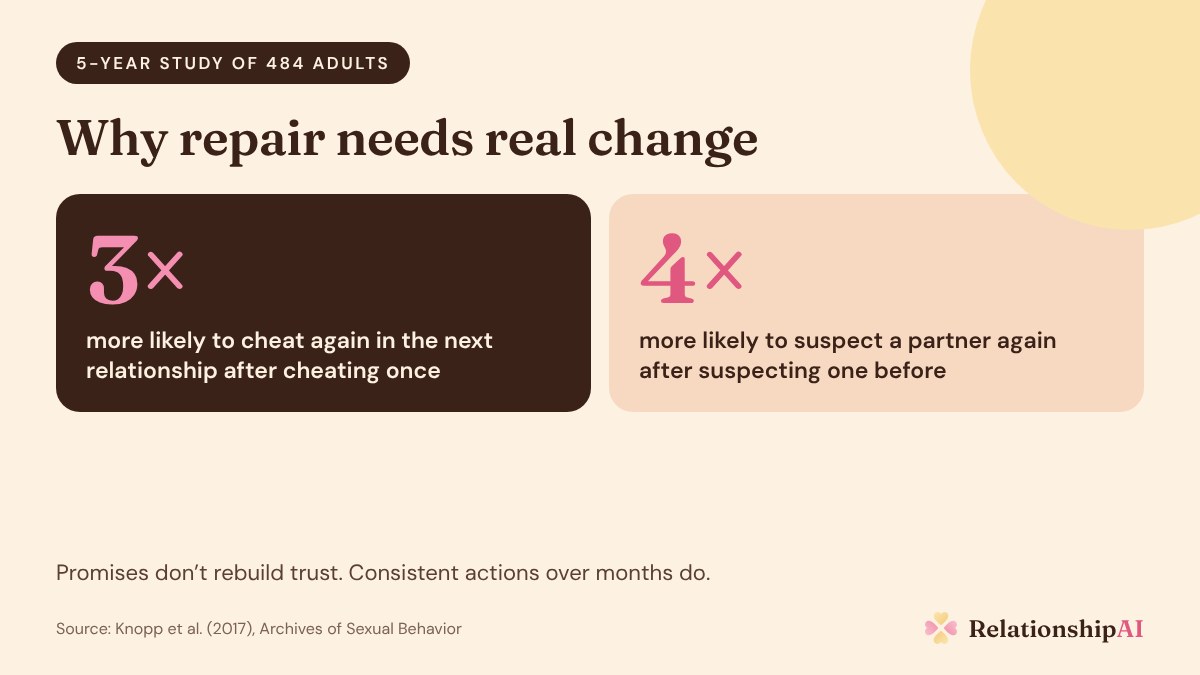
Be realistic about relapse risk. A five-year study by Kayla Knopp, Scott Stanley and colleagues found that people who cheated in one relationship were about three times more likely to report cheating in their next. That's not destiny. But it means "I promise it'll never happen again" is far less convincing than visible change over time.
Expect setbacks. An anniversary, a song, a name on a screen. Triggers can bring everything back months later. It doesn't mean you're back at the start.
Try (betrayed partner): "I'm having a hard day about it. I don't need you to fix it, I just need you to know." Try (unfaithful partner): "Thank you for telling me. What would help right now?"
The thing I'd want both partners to hear is that this stage is slow on purpose. Trust doesn't come back from one great conversation. It comes back from a hundred boring, consistent days.
Stage 4: Revitalising
In the final stage, couples in the Fife study described seeking reconnection, communicating more deeply, re-establishing trust, and moving from an early, decided forgiveness to a deeper, felt one.
This is where couples build something new, not just patch the old. Shared time, real conversations, new rituals. Some couples report that their relationship became better than before, though researchers urge caution about that claim, and it's never a reason the affair was "worth it". Our guides on deep questions to ask your partner and green flags in a relationship can help you picture what you're building toward.
How long does it take?
Usually many months, often a year or more. It depends on how long the affair lasted, how it was discovered, whether there were further lies, and how committed both people are. Stages overlap and loop back. That's normal.
When staying isn't right
Rebuilding trust requires the unfaithful partner to take full responsibility and the betrayed partner to choose, freely, to try. If the affair continues, if there's ongoing lying, or if you're being pressured or blamed for the betrayal, staying may not be safe or healthy. Our guides on whether to break up and how to get over a breakup can help you if leaving is the right choice.
A therapist experienced with infidelity can help either way. If you're stuck on what to say, how to apologize to your partner covers the first apology. For the doubt that lingers afterwards, see trust issues in a relationship.

Quick answers
Can trust really be rebuilt after cheating?
Often, yes. Many couples stay together and some report a stronger relationship afterwards. It usually takes honesty, ended contact with the affair partner, patient answers to questions and consistent change over time.
How long does it take to rebuild trust after cheating?
Usually many months to a year or more. Setbacks along the way are normal.
Will someone who cheated do it again?
Research finds a higher risk in future relationships, but it's not inevitable. Full responsibility, understanding why it happened and visible change lower the risk.
What should the partner who cheated say?
Take full responsibility without excuses, answer questions honestly and consistently, and show change through actions rather than promises.
Is couples therapy worth it after infidelity?
For many couples, yes. Approaches built specifically for affair recovery work through the shock, the meaning and the moving on, whether the couple stays together or not.
A note on safety
Discovering infidelity can bring intense emotions. If anger turns into threats or violence, or if you're afraid of your partner, please contact a local support service or helpline. And if you're struggling to cope or having thoughts of harming yourself, contact emergency services or a crisis line now.
In the US, you can reach the National Domestic Violence Hotline at 1-800-799-7233, by texting START to 88788 or at thehotline.org, and the 988 Suicide & Crisis Lifeline by calling or texting 988. Outside the US, contact a local helpline.
This article is general information, not therapy or medical advice.
Sources
- Nickerson, K., Rein, B., Gottman, J., Stone, R., Davies, R., Petrova, M., & Johnson, A. L. (2026). Should I stay or should I go after infidelity: Pathways to relationship preservation after an affair. Journal of Sex & Marital Therapy. Summary on PsyPost
- Fife, S. T., Gossner, J. D., Theobald, A., Allen, E., Rivero, A., & Koehl, H. (2023). Couple healing from infidelity: A grounded theory study. Journal of Social and Personal Relationships. Record
- Stavrova, O., Pronk, T., & Denissen, J. (2023). Estranged and unhappy? Examining the dynamics of personal and relationship well-being surrounding infidelity. Psychological Science. Summary on PsyPost
- Knopp, K., Scott, S., Ritchie, L., Rhoades, G. K., Markman, H. J., & Stanley, S. M. (2017). Once a cheater, always a cheater? Serial infidelity across subsequent relationships. Archives of Sexual Behavior, 46(8), 2301-2311. Summary on PsyPost
- Baucom, D. H., Snyder, D. K., & Gordon, K. C. (2009). Helping Couples Get Past the Affair: A Clinician's Guide. Guilford Press. Publisher page