

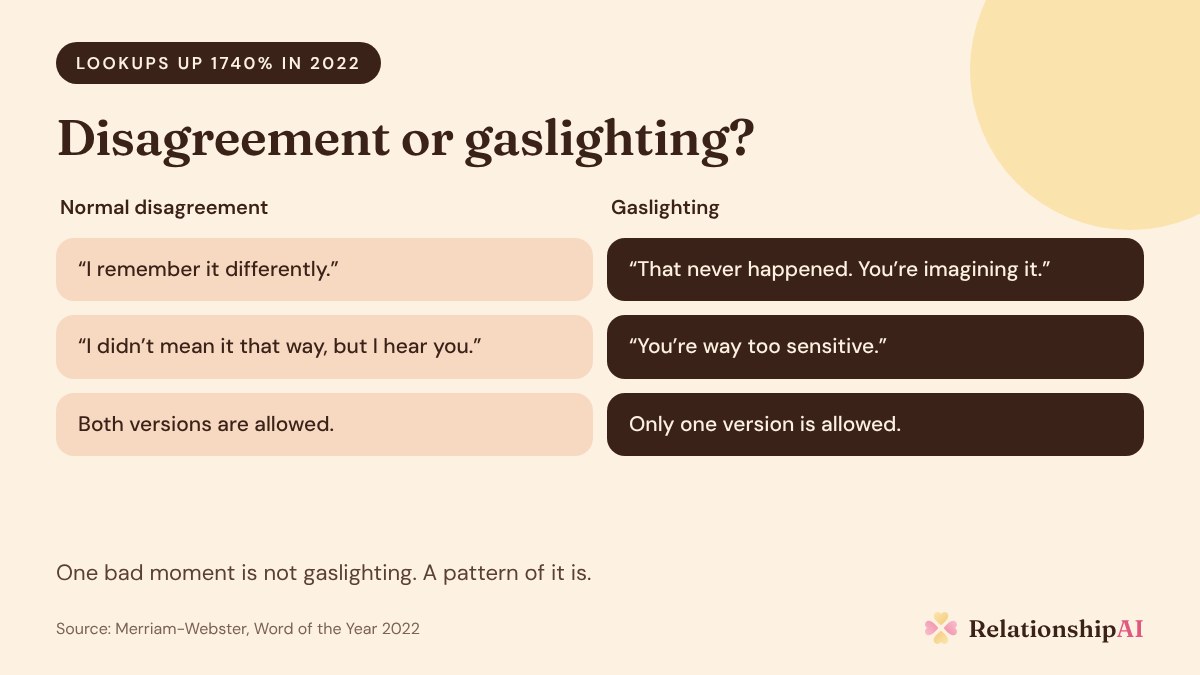
"Gaslighting" was Merriam-Webster's word of the year in 2022, and since then it has been used for almost everything: a partner remembering a dinner differently, a friend disagreeing, a boss changing their mind. That creates two problems. People in ordinary arguments start to see their partner as an abuser. And people who really are being gaslit find the word has lost its weight.
Philosopher Kate Abramson, author of On Gaslighting, put it simply in a 2026 NPR interview: "If everything gets called gaslighting, nobody takes it seriously anymore." Psychoanalyst Robin Stern, who wrote The Gaslight Effect, was just as direct: "Gaslighting is not a disagreement."
So how do you tell the difference? These five questions help.
The short answer: Gaslighting is a pattern of making someone doubt their own memory, perception or sanity, usually to gain control. Ordinary disagreement leaves room for two versions of events. Gaslighting attacks your mind rather than the event, repeats over time, and leaves you confused and dependent on the other person's version.
Question 1: Is there room for two versions?
In a normal disagreement, both people can say "I remember it differently" and leave it there. Memory is imperfect, and couples misremember things all the time.
In gaslighting, only one version of reality is allowed, and it's never yours. Even when you have evidence, a message or a witness, your version gets dismissed, reframed or laughed off.
| Ordinary disagreement | Gaslighting |
|---|---|
| "I don't remember saying that, but maybe I did." | "I never said that. You're making things up again." |
| "I see it differently." | "That's not what happened, and you know it." |
| "I didn't mean it that way, sorry it hurt." | "You're way too sensitive. Nobody else would be upset." |
| You both sometimes concede | You always end up apologizing |
Question 2: Is it about the event, or about your mind?
Disagreements are about what happened. Gaslighting slides into what's wrong with you: your memory, your stability, your sanity.
In a 2023 study, psychologist Willis Klein and colleagues asked 65 people who believed they had been gaslit by a romantic partner to describe it. Every single participant said their partner insulted and demeaned them, often implying their grip on reality was weak, calling them crazy, stupid or overly emotional. Sociologist Paige Sweet, who has studied gaslighting in abusive relationships, summed it up in the same NPR piece: gaslighting is "someone trying to make you seem or feel crazy."
If your arguments regularly end with a verdict on your mental state, notice that.
Question 3: Does it come in a pattern?
Anyone can say something unfair once, in a heated moment. Gaslighting is a pattern over time.
The Klein study found a common arc. Most relationships started with intense affection, big gestures and grand plans, very like love bombing. Then came blame for things that weren't the participant's fault, and behavior that swung unpredictably between anger and affection, or between yelling and cold silence.
Question 4: How do you feel after you talk?
Pay attention to how conversations leave you. After an ordinary disagreement you might feel annoyed, sad or unresolved. After gaslighting, people describe something different: confusion, a fog, the sense that they can't trust their own memory, and a habit of rehearsing conversations in advance to avoid "getting it wrong".
In the Klein study, people described their sense of self as shrinking, withering or broken. In a 2025 study of survivors of intimate partner violence, Helen Hailes and Lisa Goodman described how gaslighting fed long-term self-doubt and was tied into broader patterns of power and control in the relationship.
If you only answer one of the five questions, I'd make it this one. Your memory can be argued with. A pattern of walking away confused and smaller usually can't.
Question 5: Who benefits?
Sweet's research adds a useful lens. In life-story interviews with 43 women who had survived domestic violence, she found that gaslighting often draws on existing stereotypes and vulnerabilities, like the idea that women are "emotional", or someone's past mental health history or immigration status, to make one person's version seem more believable to others. Ask: does doubting myself always happen to suit the other person? Do they gain control, avoid responsibility or get their way when I doubt myself?
Not all denial is calculated. Some people deny things because they feel ashamed or defensive. The effect can still hurt, and it's still worth addressing. But a pattern that consistently benefits one person and costs the other deserves to be taken seriously.
What to do if you think you're being gaslit
Write things down. Dates, what was said, how you felt. Not to win arguments, but to give your own memory something to stand on.
Talk to someone outside the relationship. In the Klein study, the most common thing that helped people recover was time with friends and family, especially kind, empathetic people. Many said their partners had tried to keep them away from exactly those people.
Stop trying to win the argument. With a gaslighter, more evidence rarely helps. You can simply say: "I remember it differently, and I'm not going to argue about my memory." Then stop.
Get back things that are yours. People in the Klein study described regaining their sense of self through outdoor exercise, yoga, mindfulness and returning to old hobbies.
Decide what you need. Sometimes that's a serious conversation or couples therapy. Sometimes it's leaving. Our guide on whether to break up can help you think it through, and our guide on how to get over a breakup helps afterwards.
Writing things down as they happen also helps, wherever you do it. Our guide on how to stop overthinking in a relationship may also help with the replaying.
If you're worried you're the one doing it
It's a good sign that you're asking. Watch for these habits in yourself: dismissing your partner's feelings as "too sensitive", insisting your memory is always right, or turning their complaint into a conversation about their flaws. Try instead: "I don't remember it that way, but I believe it felt that way to you. Tell me more."

Quick answers
What's the difference between gaslighting and disagreeing?
In a disagreement, both versions can exist. In gaslighting, only one version is allowed, and the other person's memory, judgment or sanity is repeatedly questioned.
Can someone gaslight without meaning to?
Some people deny or minimize out of shame or defensiveness rather than a plan. The impact can still be harmful. A repeated pattern that leaves you doubting reality is worth addressing either way.
Is gaslighting abuse?
As a repeated pattern used to control or undermine someone, yes, it's a form of emotional abuse and often part of coercive control.
How do I trust myself again after gaslighting?
Keep notes, spend time with people who know you well, return to activities that are yours, and consider talking to a therapist. Self-trust usually comes back gradually.
A note on safety
Gaslighting often comes alongside other forms of control. If your partner isolates you, monitors you, controls money, threatens you or makes you afraid, please contact a local domestic abuse helpline or support service. You don't need to be sure it's "abuse" to ask for advice.
In the US, you can reach the National Domestic Violence Hotline at 1-800-799-7233, by texting START to 88788 or at thehotline.org, and the 988 Suicide & Crisis Lifeline by calling or texting 988. Outside the US, contact a local helpline.
This article is general information, not therapy or medical advice.
Sources
- Klein, W., Li, S., & Wood, S. (2023). A qualitative analysis of gaslighting in romantic relationships. Personal Relationships, 30(4), 1316-1340. Summary by the author for the Society for Personality and Social Psychology
- Hailes, H. P., & Goodman, L. A. (2025). "They're out to take away your sanity": A qualitative investigation of gaslighting in intimate partner violence. Journal of Family Violence, 40(2), 269-282. Boston College record
- Sweet, P. L. (2019). The sociology of gaslighting. American Sociological Review, 84(5), 851-875. Summary on The Society Pages
- NPR (2026): Are you sure you know what gaslighting is?, with Robin Stern, Paige Sweet and Kate Abramson
- Merriam-Webster: Word of the Year 2022: gaslighting