
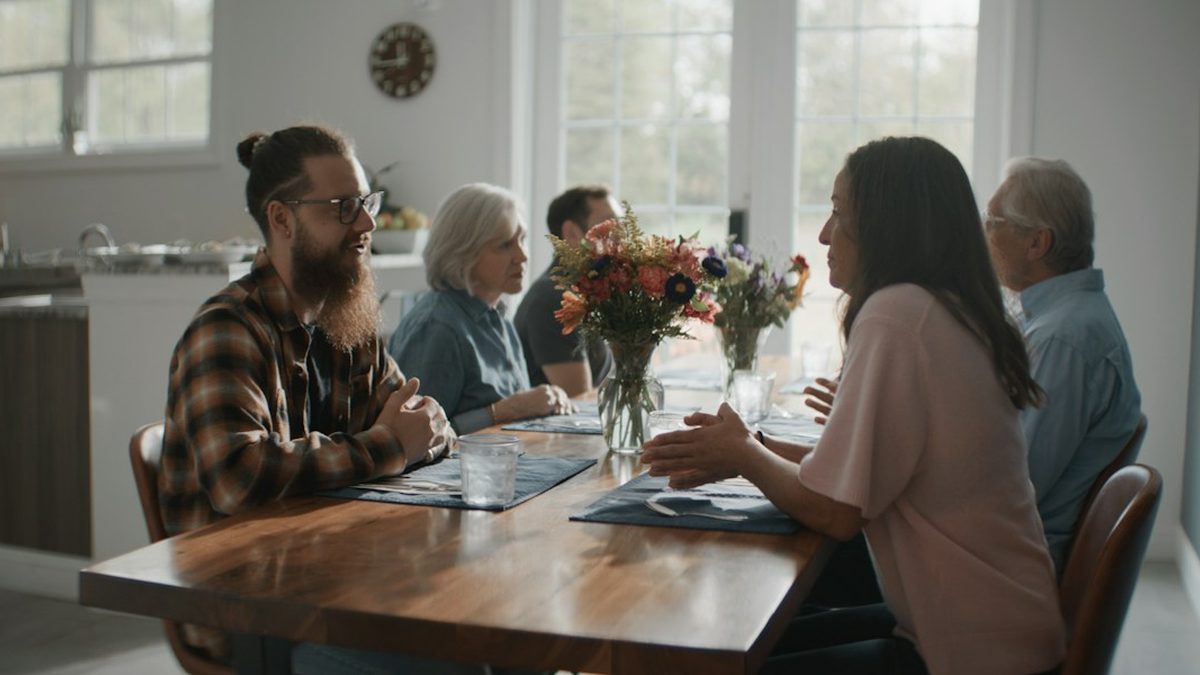
Most advice about meeting your partner's parents says the same things: dress nicely, bring flowers, be yourself. Fine, but that isn't what keeps people awake the night before. What keeps them awake is the moments: the silence after "So, what do you do?", the question about marriage, the political comment from Dad.
This guide is built around those moments. First, a quick look at why it's worth getting right. Then twelve awkward situations with words you can actually use.
The short answer: When meeting your partner's parents, ask your partner beforehand about family rules and sensitive topics, arrive with a small gift, learn names, offer to help, and keep answers to awkward questions short and friendly. Their approval matters for couples, so aim to be warm and respectful rather than perfect.
Why their opinion matters (and the myth it busts)
There's a popular idea, the "Romeo and Juliet effect", that parental disapproval pulls a couple closer. It came from a 1972 study and became a pop psychology classic. When psychologist H. Colleen Sinclair and colleagues tried to replicate it in 2014, they found the opposite. Across their measures, more interference and less approval from friends and family went with lower relationship quality, and a meta-analysis pointed the same way. Disapproval was also linked to less trust and more criticism between partners.
That matches what Susan Sprecher and Diane Felmlee found back in the early 1990s, following couples over several years: when couples felt their families and friends approved, love and commitment tended to grow.
So, no pressure, but this evening is worth some preparation. The good news: approval isn't won by being perfect. It's mostly won by being warm, interested and clearly good to their child.
One nuance worth knowing A 2015 study by Sinclair and colleagues found that people with a strong sense of making their own choices were less affected by their circle's disapproval. Parents' opinions matter, but they're not destiny. What matters most over time is how the two of you handle their opinion together.
Involvement is different from approval, though. In a 2024 study of 464 young adults in Slovenia, Timotej Glavač and Melita Puklek Levpušček found that people whose fathers were more intrusive tended to have shorter relationships. Parents who are warm and supportive help a couple. Parents who try to run it usually don't.
Before you go: 3 questions to ask your partner
- "What are they proud of, and what are they sensitive about?" This is your map of good and bad topics.
- "What do they already know about me?" You don't want to be surprised by your own story.
- "If it gets awkward, what's our signal?" A word, a look, a hand on the back. It helps more than you'd think.
I'd say this short briefing matters more than anything you say on the day. Most awkward moments come from not knowing the rules everyone else knows.
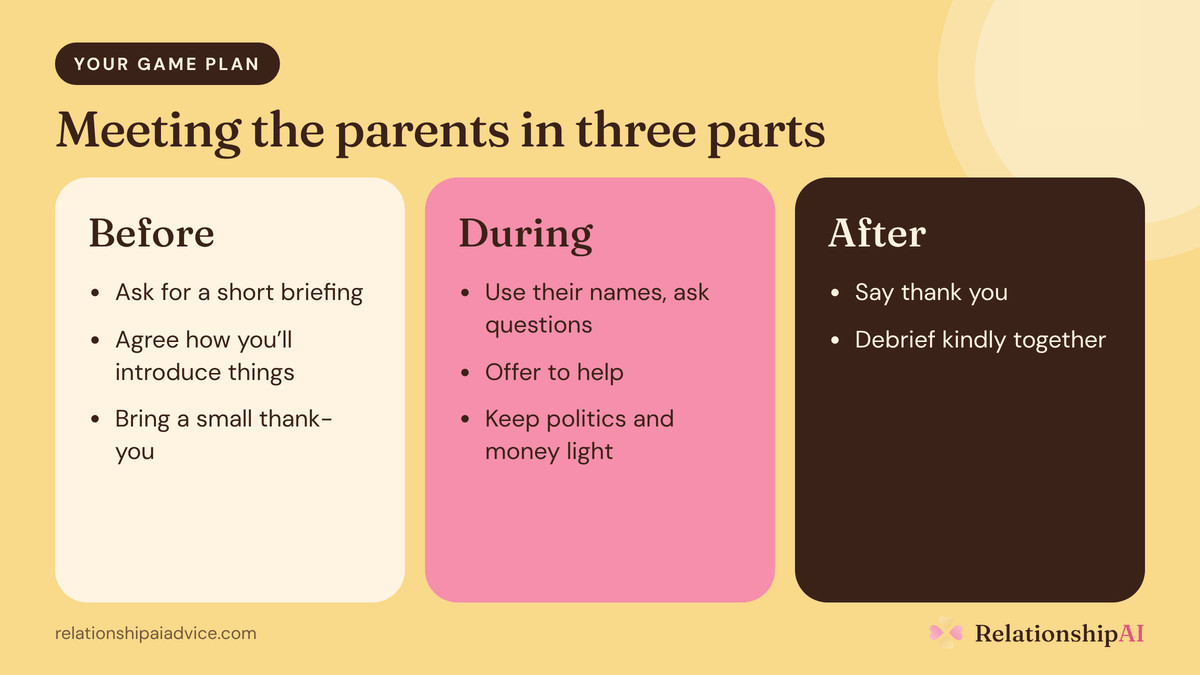
The 12 moments, and what to say
1. The first five minutes
Use their names once you know what they'd like to be called, and bring something small: flowers, a dessert, something from your hometown. "It's so nice to finally meet you. [Partner] talks about your cooking all the time."
If you're not sure how formal to be: "What would you like me to call you?" is always fine.
2. "So, what do you do?"
Answer in one sentence, then turn it back. "I work in logistics, mostly keeping deliveries on time. [Partner] tells me you were a teacher. What did you teach?"
People like people who are interested in them. This is the single most reliable move of the evening.
3. The silence
Silences feel longer to you than to them. Have two easy topics ready from your briefing: their garden, a recent trip, the family dog, a photo on the wall. "Is that you two in Greece in that photo? It looks beautiful."
4. The embarrassing story about your partner
Laugh with them, not at your partner, and add something kind. "That's adorable. They're still exactly that determined."
5. A comment about politics or religion
You don't have to agree, and you don't have to debate. "That's interesting, I hadn't thought about it that way." Or: "We might see that one a bit differently, but I'd love to hear more about how you got into it."
Then move on. A first dinner is not the place to win an argument.
6. "So when are you two getting married?" (or "having kids?")
Look at your partner, smile, keep it light. "Ha, we're really enjoying where we are right now. You'll be among the first to know."
Agree on this line together beforehand. It's the most common ambush.
7. Food you don't or can't eat
Tell your partner in advance so they can mention it before you arrive. If it still comes up: "This looks wonderful. I don't eat meat, but I'm really happy with all the sides, especially this salad."
8. They speak a language you don't, or you come from different cultures
Learn a greeting and a "thank you" in their language. It's remembered for years. Ask your partner what's considered polite: shoes off, gifts, how to address elders, who serves first. "I've only learned a few words so far, but I'm working on it."
9. A question about your family
Share what you're comfortable with. If your family situation is complicated, a short, calm answer is enough. "My parents separated when I was young, so it's mostly me and my mom. We're close."
10. They seem cold or distant
It's often nerves or protectiveness, not dislike. Stay warm and don't overcorrect. Offer to help. "Can I help with anything in the kitchen?"
Helping clear the table is old advice that still works. It gives you a few minutes of easier, side-by-side conversation.
11. Your partner gets defensive with their parents
Don't take sides in the room. Stay calm and steer away. "These potatoes are incredible, by the way. Is this a family recipe?"
Talk about it later, in private.
12. Leaving
Thank them by name, mention one specific thing you enjoyed. "Thank you so much for having me. The stories about the camping trips were the best part of my week."
A short message afterwards via your partner ("Please thank your mom again for dinner") adds a nice finish.
Afterwards: the debrief
Ask your partner how they think it went, and listen to the answer without spiralling. If there was tension, separate style from rejection. Some families are reserved with everyone at first.
It also helps to hear about long-term research from psychologist Terri Orbuch, who followed married couples for 26 years. She found that when husbands felt close to their wife's parents, the couple's divorce risk was lower, but when wives were very close to their husband's parents, the risk was higher, possibly because closeness made boundaries harder. The goal isn't to become best friends overnight. It's warmth and respect with healthy boundaries.
If you'll be spending holidays with them soon, our guide on holidays with your partner's family covers longer visits. And if you'd like to understand your partner better before the big day, try a few of our deep questions to ask your partner, especially the ones about their childhood.
If you're the one introducing your partner
Brief both sides. Tell your parents one or two things your partner loves talking about, and tell your partner what to avoid. During the evening, include your partner in the conversation and step in if a question goes too far: "Let's not grill them on the first night, Mom."
Quick answers
What should you not say when meeting your partner's parents?
Avoid oversharing about past relationships, criticizing your partner (even jokingly), and starting debates on politics or religion. Also avoid complaining about the food, the trip or your own family. When in doubt, ask a question instead of making a statement.
What should I bring when meeting my partner's parents?
A small, thoughtful gift is enough: flowers, a dessert, a good bottle of something they enjoy, or a local treat. Ask your partner what fits their family, especially if there are cultural or dietary customs.
How do I make a good first impression on my partner's parents?
Learn their names in advance, greet them warmly, ask about their interests, offer to help and thank them when you leave. Warm and respectful beats trying to be perfect.
What if my partner's parents don't like me?
Give it time. First meetings are often stiff, and many parents warm up slowly. Stay polite and consistent, and agree with your partner how you will handle it as a team. If you will be seeing them often, our guide to holidays with your partner's family covers longer visits.
This article is general information, not therapy or medical advice.
Sources
- Sinclair, H. C., Hood, K. B., & Wright, B. L. (2014). Revisiting the Romeo and Juliet effect: Reexamining the links between social network opinions and romantic relationship outcomes. Social Psychology. Read the study
- Sinclair, H. C., Felmlee, D., Sprecher, S., & Wright, B. L. (2015). Don't tell me who I can't love: A multimethod investigation of social network and reactance effects on romantic relationships. Social Psychology Quarterly, 78(1), 77-99. Penn State record
- Sprecher, S., & Felmlee, D. (1992). The influence of parents and friends on the quality and stability of romantic relationships: A three-wave longitudinal investigation. Journal of Marriage and the Family, 54(4), 888-900. Summary from UC Davis
- WBUR (2012): The outsized power of the son-in-law, on Terri Orbuch's long-term study of married couples
- Glavač, T., & Puklek Levpušček, M. (2024). Romantic experiences in emerging adults: How they relate to the importance of romantic relationships and the quality of relationships with parents. Društvena istraživanja, 33(2), 223-245. Hrčak record