
"Toxic" has become an everyday word for anything from a partner who forgets your birthday to one who controls your money. That's a problem, because those situations need completely different responses. A relationship going through a rough patch might need a better conversation. A controlling one might need a safety plan.
So instead of one long list of red flags, this guide sorts the signs of a toxic relationship into three levels. Read through all three, notice which one sounds most like your last month, and then look at the next steps for that level.
The short answer: Signs of a toxic relationship range from unhealthy but fixable patterns, like poor communication, to toxic ones like contempt and constant blame, and finally coercive control: monitoring, isolation, threats and fear. If you feel afraid or controlled, treat it as abuse and contact a support service.
Level 1: Unhealthy, but often fixable
These are patterns many couples fall into, especially under stress. They hurt, and they're worth taking seriously, but they're usually two-sided and often change when both people want them to.
- Arguments go in circles and nobody feels heard.
- One of you criticizes, the other gets defensive.
- One of you pushes to talk, the other withdraws.
- You've stopped doing nice things for each other.
- Small resentments pile up because you avoid hard conversations.
What makes it Level 1: both of you can still admit mistakes, both of you sometimes try to repair, and you don't feel afraid.
Next step: a calm, specific conversation, and maybe couples counseling. Our guides to communication habits and relationship problems that keep coming back are good starting points.
Level 2: Toxic patterns
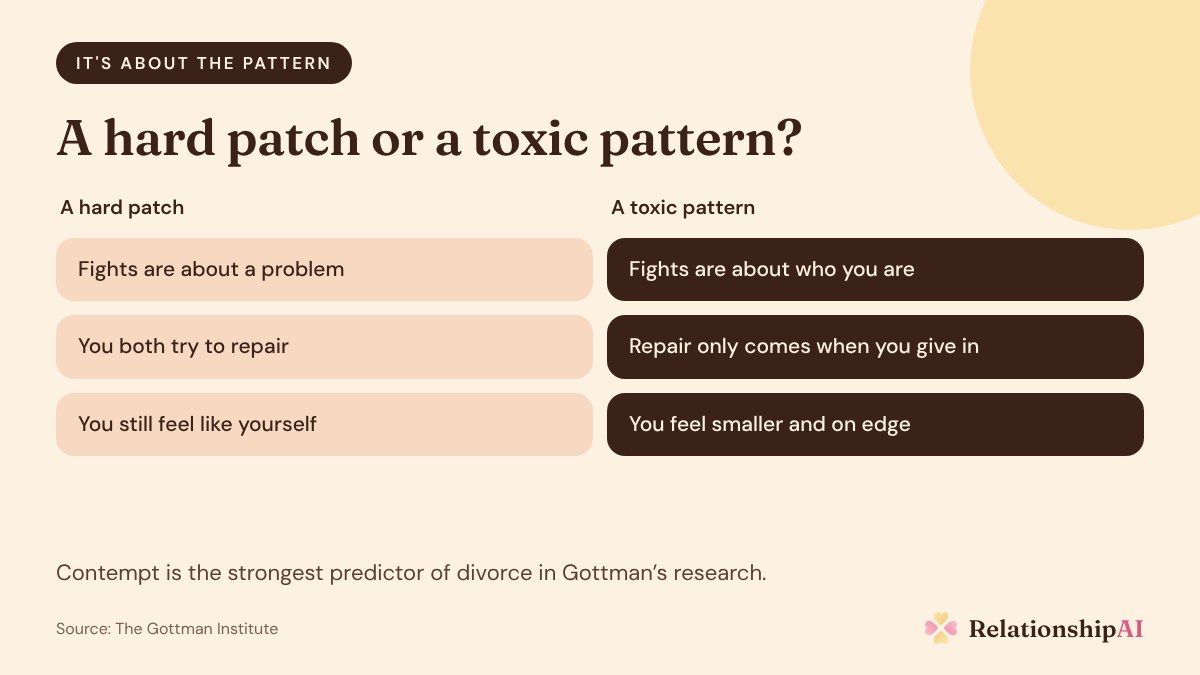
Here the problem is no longer just how you argue. It's how you're treated. Couples researcher John Gottman identified four communication patterns that predicted divorce in his studies, and singled out contempt (mockery, eye-rolling, sarcasm, treating a partner as beneath you) as the most damaging. Level 2 is where contempt and its relatives become normal.
- You're mocked, belittled or called names, in private or in front of others.
- Fights are about who you are, not about a specific problem.
- Your partner almost never takes responsibility. Somehow it always ends up being your fault.
- The silent treatment is used as punishment, sometimes for days.
- You feel smaller, quieter or more on edge than before the relationship.
- Affection feels like a reward you have to earn.
What makes it Level 2: the pattern is mostly one-directional, it's been going on for a while, and you've noticed yourself changing to avoid it.
Next step: name the pattern once, calmly, and watch the response.
“When you mock me in front of your friends, I feel humiliated. I need that to stop.”
A partner who can change will feel uncomfortable and then try. A partner who doubles down, mocks the request or turns it back on you is giving you important information. Couples counseling can help at this level, but only if both people are genuinely willing.
Level 3: Control and abuse
At this level, the issue is power. Sociologist Michael Johnson, who studied many kinds of violence between partners, made an important distinction. Some couples have fights that escalate. But in what he called intimate terrorism, harm is part of a broader pattern of coercive control: one person systematically controlling the other. Control, not the fights themselves, is what defines it.
Coercive control is often not physical. The Victorian government's prevention agency, Respect Victoria, describes it as a long-running, often hidden pattern that gradually erodes a person's boundaries, independence and self-esteem, and stresses that non-physical abuse is "not less serious when it is not physical."
Signs include:
- Checking your phone, messages or location.
- Controlling money, or making you ask for it.
- Cutting you off from friends and family, slowly or openly.
- Deciding what you wear, eat, or where you go.
- Threats: to leave, to hurt you, to hurt themselves, to share private images, to take the children.
- Making you doubt your own memory or sanity (gaslighting).
- You feel afraid of their reaction, and plan your behavior around it.
Subtle control is also the kind people most often miss. In a 2025 study of 1,872 American adults, Julie-Ann Jordan and colleagues found that people recognized obvious abuse easily, but rated quieter controlling behavior as more ordinary and less serious, especially when the person being controlled was a man. If someone tells you it's "just how relationships are", that doesn't make it so.
What makes it Level 3: fear and control. If you're changing your life to avoid their anger, that matters more than how often anything happens.
Next step: don't confront alone, and don't rely on couples counseling, which isn't recommended when one partner controls or fears the other. Talk to a domestic abuse helpline or support service. They can help you think through options safely, whether or not you want to leave.
I want to be very direct about this level: an app, an article or a better way of talking won't fix it. If this section sounds familiar, the helplines below are the next step.
A quick self-check: the last month
Think about the last four weeks, not the best or worst day. Which statements are true?
- I've felt afraid of my partner's reaction. (Level 3)
- I've been checked, tracked or restricted in who I see or what I spend. (Level 3)
- I've been mocked, insulted or treated with contempt. (Level 2)
- I've apologized for things I don't believe were my fault, just to end it. (Level 2)
- We've had the same argument several times without resolving it. (Level 1)
- We've both said hurtful things, and both tried to make up. (Level 1)
Your highest level is the one to act on. One Level 3 statement outweighs several Level 1 statements.
Why it's so hard to leave, even when you know
If you recognize Level 2 or 3, you may also notice a strong urge to explain it away. That's not weakness. In a study of women at a shelter, Caryl Rusbult and John Martz found that whether women went back to an abusive partner was strongly linked to their commitment, and that commitment was shaped by practical things: fewer or worse economic alternatives, more invested in the relationship (for example, being married), and less severe abuse.
In other words, staying often has more to do with money, children, housing and shared history than with how much someone "lets" themselves be treated badly. That's why support services focus on practical options, not just feelings. And unpredictable affection, warmth after coldness, can make the good moments feel even more intense, which is part of why love bombing cycles are so confusing.
Am I the toxic one?
Asking the question is a good sign. Look honestly at Level 1 and 2 in your own behavior: contempt, never apologizing, punishing with silence, controlling your partner's choices. If you recognize them, you can change them, and a therapist can help. Our guide on how to apologize to your partner is a good place to start repairing.
For Level 1 and 2 situations, it can help to rehearse a hard conversation first, for example in Partner Practice. For Level 3, an app isn't the answer. Please contact a helpline.
If you decide to end things, our guides on whether to break up and how to get over a breakup can help, and our guide to codependency explains why caring can sometimes keep you stuck.

Quick answers
What are the signs of a toxic relationship?
Contempt and belittling, never taking responsibility, silent treatment as punishment, feeling smaller or afraid, and, at the most serious level, control over your phone, money, friends or movements.
What's the difference between toxic and abusive?
"Toxic" usually describes harmful patterns like contempt or blame. Abuse involves power and control, including coercive control, threats and violence. When you feel afraid or controlled, treat it as abuse and get support.
Can a toxic relationship be fixed?
Level 1 patterns often can, and sometimes Level 2 if both people genuinely want to change. Coercive control rarely changes without the controlling partner taking full responsibility and getting specialist help.
Is it toxic if we fight a lot?
Not necessarily. Frequent fights that stay respectful and get repaired are different from fights that involve contempt, fear or punishment.
A note on safety
If you're afraid of your partner, are being controlled, threatened or hurt, please contact a local domestic abuse helpline or support service. If you're in immediate danger, call emergency services. If your phone or computer may be monitored, use a friend's device or a safe computer.
In the US, you can reach the National Domestic Violence Hotline at 1-800-799-7233, by texting START to 88788 or at thehotline.org, and the 988 Suicide & Crisis Lifeline by calling or texting 988. Outside the US, contact a local helpline.
This article is general information, not therapy or medical advice.
Sources
- Johnson, M. P. (2008). A Typology of Domestic Violence: Intimate Terrorism, Violent Resistance, and Situational Couple Violence. Northeastern University Press. Summary (US Office of Justice Programs)
- Rusbult, C. E., & Martz, J. M. (1995). Remaining in an abusive relationship: An investment model analysis of nonvoluntary dependence. Personality and Social Psychology Bulletin, 21(6), 558-571. Abstract
- Respect Victoria: Coercive control, non-physical violence and relationship red flags
- Jordan, J.-A., Hurst, N., McCartan, C., McFadden, D., Shannon, C., Dyer, K. F. W., & Lagdon, S. (2025). Sex Roles. DOI. Summary on PsyPost
- Gottman Institute: The four horsemen: the antidotes
- Centers for Disease Control and Prevention: About intimate partner violence