

Most advice about jealousy in a relationship treats it as one thing: a bad feeling you should get rid of. Research says it is at least two different things, and they behave very differently. One is a short, sharp sting when something actually happens. The other is a slow loop of suspicion, checking and replaying that can grow without anything happening at all.
Mixing the two up is behind most of the myths below. Sorting them out is the fastest way to know whether your jealousy is telling you something about your relationship, or something about your mind at 1am.
The short answer: Jealousy in a relationship is normal in small doses, but rumination, phone checking and constant questioning make it worse. Reactive jealousy responds to a real event, while suspicious jealousy grows from fear without evidence. What helps is naming the fear, talking about specific needs and building security rather than surveillance.
Myth 1: "Jealousy is one feeling"
Psychologists Robert Rydell and Robert Bringle separated jealousy into two kinds:
- Reactive jealousy: the emotional jolt when something real happens, like seeing your partner flirt openly at a party.
- Suspicious jealousy: the thinking and doing side, worrying about what might be happening, imagining scenarios, checking up.
In their studies, the two had different roots. Reactive jealousy went together with more trust and commitment in the relationship. Suspicious jealousy went together with insecurity, anxious or avoidant attachment and lower self-esteem.
| Reactive jealousy | Suspicious jealousy | |
|---|---|---|
| Starts with | Something that actually happened | A thought about what might happen |
| Feels like | A sharp sting that fades | A loop that keeps coming back |
| Tends to lead to | A conversation | Checking, questioning, replaying |
| Linked in research to | Trust and commitment | Insecurity and lower self-esteem |
So the first useful question is not "Am I jealous?" but "Did something happen, or am I reacting to a story in my head?"
Myth 2: "If you weren't jealous, you wouldn't care"
There's a grain of truth here, which is why the myth survives. A flash of reactive jealousy often shows you value the relationship. But the line breaks down with the suspicious kind. Constant suspicion isn't proof of love. It's proof of fear, and fear tends to make people controlling rather than closer.
A partner who never feels a twinge is not necessarily indifferent. And a partner who checks your messages every night is not necessarily more devoted.
Myth 3: "Thinking it through will make me feel better"
This one feels true, because analyzing feels like doing something. But in a study of 199 people in relationships, Rachel Elphinston and colleagues found that jealous thinking was linked to lower relationship satisfaction, and that a big part of the link ran through rumination: going over the same worries again and again.
In other words, the replaying is not the cure. It's often the mechanism that turns a passing worry into lasting unhappiness. Our guide on how to stop overthinking in a relationship has practical ways to interrupt the loop.
Try this when the loop starts Write the worry down in one sentence. Then write one sentence for what you actually know. "He hasn't replied in three hours" is a fact. "He's talking to someone else" is a story. Set a 15-minute "worry slot" for later in the day, and when the thought comes back before then, tell yourself: "Later, not now." It sounds small. It works because it breaks the replaying, not the feeling.
Myth 4: "Checking their phone will settle it"
Checking rarely settles anything. If you find nothing, the relief lasts minutes and the doubt returns ("maybe they deleted it"). If you find something ambiguous, you now have a fight and a breach of trust on your side.
Interestingly, the same Elphinston study found that checking-up behaviors had a mixed pattern: they were linked to more rumination, but not simply to lower satisfaction. Checking isn't always a sign the relationship is failing. It is, however, a reliable way to keep the worry alive.
It's also worth knowing what can trigger the urge. A 2022 study of 346 people in relationships by Janneke Schokkenbroek and colleagues found that people whose partners often ignored them for their phones ("phubbing") were somewhat more likely to look through their partner's messages or online activity. The effect was small, but the message is useful: snooping sometimes grows out of feeling ignored, not only out of suspicion. That's something you can talk about.
I'd say this is the most important myth on the list. Checking feels like it will end the doubt. It almost never does. It just moves the doubt to the next thing.
Myth 5: "Social media just shows what's already there"
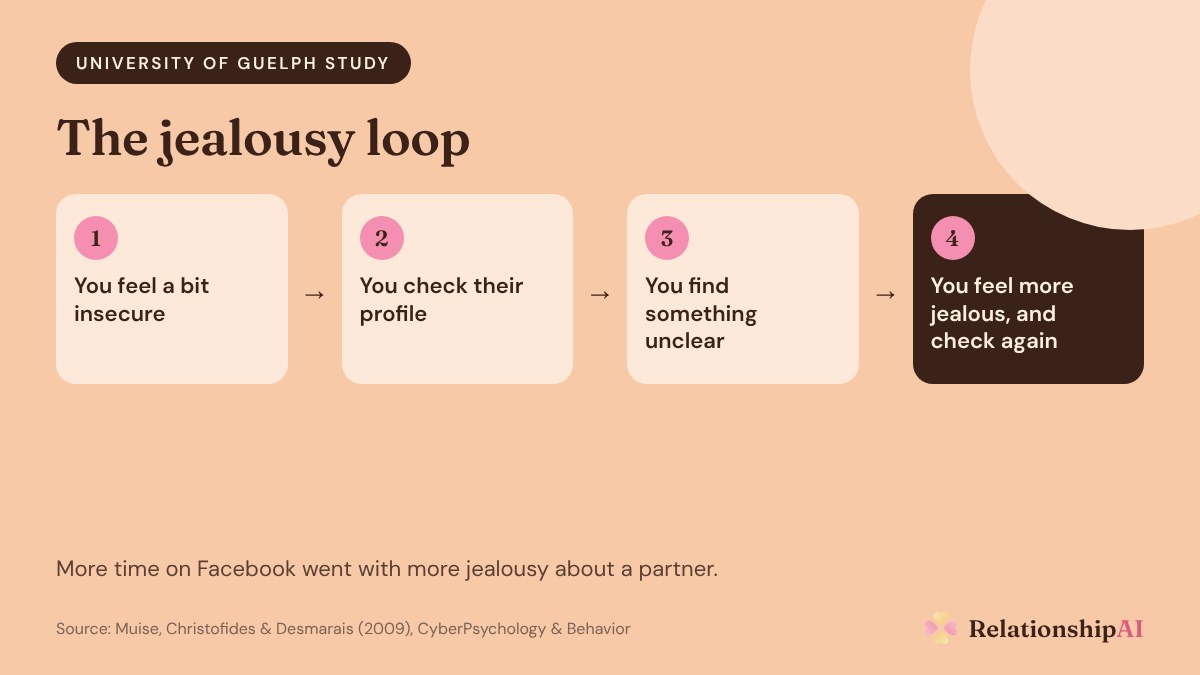
Social media adds information that would never have reached you otherwise: a like on an old photo, a new follower, a comment from someone you don't know. In a well-known early study, Amy Muise and colleagues found that the more time students spent on Facebook, the more jealousy they reported, and they described a feedback loop. Ambiguous information triggers jealousy, which leads to more checking, which turns up more ambiguous information.
The fix isn't to delete everything. It's to notice when you're scrolling to look for something and to stop there.
Myth 6: "Men and women get jealous about completely different things"
You've probably heard that men are more upset by sexual infidelity and women by emotional infidelity. Some studies do find that pattern, mostly when people are forced to choose one or the other. But when David DeSteno and colleagues let people rate how upsetting each one was on a scale, instead of picking between them, the difference between men and women largely disappeared.
The practical takeout: don't assume you know what will hurt your partner because of their gender. Ask. "What would feel like a betrayal to you?" is a surprisingly good conversation to have before anything goes wrong.
Myth 7: "Jealousy means something is wrong with the relationship"
Sometimes it does. Often it doesn't. Suspicious jealousy tends to travel with the person from relationship to relationship, because it's rooted in insecurity and attachment rather than in what the current partner does. If you notice the same fears with every partner, our guides on relationship anxiety and attachment styles are a better starting point than investigating your partner.
But if your partner is regularly secretive, inconsistent or dismissive when you raise concerns, your jealousy may be pointing at something real. Our guide on trust issues in a relationship helps you tell the difference.
What actually helps
Name which kind it is. Reactive or suspicious? Did something happen?
Say the feeling, not the accusation. Instead of: "Who is she? Why is she always liking your posts?"
“I noticed I got a bit jealous when I saw that. It's probably my stuff, but I wanted to tell you rather than stew on it.”
Ask for something specific. Vague reassurance ("Do you still love me?") fades fast. Specific requests last longer.
“When you're going to be out late, a quick text would really help me relax.”
Agree on what you both consider okay. Phones, exes, friendships, flirting. Couples differ, and a ten-minute conversation about it removes a lot of guesswork.

If your partner is the jealous one
Be patient with the feeling and firm about the behavior. You can reassure without giving up your privacy or friendships.
One way to put it: "I understand you feel worried, and I want to help. I'm also not okay with you going through my phone. Can we talk about what would actually help you feel safer?"
If you'd rather practice that conversation first, Partner Practice lets you do it privately with an AI playing your partner.
Quick answers
Is some jealousy in a relationship normal?
Yes. A brief, reactive sting when something real happens is common and can even go with commitment. Constant suspicion, checking and controlling are different and worth addressing.
What's the difference between healthy and unhealthy jealousy?
Healthy jealousy is a feeling you can name and talk about. Unhealthy jealousy turns into surveillance, accusations, restrictions or anger.
How do I stop being jealous?
Notice whether something actually happened, interrupt rumination instead of feeding it, share the feeling without accusing, and work on the insecurity underneath, ideally with support.
Should I check my partner's phone?
It rarely helps. It tends to feed the worry and can damage trust from your side. Talking about what triggered the urge usually gets you further.
When does jealousy become toxic?
When it is used to control: checking, restricting who your partner sees, demanding passwords, threats or punishment. That is a safety issue, not a sign of love.
A note on safety
Jealousy is one of the most common justifications for controlling and abusive behavior. If a partner monitors your phone, isolates you from friends, threatens you or makes you afraid, please contact a local domestic abuse helpline or support service. Our guides on signs of a toxic relationship and gaslighting may help you see the pattern clearly.
In the US, you can reach the National Domestic Violence Hotline at 1-800-799-7233, by texting START to 88788 or at thehotline.org, and the 988 Suicide & Crisis Lifeline by calling or texting 988. Outside the US, contact a local helpline.
This article is general information, not therapy or medical advice.
Sources
- Rydell, R. J., & Bringle, R. G. (2007). Differentiating reactive and suspicious jealousy. Social Behavior and Personality, 35(8), 1099-1114. DOI
- Elphinston, R. A., Feeney, J. A., Noller, P., Connor, J. P., & Fitzgerald, J. (2013). Romantic jealousy and relationship satisfaction: The costs of rumination. Western Journal of Communication, 77, 293-304. Full text (PDF)
- Schokkenbroek, J. M., Hardyns, W., & Ponnet, K. (2022). Phubbed and curious: The relation between partner phubbing and electronic partner surveillance. Computers in Human Behavior. Summary on PsyPost
- DeSteno, D., Bartlett, M. Y., Braverman, J., & Salovey, P. (2002). Sex differences in jealousy: Evolutionary mechanism or artifact of measurement? Journal of Personality and Social Psychology, 83(4). Summary in the APA Monitor
- Muise, A., Christofides, E., & Desmarais, S. (2009). More information than you ever wanted: Does Facebook bring out the green-eyed monster of jealousy? CyberPsychology & Behavior, 12(4), 441-444. Summary on EurekAlert