

Words of affirmation, quality time, receiving gifts, acts of service, physical touch. Gary Chapman's five love languages, first published in 1992, have become one of the most quoted relationship ideas in the world. Dating profiles list them. Couples take the quiz on the second date.
The core idea, that people feel loved in different ways and it helps to know how your partner does, is genuinely useful. But several of the popular beliefs built on top of it don't hold up well. Here are six of them, checked against what researchers have actually found.
The short answer: The five love languages are a useful conversation starter, but research doesn't support the idea that everyone has one main language or that matching languages makes couples happier. What helps more is showing love in many ways and paying attention to what your partner specifically appreciates.
Belief 1: "Everyone has one main love language"
What research says: mostly not.
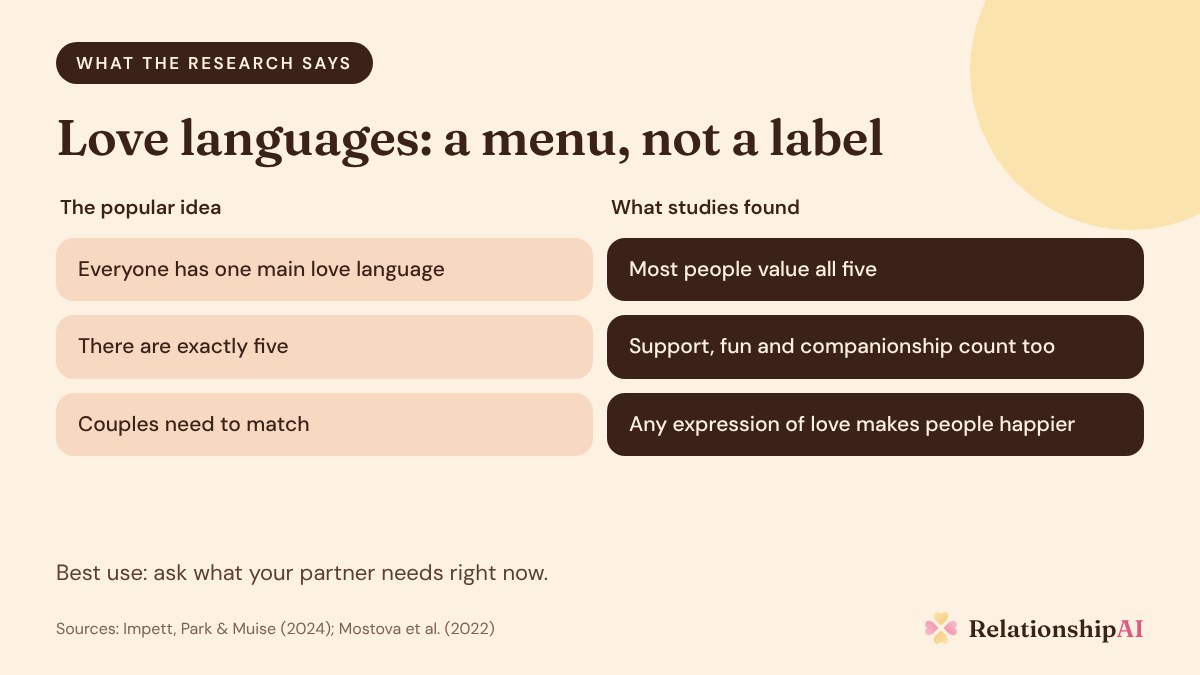
The quiz forces you to pick: words or time, gifts or touch. In a 2024 review, psychologists Emily Impett, Gideon Park and Amy Muise pointed out that when people are allowed to rate each kind of affection separately, instead of choosing between them, most people rate several or all of them as important. People aren't usually "a quality time person". They're people who need a mix, with some preferences.
Use it like this: instead of asking "What's your love language?", ask "Which of these would mean the most to you this week?"
Quick quiz: If you want a quick starting point anyway, the free 2-minute love language quiz helps you put words to what makes you feel loved, so you can talk about it with your partner.
Belief 2: "There are exactly five"
What research says: the list leaves important things out.
The same review argued that some of the most important ways partners show love aren't on Chapman's list: supporting each other's goals, emotional support during hard times, and simple companionship. Their suggestion is to think of love like a balanced diet. The five languages are some of the nutrients, not the whole menu.
Use it like this: add your own categories. "When I'm stressed, what helps most is when you just sit with me" is a love language too. Our guide on supporting your partner when they're stressed covers that one in depth.
Belief 3: "Couples with matching love languages are happier"
What research says: weak evidence.
In a 2017 study of 67 couples, researchers Bunt and Hazelwood tested exactly this. Having the same primary love language made little difference to satisfaction. What mattered more was self-regulation: each partner's ability to manage their own reactions and keep putting effort into the relationship.
Use it like this: don't worry if your "types" don't match. Different preferences just mean you'll have to pay a bit more attention, which is good for a relationship anyway.
Belief 4: "Speaking your partner's language makes a real difference"
What research says: this part holds up.
In a 2022 study of 100 couples, Olha Mostova, Maciej Stolarski and Gerald Matthews found that people whose partners showed love in the way they preferred to receive it were more satisfied with their relationship and their sex life. Interestingly, being a more empathetic person didn't automatically make someone better at it. It seemed to take attention and effort.
Use it like this: this is the useful core of the whole idea. Notice what lands for your partner, and do more of it, on purpose.
Belief 3 and Belief 4 aren't a contradiction Having the same preference doesn't matter much. Responding to your partner's preference does. One is about your types. The other is about your behavior. The research supports the behavior.
Belief 5: "Your love language is who you are"
What research says: needs change.
There's no strong evidence that love languages are fixed traits. Common sense and experience suggest the opposite: a new parent may long for acts of service, someone grieving may need physical comfort, someone in a long-distance relationship may treasure words. What you need in a stressful month can be very different from what you need on holiday.
Use it like this: check in again from time to time. "Is there anything I could do more of at the moment that would help?" is a great question for a quiet Sunday.
Belief 6: "If they really loved me, they'd know my love language"
What research says: nobody can read minds, and expecting it creates resentment.
The Mostova study found that even empathetic partners weren't automatically good at responding to their partner's preferences. Love doesn't give people telepathy. Asking clearly is not unromantic. It saves months of quiet disappointment.
“It means a lot to me when you tell me what you appreciate about me. I don't need big speeches, just the occasional sentence.”

What actually helps
Put the research together and a simpler, more useful version of the idea emerges:
| Instead of | Try |
|---|---|
| Taking a quiz once and labeling each other | Asking what would help right now, and asking again later |
| Waiting for your partner to guess | Saying clearly what makes you feel loved |
| Giving love the way you like to receive it | Noticing what actually lands for them |
| Keeping score of who did what | Aiming for a varied "diet" of care over time |
| Treating different preferences as a problem | Seeing them as a reason to pay attention |
For more ideas, see our guide on how to say "I love you" without words, and for steady signs that someone shows love well, our list of green flags in a relationship. If you're apart, our long distance relationship tips cover love from a distance. And if the care is there but the excitement isn't, see how to keep the spark alive.
My take: love languages are a good conversation starter and a bad rulebook. Use them to ask better questions, not to decide what your partner is allowed to need.
Quick answers
What are the 5 love languages?
Words of affirmation, quality time, receiving gifts, acts of service and physical touch. Gary Chapman described them in his 1992 book, and they remain a popular way to talk about how people like to give and receive love.
Are love languages scientifically proven?
Only partly. Research supports the idea that responding to what your partner appreciates helps, but not that everyone has one main language or that there are exactly five. Most people value several kinds of love.
Do couples need the same love language?
No. Studies have not found that couples with matching love languages are happier. What matters more is noticing what your partner appreciates and showing love in that way, even when it differs from your own preference.
How do I find out my partner's love language?
Ask, and watch. Notice what they thank you for, what they complain is missing and how they show love themselves. You can also take our love language quiz together and use the results to start a conversation, not to settle one.
What if our love languages are completely different?
That is common and workable. Treat it like learning a few phrases in another language: small, regular gestures in their style matter more than big ones. For ideas, see how to keep the spark alive and our date night questions.
This article is general information, not therapy or medical advice.
Sources
- Impett, E. A., Park, H. G., & Muise, A. (2024). Popular psychology through a scientific lens: Evaluating love languages from a relationship science perspective. Current Directions in Psychological Science. DOI
- Mostova, O., Stolarski, M., & Matthews, G. (2022). I love the way you love me: Responding to partner's love language preferences boosts satisfaction in romantic heterosexual couples. PLOS ONE, 17(6), e0269429. PubMed
- Bunt, S., & Hazelwood, Z. J. (2017). Walking the walk, talking the talk: Love languages, self-regulation, and relationship satisfaction. Personal Relationships, 24(2), 280-290. Abstract
- University of Florida, SMART Couples: Do you speak your partner's love language? Does it matter?
- Chapman, G. (1992). The Five Love Languages: How to Express Heartfelt Commitment to Your Mate. Northfield Publishing.